
Millions in crypto and formal transparency: how officials’ declarations record their wealth without a harsh reaction from the state

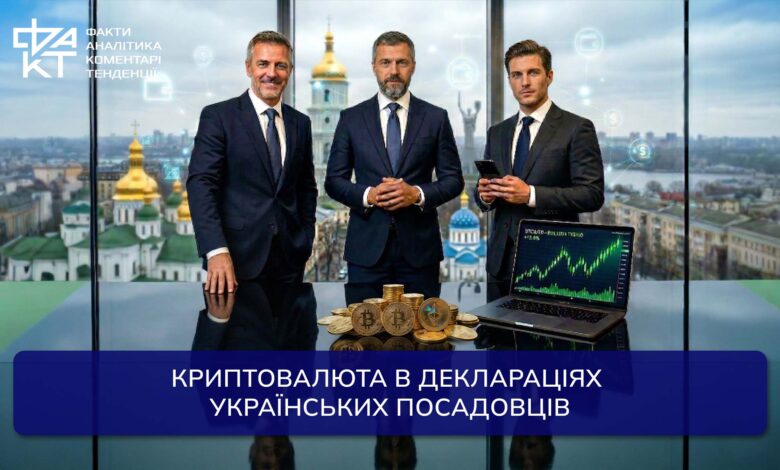
While for most Ukrainians, war means the loss of their homes, jobs, savings, and even minimal predictability, the declarations of officials reveal a completely different financial reality. They declare crypto wallets worth millions, assets for their wives, property in “use,” and figures that do not correlate with their official salaries. The most striking thing about this situation is both the size of individual assets and how easily they are incorporated into the public reporting system without immediate and harsh reaction from regulatory authorities. When they see these assets but do not react to them in any way for years, the declaration ceases to be a tool of transparency; it is merely a document that records the gap between the public service and the assets of representatives of state authorities that are officially declared.
Crypto in declarations: how digital assets became a common phenomenon for officials
If we look at the declaration campaign for 2025, submitted in the spring of 2026, the most telling thing in it is not the appearance of individual crypto wallets with solid sums, but the already formed mass of this phenomenon. Ukrainian officials are increasingly indicating digital assets in their reports, and among the leaders in the number of declared cryptocurrency were law enforcement officers – the main fighters for compliance with the laws in the state. In 2025, the largest number of crypto assets was declared by employees of the National Police – 27.9% of the total number of such declarants, followed by prosecutors with a share of 19.7%, and third place was taken by servicemen of the Armed Forces of Ukraine – 13.7% (but not those fighting on the front lines). The main stage of filing declarations for 2025 has already been completed, so the NACP is now engaged in verification, or rather, recording data, and already has the first results.
As in the past year, officials continue to indicate significant amounts of Bitcoin, Ethereum and Tether, and such assets are very often registered in the names of wives and other family members. For the Ukrainian declaration system, this has long become a separate risk area, because the formal ownership of an asset by a family member does not at all remove the question of the actual owner, the source of origin of funds and real control over them.
The most striking cases of 2026 well illustrate that the trend is gaining momentum. The head of the Ivano-Frankivsk regional prosecutor’s office, Anton Voitenko, in addition to apartments purchased in 2023 and 2025, and a TOYOTA car purchased also during the war in 2022, indicated in his declaration the XLM cryptocurrency registered on his wife: more than 34 thousand units on the Binance platform, valued at 415 thousand hryvnias.
Prosecutor from Kostyantynivka Yan Druz declared Bitcoin, as well as 30 Ethereum on his wife, the total value of this package as of April 2026 exceeded 5.5 million hryvnias. Former NABU employee Oleksandr Rykovtsev declared 13.2 bitcoins for his wife, which was estimated at approximately $1.5 million. The head of the Kremenchuk District Prosecutor’s Office Oleh Balayev also indicated Bitcoin in his declaration. The overall picture becomes even more vivid when large amounts are combined with strange ways of displaying them in reports. An officer of the Svyatoshyn CCC in Kyiv, Roman Danylyshyn, declared 4,716 ETH, which at market value is approximately 440 million hryvnias, but in his declaration he indicated a price of only 195 thousand hryvnias. It was this gap that caused a resonance in the media, after which he made changes to the document.
If we move from individual stories to types of cryptocurrencies, then a rather interesting hierarchy is also formed here. Among Ethereum owners, one of the largest declarants was the same Roman Danylyshyn with his 4716 ETH, while the deputy of the Khmelnytskyi district council Oleksandr Kizlyar declared 1000 ETH. In the Bitcoin segment, the leader seems to be the same Kizlyar, who together with his wife indicated 100 BTC, and in total, Ukrainian officials declared 376 bitcoins. In the Tether category, the first place was taken by the head of the Transcarpathian Court of Appeal Anna Fizikosh with 1 million USDT, which corresponds to one million dollars, while Vitaly Brovko from the Prosecutor General’s Office previously declared over 774 thousand USDT.
The feeling of blurred boundaries between serious assets and almost carnival entries intensifies when the declarations include not only classic coins, but also frankly exotic tokens. Thus, the member of the BEB commission Andriy Kozlov declared 634 trillion ZillaMatrix tokens. In addition, the declarations of 2026 mention MAGATRUMP, Baby Moon Floki and HarryPotterObamaSonic10Inu. The appearance of such positions changes the optics of the entire topic: on the one hand, crypto declaration claims to be a modern financial instrument, on the other hand, some reports begin to resemble a mixture of an investment portfolio, a speculative game and demonstrative declarative irresponsibility, where alongside Bitcoin and stablecoins there are assets with names that are more like an Internet joke than a serious financial product.
The method of storing these assets also looks quite characteristic, because most of the cryptocurrency is not kept in autonomous wallets, but mainly on crypto exchanges. For the declarant, this means convenient access to assets and ease of fixing the platform, and for the regulatory authority – an additional array of issues related to the movement of funds, user identification and the relationship between the person specified in the declaration and the person who actually manages the exchange account.
Against this motley background, state control looks like an attempt to catch up with a process that has long moved forward without clear rules. The NACP has already begun to massively detect errors in coin names, in particular cases when declarants confuse the tickers ETH and USDT, and treats such failures as providing inaccurate information. This aspect may seem technical, but in the crypto environment, an incorrect ticker means a different asset, volume, and a completely different market value. Therefore, even a seemingly minor inaccuracy in the declaration in the digital environment works like a crack in the testimony: it calls into question the competence of the declarant or the deliberate inaccuracy of the information provided by him.
The tax block only intensifies this tension, because 2026 turned out to be a period when not only property, but also fiscal issues are concentrated around virtual assets. The public discussion includes a preferential tax rate of 5% on income from the sale of virtual assets, with a further increase to 18% and the addition of a 5% military levy in the next period. The very fact that crypto has entered the field of the tax sphere so deeply shows the change in the scale of the phenomenon. The state now operates not as a point market for enthusiasts, but as a sector that is present in the declarations of thousands of officials.
Another example is the declaration of the head of the parliamentary committee on environmental policy, Oleg Bondarenko, which attracts attention not by the fact of owning bitcoins, but by how they are reflected in it. According to the document, the People’s Deputy from the Servant of the People party declared 80 Bitcoins and indicated their value at 79,930 hryvnias, although as of April 6, 2026, the market price of such an amount is almost 244 million hryvnias. The gap between the declared and real value is so large that it is a significant loss of any connection between the declaration and the actual scale of the asset.
It is especially significant that we are not talking about a few symbolic coins, but about 80 bitcoins, that is, an asset that at the current exchange rate is equal to a very large-scale fortune. When a People’s Deputy indicates an amount that looks almost caricaturedly small for such an amount, a key question arises for the control system: why does declaration exist if it allows one to so freely separate the paper figure from market reality?
Against the backdrop of war, economic exhaustion, and constant calls from elected officials for integrity, this situation looks particularly toxic. When a representative of the ruling faction, who heads a parliamentary committee, demonstrates such a dubious model of declaration, the blow falls not only on his reputation, but also on trust in the entire party.
Also interesting is the declaration of the former head of the SBI supervision department of the Prosecutor General’s Office, Vitaliy Brovko, who now heads the security department of Naftogaz. It contains almost the entire set of signs that in Ukrainian realities have long become markers of a potential conflict between declaration and the real issue of the origin, structure and transparency of assets. In this case, it is not the mere fact of the presence of cryptocurrency that is indicative, because the possession of digital assets is not a violation of the law, but the combination of several signs that have long been perceived as alarming indicators in Ukrainian anti-corruption realities. A large portfolio of crypto in the name of the wife, significant income from her business activities, the sale of digital assets, the use of real estate and cars registered to third parties, as well as accounts abroad create a dense field of questions to which society has the right to receive convincing answers.
Brovka’s scheme with real estate is especially telling, since it reproduces the mechanism of distancing an official from the asset that he actually uses, well-known to Ukrainians. If a family lives in a 183.2 square meter apartment in Kyiv and uses a 350 square meter house, but both properties are registered to other individuals, public interest naturally shifts from the question of “is it allowed” to the question of “why is it organized this way?” The transport block is no less revealing, as three expensive cars, one of which is registered in the format of use, the other through the wife’s mother, and another one also not registered as direct ownership, complement the same model.
However, the most difficult element of Brovko’s declaration to verify is precisely the cryptocurrency component, since digital assets, even declared, leave a lot of room for questions regarding the moment of acquisition, source of funds, movement of assets between wallets, and the ratio between official income and portfolio size. Declaring significant amounts of XRP, USDT, Ethereum Classic, Monero, Dash, Tron, Toncoin, PEPE and other assets does not in itself prove any offense, but participation in this construction of privacy-oriented coins, in particular Monero, naturally increases the sensitivity of the situation. For any average investor, this could remain a private financial story, but in the case of a person who worked in a high position in the Prosecutor General’s Office, such an array of digital assets automatically becomes the subject of public scrutiny, and not just declarative accounting.
This picture becomes even more pronounced when income figures are superimposed on the status of the declarant himself and his career trajectory. For 2025, Brovko declared a salary in the Prosecutor General’s Office and in Naftogaz, while his wife showed millions in income from entrepreneurial activity and the sale of cryptocurrency.
A separate political dimension is also created by Brovka’s current position, as he is the head of the security department of a strategic state-owned company. In a country living in a full-scale war, any stories about complexly structured assets, funds abroad, expensive use of property, and the lack of explained household expenses are inevitably read as a matter of not only integrity, but also state security, given the dubious earnings of high-ranking officials.
The worst consequence of such declarations is the slow destruction of trust in the anti-corruption system. When corruption fighters see all these crypto wallets, premium cars, use of other people’s homes, and millions in family incomes, but are unable or unwilling to take countermeasures, society perceives the declaration as a theater of formalities. In such a model, the main thing is not the honesty of the official, but his ability to competently distribute assets between his wife, relatives, use, foreign accounts and intangible instruments that are difficult to verify.
Why officials transfer wealth to cryptocurrency and how they deal with it abroad
The massive appearance of cryptocurrency in the declarations of officials is explained not by a passion for new technologies, but by the rather pragmatic properties of this instrument. For them, this form of storing funds has an obvious practical advantage: the asset does not lie in a bank vault, is not tied to one financial institution and can be stored on an exchange or in a digital wallet, which is easy to indicate in the declaration and is just as easy to transfer to another service.
Additional attractiveness of cryptocurrency is also given by the general financial context in which the country lives during the war. Currency restrictions, administrative control over capital movements, distrust of long-term storage of funds in hryvnia, and demand for fast cross-border transactions create an environment in which digital assets are beginning to act as a backup financial cushion. Market research shows that even in the conditions of a full-scale war, Ukraine maintained very high crypto activity, with large transactions growing especially noticeably. In such a situation, cryptocurrency for some officials looks like a way to keep a significant amount in an asset that is easy to move, quickly convert, and not directly linked to the traditional banking system.
The predominance of stablecoins in declarations also clearly shows the logic of these decisions, because for the storage of wealth, stability is often more important than the possibility of a sharp increase in price. When a declarant chooses not just Bitcoin or Ether, but a large amount in USDT, he is actually betting on an instrument that resembles a digital dollar. For someone who wants to have a liquid reserve available at any time, this model seems convenient: the asset can be moved quickly, it does not depend on the bank’s schedule, does not require physical transportation and does not fluctuate in price as much as classic cryptocurrencies. That is why stablecoins often appear in the declarations of Ukrainian officials no less often, and in some cases more often, than more publicly promoted assets.
The nature of control also plays a significant role in the choice of cryptocurrency, because digital assets are much more difficult to assess with a superficial check than cash, a bank deposit or classic real estate. Formally declared crypto exists in the report, but to understand its origin, date of acquisition, route of movement and real owner, not only financial documents are needed, but also technical analysis of the blockchain, access to exchange data and comparison of wallet addresses with specific individuals. Because of this, cryptocurrency creates a completely different area of maneuver for the declarant than for conventional assets, and for the regulatory body – a different level of complexity, where the formal presence of a record does not mean full transparency.
International practice shows that the presence of crypto in the financial reports of officials is not a Ukrainian anomaly in itself. In the United States, financial disclosure rules have required declaring cryptocurrency as an investment asset for several years, and there are many examples in the public domain when politicians reflected Ethereum or Bitcoin in their reports for significant amounts. However, there is a significant difference between Ukraine and other countries, because there the emphasis is not on the fact of owning cryptocurrency, but on the strict obligation to explain the origin of the asset, its valuation and possible conflict of interest.
This was even more pronounced in countries that in recent years have separately included cryptocurrency in the financial control rules for civil servants. For example, in South Korea, digital assets became part of the mandatory declaration for high-ranking officials, after which hundreds of employees with them appeared in public reports. This indicates that in different countries, cryptocurrency is the object of strict control among officials, because it combines an investment tool, a channel for transferring value across borders and a source of potential conflict of interest.
The peculiarity of Ukraine compared to other countries is that the combination of a war economy, currency restrictions, a large number of security forces and prosecutors among declarants, as well as the habit of recording part of the assets to wives or other family members creates a completely different effect. Under such conditions, cryptocurrency is perceived as a tool that gives the official high capital mobility, a complex trajectory of the flow of funds and additional distance between ownership and its public explanation.
На тлі війни, яка для мільйонів українців обернулася втратою житла, роботи, звичного способу життя і базової фінансової безпеки, декларації посадовців з дедалі більшими криптопортфелями, готівковими резервами та активами свідчать як про соціальний розрив, так і глибоку деформацію державної системи. Поки одні родини збирають кошти на оренду житла після евакуації, продають майно, щоб пережити черговий місяць, або починають життя з нуля, інші демонструють здатність успішно, а головне, безкарно, нарощувати капітал, зароблений «чесною працею» в межах однієї країни. Коли суспільство бачить, що війна для одних означає горе і зубожіння, а для інших ‒ нові інструменти накопичення, питання виникає до самої моделі держави, в якій посадовці дедалі частіше посилюють свої апетити, надаючи їм формально пристойного вигляду в своїх деклараціях.


