Cutting Boarding Schools and Family-Type Orphanages: How Reform Leaves Children in Danger

The deinstitutionalization reform in Ukraine, which aimed to replace boarding schools with modern family-based forms of upbringing, has in practice created critical gaps in the system of child protection, especially for those affected by war. The closure of boarding schools is taking place without a corresponding increase in the network of foster families and family-type orphanages, which effectively leaves children in dangerous or unstable conditions. Due to the lack of planning and a professional approach, the state system loses the opportunity to provide protection and support to those who need it most – children of war, who are forced to evacuate or remove from dangerous families due to hostilities, the destruction of their homes, or the loss of parental care.
Consequences of reforms for children of war
People’s Deputy of Ukraine Pavlo Sushko stated that the simultaneous reduction of the boarding school network and the number of family-type orphanages and foster families is creating a systemic crisis. According to him, there have been statements about reform for decades, but practically nothing has changed: institutions are being closed without re-profiling, new places for children are not being created, and family forms of upbringing are being reduced. As a result, children removed from dangerous families or transferred from boarding schools are left without a safe environment and proper care.
Sushko emphasizes that society is often presented with encouraging statements, but the reality differs from official messages. Children, especially those affected by war, remain in conditions where their lives and development are at serious risk, because the state system physically has no place for them.
Statistics of the reduction of family forms of upbringing
According to the data provided by the People’s Deputy, the number of foster families and family-type orphanages has been systematically decreasing in recent years:
-
2014 — 5041 families
-
2015 — 4840 families
-
2016 — 4770 families
-
2017 — 4696 families
-
2018 — 4615 families
-
2019 — 4499 families
-
2020 — 4407 families
-
2021 — 4349 families
-
2022 — 4237 families
-
2023 — 4095 families
-
2024 — 4076 families
-
2025 — 4033 families
“And if the reform was carried out correctly, professionally, then there should have been growth …. And this is where the children killed and maimed by their parents come from. Who are not taken away, because there is simply nowhere to go”, – Sushko emphasized.
Examples of the closure of family-type orphanages
In addition, the people’s deputy stated that in practice, the closure of family-type orphanages without creating alternative places leads to the fact that children remain where they are in danger. Thus, the recent closure of one of the DBST deprived ten children of the opportunity to move to a safe family form of upbringing. These children, who have already experienced trauma from war or troubled families, find themselves in a situation where the state cannot provide basic needs in care, protection, and housing.
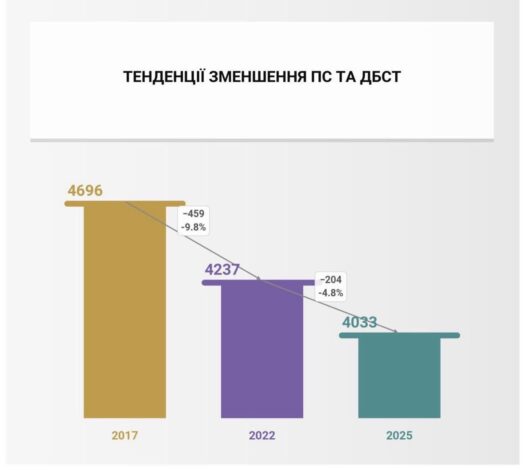
Sushko emphasizes that such a reform has actually destroyed the system, creating risks to the life and health of children:
“What reforms are you still missing? In the screenshot – another DBST (FAMILY-type orphanage) has ceased to function, and these are 10 children for placement in a family form. When everything is closed, and there are simply no new places – children die where they were not taken from, because there is no place left. They were reformed…”.
The deinstitutionalization reform requires revision and a professional approach, in particular, taking into account the specific needs of children of war. While boarding schools and family forms of upbringing are being reduced, the state is unable to perform its key function – to ensure the safety, proper care and development of children who have survived conflict and dangerous circumstances.
An important step should be the creation of new family-type orphanages, support and increase the number of foster families, as well as the systematic re-profiling of closed boarding schools to meet the modern needs of children affected by war. Without such changes, the risks to children will remain high, and dozens, if not hundreds, of children of war may find themselves in dangerous or unacceptable conditions, which contradicts the basic tasks of the state protection system.