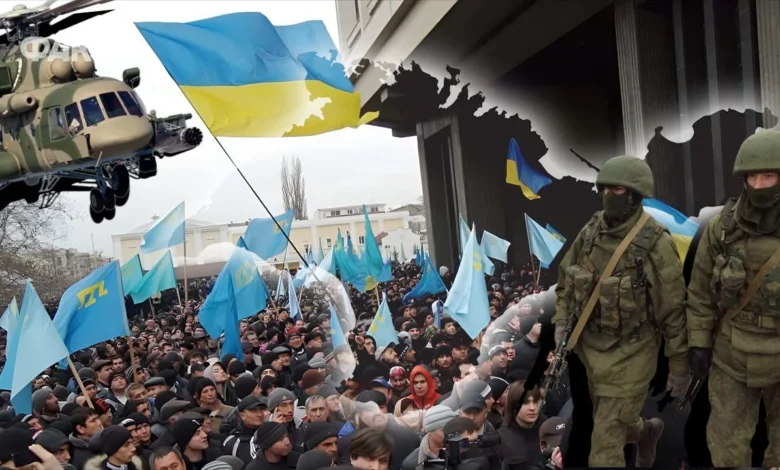
February 26 is celebrated as the Day of Crimean Resistance to Russian Occupation, the World Day of Leisure, and the Day of Digital Learning. This day has left a noticeable mark in world and Ukrainian history over the years due to wars, political decisions, scientific discoveries, and events that have influenced the fate of states.
Day of Crimean Resistance to Russian Occupation
On February 26, Ukraine commemorates the events of 2014, when a mass rally in support of the territorial integrity of Ukraine was held near the building of the Supreme Council of the Autonomous Republic of Crimea in Simferopol. The action was organized by the Mejlis of the Crimean Tatar people in response to the Crimean parliament’s intentions to consider changing the status of the peninsula. That day, thousands of people gathered outside the walls of the parliament — Crimean Tatars, Ukrainians, and representatives of other nationalities. The rally was the largest pro-Ukrainian demonstration in Crimea since the beginning of the Russian operation to seize the peninsula.
The next day, the parliament building was seized by armed military personnel without insignia, and Russia subsequently established control over key facilities in Crimea. The events of February 26 were the last large-scale open action of resistance before the start of the active phase of the occupation. In 2020, the Verkhovna Rada of Ukraine established this date as a memorable day at the state level. For Crimean Tatars, February 26 is of particular importance, since it was they who became the main organized force of peaceful resistance in those days.
Important facts
During the rally on February 26, 2014, about 10–15 thousand people were near the Crimean parliament, which was an extremely large number for Simferopol at the time, and this gathering actually thwarted the deputies’ attempt to quickly vote for a decision on the separation of the peninsula.
In 2016, Ukraine officially recognized February 26 as the date of the beginning of the temporary occupation of Crimea by the Russian Federation, which is enshrined in legislation and used in international legal documents.
The leader of the Crimean Tatar people, Mustafa Dzhemilev, was banned from entering Crimea by the Russian authorities in 2014, despite the fact that he had lived on the peninsula all his life and returned there after the Soviet deportation.
After the occupation, Russia recognized the Mejlis of the Crimean Tatar people as an extremist organization and banned its activities, and in 2017 the International Court of Justice obliged Russia to lift this ban as a temporary preventive measure.
On the day of the rally, a pro-Russian rally was also taking place outside the parliament, which created a tense situation. Two people died in the stampede, and these events were the only deaths during the open confrontation in Crimea until the appearance of armed military without insignia.
After 2014, part of the archives and museum collections of Crimea were taken to the territory of Russia, and the issue of the cultural heritage of the peninsula became the subject of international lawsuits and long diplomatic disputes involving Ukraine.
World Day of Slowness
World Day of Slowness is celebrated as a reminder of the value of slowing down the pace of life and a conscious attitude to time. The initiative originated in Italy in the early 2000s as part of the movement for a more measured lifestyle, which called for reducing the daily pursuit, paying more attention to the quality of work, rest and communication. The date gradually gained popularity in different countries and became an unofficial reason to reflect on one’s own rhythm of life.
The idea of the day is related to the slow movement culture – an approach that encompasses food, travel, education and urban planning. Supporters of this trend advocate a balance between productivity and recovery, emphasizing the impact of constant rush on mental and physical health. In Ukraine, this date does not have state status, but it is mentioned in the media and is used as an informational occasion to discuss the topic of overload, burnout and digital addiction.
Interesting facts
The slow movement began in 1986 in Rome after the opening of a fast food restaurant near the Spanish Steps; the protest grew into the creation of the international Slow Food initiative, which advocates for the preservation of local gastronomy and traditional farming.
The Cittaslow network of cities unites dozens of small cities in different countries that voluntarily implement standards of slower urban life, limit traffic in the centers and support local producers.
Research by British economist John P. Robinson has shown that the feeling of a constant lack of time has increased even during periods of shortened workweeks associated with the development of digital technologies and multitasking.
In Japan, there is a practice of shinrin-yoku — “forest bathing” — officially supported by government health programs; the method involves slow walks in the forest and is used to reduce stress and blood pressure.
In Ukraine, the first modern-style farmers’ markets, focused on local producers and seasonal products, began to actively appear after 2014 in Kyiv and Lviv as part of a broader interest in conscious consumption.
Psychologists at Harvard University have found that the habit of constantly checking your smartphone creates a sense of urgency even in the absence of real deadlines, and the average user touches the screen hundreds of times a day.
The Scandinavian countries are known for the concept of lagom, a Swedish concept of moderation and sufficiency that influences the organization of work and life and supports a balance between work and rest.
According to research by European transport authorities, the average speed of car travel in the central areas of large cities has hardly changed in recent decades, despite the increase in car power, which calls into question the idea of constant acceleration as a sign of progress.
Digital Learning Day
Digital Learning Day is celebrated every year on the last Thursday of February. The initiative appeared in the USA in 2012 as a way to draw attention to the role of technology in education and support teachers who introduce online tools into the learning process. The date has no fixed number, so in some years it even falls on February 29. The event covers schools, universities, educational platforms and companies working in the EdTech field.
Digital learning includes distance learning, interactive platforms, the use of artificial intelligence to personalize programs, and access to educational materials via the Internet. After 2020, the development of online education accelerated significantly due to the COVID-19 pandemic, which forced educational institutions around the world to switch to distance learning formats. In Ukraine, digital tools have been actively integrated into both school and university education, as well as into the sphere of non-formal learning for adults.
Interesting facts
The Coursera platform, founded by Stanford professors in 2012, has attracted tens of millions of students in a few years and has become one of the largest providers of massive open online courses in the world.
Since its launch in 2014, the Ukrainian online education studio Prometheus has provided free access to courses to hundreds of thousands of users and has collaborated with the country’s leading universities.
In 2023, UNESCO published recommendations on the use of artificial intelligence in education, emphasizing the need to control the quality of content and protect students’ personal data.
The first experiments with distance learning took place in the 19th century in Great Britain, when materials and assignments were sent by mail, and checked works were returned to students by letter.
During the full-scale war in Ukraine in 2022, thousands of schools switched to an online format in less than a few weeks, which became one of the largest educational transitions in Europe during wartime.
Studies show that short interactive video lessons lasting up to 6–9 minutes hold students’ attention much more effectively than traditional long lectures without feedback.
Estonia is considered one of the most digitalized education systems in Europe, where even before the pandemic, most schools used electronic diaries, online platforms and digital textbooks as the main learning tool.
Historical events on this day
1266 – The Battle of Benevento took place between supporters of the papacy and supporters of imperial power, in which the troops of Charles of Anjou defeated the army of Manfred of Sicily, which changed the balance of power in Southern Italy and increased French influence in the region.
1616 – Galileo Galilei recognized the decision of the Inquisition to prohibit support for the heliocentric system of Nicolaus Copernicus; the scientist was ordered to abandon the spread of ideas about the movement of the Earth around the Sun under threat of harsher punishment.
1658 – The Peace of Roskilde is signed between Denmark and Sweden, according to which Denmark lost significant territories, including Skåne, which significantly changed the political map of Scandinavia.
1815 – Napoleon Bonaparte left the island of Elba, where he had been exiled after abdicating the throne, and went to France, beginning the period known as the Hundred Days, which ended with the defeat at Waterloo.
1832 – Emperor Nicholas I declared the Kingdom of Poland an integral part of the Russian Empire after the suppression of the November Uprising, which was accompanied by the elimination of the remnants of autonomy and the strengthening of control by St. Petersburg.
1876 – The Treaty of Kanghwa between Korea and Japan is concluded, which opened Korean ports to Japanese trade and marked the beginning of active Japanese penetration of the Korean Peninsula.
1878 — the trial of Ivan Franko, who was accused of spreading socialist ideas, began in Lviv; the trial became one of the first high-profile persecutions of Ukrainian intellectuals in Galicia.
1885 — the Berlin Conference ended, at which European states agreed on the principles of the colonial division of Africa, which caused large-scale changes on the continent and long-term conflicts.
1886 — in Horlivka, engineers Minenkov and Auerbach received the first mercury within the Russian Empire, which was important for the development of the chemical and military industries.
1895 — a glass-blowing machine was patented in Ohio, which mechanized the production of bottles and significantly reduced their cost, opening the way to mass production of containers.
1918 — The Soviet Republic of Sailors and Builders, formed in the context of revolutionary events, ceased to exist, reflecting the instability of political regimes in post-revolutionary Europe.
1921 — The Kamianets-Podilskyi State Pedagogical Institute was founded, which became one of the leading centers for teacher training in Ukraine.
1935 — Engineer Robert Watson-Watt demonstrated the capabilities of radar technology to the British military, which later played a key role in air defense during World War II.
1936 — A group of officers of the Imperial Japanese Army attempted a coup in Tokyo, seeking to establish military control over the government; the uprising was suppressed, and its organizers were executed.
1945 — after long battles, American troops regained control of the island of Corregidor in the Philippines, which was of strategic importance for operations in the Pacific region.
1960 — an An-10 aircraft of the Aeroflot airline crashed during an approach to Lviv, which became one of the largest aviation tragedies in Ukraine at that time.
1980 — Egypt was the first among the Arab states to establish full diplomatic relations with Israel after signing peace agreements, which significantly changed the political situation in the Middle East.
1987 — the Anglican Church adopted a decision to admit women to the priesthood, opening a new stage in the internal reforms of this denomination.
1992 — Ukraine establishes diplomatic relations with Finland, expanding international recognition after regaining independence.
1992 — The city of Khojaly is the scene of a mass civilian massacre during the Nagorno-Karabakh War, one of the most tragic episodes of the conflict.
1993 — A truck bomb explodes in the underground parking lot of the World Trade Center in New York City, killing six people and injuring thousands; the attack is one of the first large-scale terrorist attacks against the complex.
2004 — The European Parliament recognizes the 1944 deportation of the Chechen people as an act of genocide, giving a political assessment of the actions of the Stalinist regime.
2013 — A hot air balloon crash in Luxor killed 19 tourists and drew attention to the safety of air tours.
2022 — Ukrainian troops repelled a Russian landing attempt to gain a foothold in Vasylkiv near Kyiv, thwarting plans for a rapid advance on the capital at the start of a full-scale invasion.