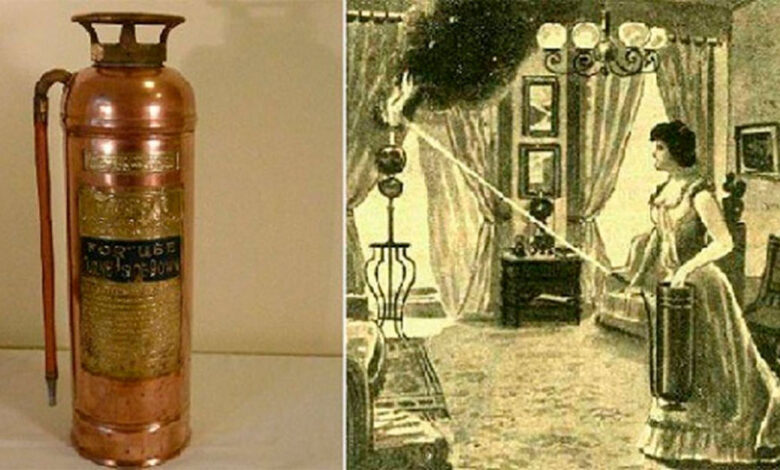
February 7th is the Birthday of the Fire Extinguisher, the Day of the Periodic Table, and the Day of the Number e. The events of this day in different years combine scientific discoveries, tragic pages of history, and decisions, the consequences of which are felt for decades.
Birthday of the Fire Extinguisher
February 7th is the Birthday of the Fire Extinguisher, associated with the receipt in 1863 of a patent for one of the first effective portable fire extinguishing means. Engineer Alan Cray in the state of Virginia, USA, patented a portable device for extinguishing fires. It was this invention that made it possible to quickly and relatively safely eliminate small fires without involving special fire brigades.
The fire extinguisher became the answer to the need for a quick local response to fires without involving complex systems and special equipment.
The appearance of the fire extinguisher significantly changed approaches to fire safety in residential buildings, in production, and in transport. Its development went hand in hand with the improvement of fire extinguishing agents, which made it possible to fight fires of various classes and significantly reduce human losses and material damage.
Interesting facts
The very first attempts to create a means of extinguishing fires appeared almost 300 years ago. In 1715, in Germany, Zacharias Greil proposed a device in the form of a wooden barrel filled with approximately 20 liters of water, with the addition of gunpowder and fuse. During a fire, the fuse was set on fire, after which the barrel was thrown or rolled directly into the fire, where it exploded and dispersed the water, suppressing the flame.
Later, fire extinguishers appeared in the form of glass flasks with water or saline solution, which were thrown directly into the fire, and the effectiveness of this method depended heavily on the accuracy of the throw.
One of the early metal fire extinguishers worked on the principle of a chemical reaction between soda and acid, which produced carbon dioxide, which pushed water onto the flame.
Powder fire extinguishers began to be widely used only in the second half of the 20th century, when stable finely dispersed mixtures appeared that could quickly block the access of oxygen to the fire.
Not all fire extinguishers are suitable for extinguishing electrical equipment, and choosing the wrong type can lead to electric shock or aggravation of the fire.
Carbon dioxide fire extinguishers cool the ignition source to very low temperatures, so if used incorrectly they can cause cold burns.
In Ukraine, the mandatory presence of fire extinguishers in transport and in facilities for mass gatherings was established at the regulatory level back in the Soviet period and later adapted to modern standards.
Ukrainian enterprises produce fire extinguishers of various types, including powder and carbon dioxide, which are used not only domestically, but also exported.
The service life of a fire extinguisher is limited, and even without use it can lose its effectiveness due to caking of the powder or loss of pressure.
During the full-scale war in Ukraine, fire extinguishers have become critically important in the civilian and military environment, as they allow you to quickly extinguish fires after shelling, drone strikes and missiles without waiting for the arrival of fire departments.
Ukrainian rescuers and military personnel adapted the use of fire extinguishers to combat conditions, in particular, using them to quickly extinguish fires in confined spaces of dugouts and shelters.
The demand for fire extinguishers in Ukraine has increased sharply after 2022, which has led to the expansion of production and imports of these fire extinguishing agents for civil protection.
Periodic Table Day
This day is dedicated to the publication in 1869 of the first version of the periodic table of chemical elements by Dmitri Mendeleev. It was the first to arrange known elements in order of increasing atomic mass and showed the periodic recurrence of their properties, which made it possible to systematically explain chemical laws.
The periodic table became the basis for the development of modern chemistry, materials science, physics and many applied sciences. Its structure made it possible to predict the existence of yet undiscovered elements and their properties, which was later repeatedly confirmed experimentally and made the table a universal scientific tool.
Interesting facts
In the first version of the table, Mendeleev left empty cells and described the properties of then-unknown elements, in particular gallium, scandium and germanium, all of which were later discovered with characteristics very close to his predictions.
Mendeleev deliberately violated the order of increasing atomic mass for some elements if their chemical properties required it, which was later explained by the discovery of the atomic number.
The modern periodic table contains 118 confirmed elements, and all elements with an atomic number above 92 are radioactive and practically do not occur in nature.
One of the elements of the table, technetium, became the first element that was first predicted theoretically and only then artificially synthesized in the laboratory.
The names of many elements are associated with geography, in particular polonium was named after Poland, and scandium – after Scandinavia.
Ukrainian scientists contributed to the development of the chemistry of the elements, in particular to the study of the properties of rare and radioactive elements in the 20th century in the scientific centers of Kyiv, Kharkiv and Lviv.
In Ukraine, uranium ores began to be actively studied in the 1930s, which later became the basis for the development of nuclear science and energy.
Some chemical elements discovered in the 20th century have existed for only a fraction of a second, but are still officially included in the periodic table because their properties have been experimentally recorded.
There are several alternative forms of the periodic table, including spiral and three-dimensional ones, which attempt to more clearly show the periodicity of the properties of the elements.
E Day
This day is dedicated to a mathematical constant that arises in processes of growth and change. The number e is approximately equal to 2.71828 and appears naturally in the analysis of continuous processes, including percentage growth, differential equations, and limit theory.
The constant e is fundamental to mathematical analysis, probability theory, physics, economics, and computer science. It underlies the natural logarithm, and is used to describe radioactive decay, oscillatory processes, signal propagation, and the modeling of complex systems.
Interesting facts
The number e was not discovered at one point, it gradually appeared in the works of various mathematicians of the 17th century during the study of compound interest and logarithms.
The designation e was fixed by Leonard Euler in the 18th century, and it was after that that the number became a separate mathematical constant with its own symbolism.
The number e is irrational and transcendental, that is, it cannot be written exactly as a fraction and cannot be obtained as a solution to any algebraic equation with integer coefficients.
The graph of the function eˣ has a unique property: at any point its value is equal to the value of its own derivative.
The number e naturally arises in the theory of queues, which is used to model transport flows, computer networks and telephone communications.
In economics, the number e is used to describe continuous interest accrual and to model long-term financial processes.
In Ukrainian universities and scientific schools, the number e is traditionally considered as a basic constant of mathematical analysis, and the works of Ukrainian mathematicians of the 20th century actively used exponential functions in applied research.
The number e appears in formulas describing random processes, in particular in the normal distribution, which is widely used in statistics and physics.
The number e can be approximated by infinite series, fractions, and limits, and all these methods give different rates of convergence, which makes e a convenient object for educational and scientific experiments.
Historical events on this day
457 — Leo I Macella became Byzantine emperor.
1483 — the famous Ukrainian scientist Yuriy Drohobych published the book “Prognostic assessment of the current year 1483” (Iudicium pronosticon Anni M.cccc.lxxxiii) in Rome with Echuarius Zilber, which is the first known printed book by a Ukrainian author.
1497 — supporters of Girolamo Savonarola burned thousands of secular, “sinful” books, art objects, etc. in Florence.
1807 — the Battle of Preussich-Eylau in the War of the Fourth Coalition.
1831 — the Polish Sejm approved the red-and-white flag as the national one.
1855 — the Treaty of Shimoda was signed — the first diplomatic agreement between Russia and Japan, which established the border of the two states.
1889 – American Herman Hollerith (1860–1929) patented the first electric calculating machine.
1906 – The SOS signal was first proposed as an international distress signal (instead of the CQD code previously used on ships).
1942 – In the territory of modern Banja Luka, the Croatian Ustasha killed more than 2,300 Serbs, mostly women, children, and the elderly.
1968 – The Beatles’ song “Sergeant Pepper’s Lonely Hearts Club Band” won a Grammy Award.
1991 – The Provisional IRA fired mortars at the residence of the Prime Minister of the United Kingdom, 10 Downing Street.
1992 – 12 member states of the European Communities signed the Maastricht Treaty, the main agreement of the European Union.
1992 — The Republic of Benin recognized the independence of Ukraine.
1998 — The XVIII Winter Olympic Games opened in Nagano, Japan.
2009 — The wildfires in the state of Victoria led to the worst natural disaster in Australian history, killing 173 people.
2010 — The second round of presidential elections in Ukraine took place, won by Viktor Yanukovych.
2016 — North Korea launched Kwanmyeonsong-4 into space, violating numerous UN treaties.
2018 — The defeat and destruction of the advanced units of the Russian Special Forces (“Wagner PMC”) near Deir ez-Zor by American troops in Syria on the night of February 7-8.
2022 — after the start of Russia’s full-scale invasion of Ukraine, a fire extinguisher became one of the basic means of civil security, which began to be stored en masse in residential buildings, shelters, and transport due to constant fires after rocket and artillery strikes.
2022 — in front-line cities, fire extinguishers were often used by residents even before the arrival of rescuers to extinguish fires in apartments, entrances, and on roofs, where ammunition fragments or incendiary elements had fallen.
2023 — Ukrainian military and volunteers included fire extinguishers in the standard equipment of cars and armored vehicles, since fuel ignition after damage to equipment repeatedly led to the death of crews without the ability to respond quickly.
2023 — in conditions of repeated shelling and destroyed infrastructure, fire extinguishers were used to contain fires at critical infrastructure facilities, when fire departments could not physically reach the scene of the fire quickly.
2024 — demand for fire extinguishers in Ukraine remained consistently high, which led to the expansion of domestic production and the reorientation of some enterprises to the production of fire extinguishing agents for civil defense and the front.
“Fat Tuesday” in Florence
On February 7, 1497, on “Fat Tuesday” — the day of carnival festivities before Lent — an event took place in Florence that went down in history as one of the most striking examples of mass religious fanaticism and the destruction of culture.
At that time, the de facto ruler of the city was the Dominican friar Girolamo Savonarola, a charismatic preacher who gained widespread support from the townspeople thanks to his speeches about the “fall of morals”, the imminent end of the world and the need for universal repentance. He argued that greatness and prosperity awaited Florence if it renounced luxury and sin, referring to his own visions and revelations, allegedly received from the Virgin Mary.
Savonarola’s influence grew so rapidly that over time he became the main political figure of the city and received armed protection. To “cleanse” Florence, detachments of young people, known as the “innocent lambs”, were created. They went from house to house, demanding that residents give up objects that were considered manifestations of vanity and sin. In fact, it was a religious morality police operating under the guise of piety.
The campaign culminated on Carnival Day, February 7, when a giant pyramid of confiscated items was built in the main square of Florence. Cosmetics, perfumes, jewelry, mirrors, masquerade costumes, musical instruments, playing cards, sculptures of ancient gods, as well as books by ancient and medieval authors – Ovid, Cicero, Horace, Virgil, Petrarch, Boccaccio – were dumped into it. Paintings and drawings deemed “obscene” also ended up there.
According to legend, the artist Sandro Botticelli, who came under the influence of Savonarola and joined his supporters, personally threw several of his paintings on mythological subjects into the fire. If so, the world has lost part of his legacy, which could be compared to “The Birth of Venus”. The dimensions of the pyramid, according to eyewitnesses, reached about 20 meters in height and 30 meters in width. An attempt by one merchant to buy all these valuables for a huge sum was rejected, and a figure of Satan with the features of the same merchant was installed on the top of the pyramid.
The pyramid was set on fire to the chants and shouts of the crowd “Glory!” Any attempts at protest were quickly suppressed by Savonarola’s supporters. Similar “bonfires of vanity” were later repeated, turning into a kind of purification ritual, which historians later called a monument to human fanaticism and at the same time sincere, but destructive faith.
However, this period did not last long. Pope Alexander VI excommunicated Savonarola from the church and threatened Florence with an interdict. The secular authorities forbade him from public sermons and initiated a trial. Savonarola agreed to the “God’s judgment” and volunteered to undergo a trial by fire, but the event scheduled for April 7, 1498 was canceled due to a heavy downpour.
Savonarola and two of his associates were soon imprisoned. Under torture, he confessed that his prophecies and visions were fabricated. On May 23, 1498, all three were executed by hanging, and their bodies were burned in the same square where the “bonfires of vanity” had previously burned.
The consequences of these events were profound: Florence lost a large number of works of art, sculptures, and unique manuscripts, many artists and intellectuals left the city, fleeing the atmosphere of religious pressure, and society again found itself divided into supporters and opponents, setting its cultural development back several years.
Second round of presidential elections in Ukraine
On February 7, 2010, the second round of presidential elections took place, in which Viktor Yanukovych (48.95%) defeated the incumbent Prime Minister Yulia Tymoshenko (45.47%) with a margin of about three percent. The then President of Ukraine, Viktor Yushchenko, received only 5.45% of the vote in the first round.
It was not without “betrayal”, but soon after the inauguration, the Constitutional Court of Ukraine annulled the 2004 political reform, returning the country to a presidential-parliamentary form of government and significantly expanding Yanukovych’s powers.
Criminal cases were opened against key political opponents, in particular Yulia Tymoshenko. At the same time, new forces gained strength in the political arena — the Svoboda and UDAR political parties, which formed the “Committee of Resistance to Dictatorship”.
Ukraine sharply took a course towards rapprochement with Russia: the “Kharkiv Agreements” were signed, which extended the presence of the Russian Black Sea Fleet in Crimea until 2042 in exchange for a discount on gas. Already in 2010, a law was passed on Ukraine’s non-aligned status, which officially excluded the goal of joining NATO from the state’s priorities. In the same year, Yanukovych agreed with Barack Obama to completely remove Ukraine’s highly enriched uranium reserves by 2012.
The economy was relatively stabilized: roads, airports, and stadiums were being built in preparation for the European Football Championship, the government initiated reforms in the tax, pension, and medical sectors, as well as business deregulation. The dollar exchange rate was maintained at 8 hryvnias.
The failure of negotiations with the IMF forced the search for alternative sources of financing, which resulted in an agreement with Russia in 2013 on a $15 billion loan through the purchase of Ukrainian Eurobonds.
This was followed by the refusal to sign the Association Agreement with the EU in November 2013, which provoked mass protests — Euromaidan, deaths, and Yanukovych’s flight to Rostov in February 2014.
In 2019, a Ukrainian court sentenced Viktor Yanukovych in absentia to 13 years in prison for high treason and aiding and abetting an aggressive war.
Yanukovych’s rule is usually assessed as a period of “lost opportunities” for Ukraine.
First use of firearms by newly created patrol police in Kyiv
On February 7, 2016, the newly created patrol police used firearms for almost the first time in their history — a car that was moving at a dangerously high speed was fired on in nighttime Kyiv.
After the young people in the BMW ignored the police officers’ demands to stop, the patrol officers began a pursuit. When the foreign car drove into the oncoming lane, law enforcement officers opened fire on the car. As a result of the chase, a 17-year-old boy was shot dead, and the patrol officer was charged with abuse of authority, attempted murder, and premeditated murder.
At the time, the metropolitan prosecutor’s office stated that the police officer’s guilt had been proven: “the chase lasted 32 minutes, of which 25 shots were fired by the patrol officers during 12 minutes. At the time of the fatal shot, the car was actually stopped, and the police officer was 1.4 meters away from the BMW – … he could have shot at the engine, at the wheels, but he shot at the interior.”
The leadership of the National Police and the head of the Ministry of Internal Affairs were personally present at the selection of a preventive measure for the police officer. In April 2017, the police officer was reinstated.
Amendments to the Constitution of Ukraine
On February 7, 2019, the Verkhovna Rada of Ukraine, by 334 votes, introduced amendments to the Constitution, which established the course for Ukraine’s full membership in the European Union and NATO.
The document was supported by deputies of the BPP, “People’s Front”, “Samopomich”, “Batkivshchyna” and “Radical Party” factions, as well as the majority of non-faction deputies and the “Will of the People” group. The “Opposition Bloc” faction spoke out against it.
The draft amendments to the Constitution were submitted by President Petro Poroshenko in September 2018. The head of state stated that the issue of Ukraine’s accession to NATO should be put to a referendum so that citizens express their consent to such a decision.