
Lessons underground: how children from the Kupyanska community are taught in Kharkiv in the university shelter

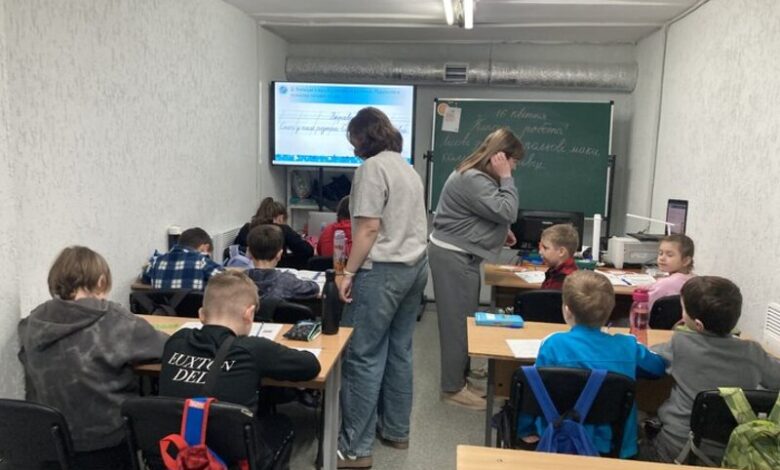
The war changed the way of life and residence for thousands of Ukrainian children, as well as the way of learning, in which the usual school day had to be replaced by evacuation, distance learning and a constant lack of live contact with a teacher. For children from frontline communities, returning to face-to-face classes, even for a few hours, means more than just scheduled lessons. Along with learning, the habit of discipline, communication with peers, a sense of safe space and a clear daily rhythm return. In Kharkiv, such an opportunity was organized for schoolchildren from the Kupyansk community in the university shelter, where they combined studies, preparation for NMT, psychological support, clubs and hot meals.
How the learning space works
The educational space in the shelter of the Semyon Kuznets Kharkiv National Economic University has become a place where children from the Kupyanska community can return to live learning after evacuation and a long distance format. Here, students have been organized consultations on basic subjects, preparation for the national multi-subject test, classes based on interests, meetings with a psychologist, and hot meals. For children of war, this opportunity means much more than a few hours of lessons, because it returns the rhythm, communication, and the feeling of an orderly day.
Up to 60 students can be in the shelter at the same time, and about 50–55 children from three lyceums of the Kupyanska community come to classes every day. In total, 250 schoolchildren who evacuated from the community attend consultations, and this figure covers approximately a quarter of all students who left.
According to the words of Yulia Zhadanovska, the deputy director of Kupyansk Lyceum No. 1, the space was organized so that children would come with interest and feel free in it. In addition to educational consultations, they hold clubs, an English-language club, creative classes, and meetings with a psychologist. Children embroider, work with beads, communicate with each other, and gradually return to the familiar school environment that many missed after leaving home.
Schoolchildren from various settlements of the Kupyansk community, in particular from Lisna Stinka, Kurylivka, Kivsharivka, Novoosynovo, and Osynovo, travel to Kharkiv to study. Some of the children live in Kharkiv itself, some in the suburbs, and there are also students from Chuguyev.
Nina Yudayeva, the director of Kupyansky Lyceum No. 3, says that five classrooms have been set up in the shelter, so classes are held alternately on different days. This schedule has made it possible to disperse the flow of children and at the same time maintain the regularity of classes for different age groups.
Organization of classes and educational areas
The work of the space is built on a clear schedule. Junior schoolchildren come almost every day, except Friday. Separate days have been set for fifth, sixth, and seventh grades — Monday and Wednesday. Senior schoolchildren, from eighth to eleventh grades, attend classes on Tuesday, Thursday, and Friday.
Two groups have been organized for eleventh graders, since there are many people who want to prepare for the NMT. Children study mathematics, history of Ukraine, Ukrainian language, and also master physics, English, geography, and biology. Teachers from the University of Economics also joined the preparation of graduates.
Daily meals for children are provided by the World Central Kitchen volunteer organization, with which the Kupyanska community has been cooperating for almost four years. Lunches for students are free, and food is brought daily.
For children who spend several hours in the space, a hot lunch has become part of a stable school day, where there is study, rest, and a predictable routine. In wartime conditions, such domestic stability has a special value, because it helps a child feel care not in words, but in specific everyday things.
One of the features of this space was an agreement with parents about phones. Before classes, children put them in special boxes that remain in sight. If necessary, you can use the phone, but during lessons, children study without constant distraction from the screen.
The school explains that this order increases concentration and restores live communication between students. During breaks, children talk more to each other, and during classes they listen more attentively to teachers and are more actively involved in their work.
The educational space was equipped at the expense of the Kupyansk city administration together with the university administration. Some of the educational equipment was removed during the evacuation, so teachers are able to work with the equipment that was previously used in Kupyansk. Chromebooks, computers and other materials necessary for classes were transported to Kharkiv.
At the same time, not everything was removed. Nina Yudaeva, who has been living in Kharkiv for four years, says that the lyceum suffered significant losses, because the speed of the evacuation left very little time for preparation. The calculation of resuming studies in her hometown was kept to the last, which is why some of the property remained in Kupyansk.
What changes are teachers already seeing and what are their plans for the future?
Yulia, a primary school teacher who also evacuated from Kupyansk-Vuzlovye, says that children who regularly attend consultations have made noticeable progress. According to her observations, after a month of classes, students become bolder in completing tasks, are more willing to answer questions, and are less shy.
For teachers, this space has provided another important opportunity — to see children live, evaluate their work without the mediation of a screen, and better understand what needs to be worked on next. Distance learning does not provide such contact, so a face-to-face meeting with the class helps to notice gaps more quickly and choose an appropriate approach.
Lyceums have already started accepting applications from parents of future first-graders. In addition, the school management is discussing involving preschoolers from the Kupyansk region in classes, if the administration agrees and the space can be expanded.
So, for children of war, education is being restored literally in underground rooms, where, along with textbooks, there are lunches, psychological support, creative activities, and live contact with a teacher. For schoolchildren who have lost their usual school along with their home and daily route to class, this organization of education has become a way to regain at least a part of a normal childhood life.


