
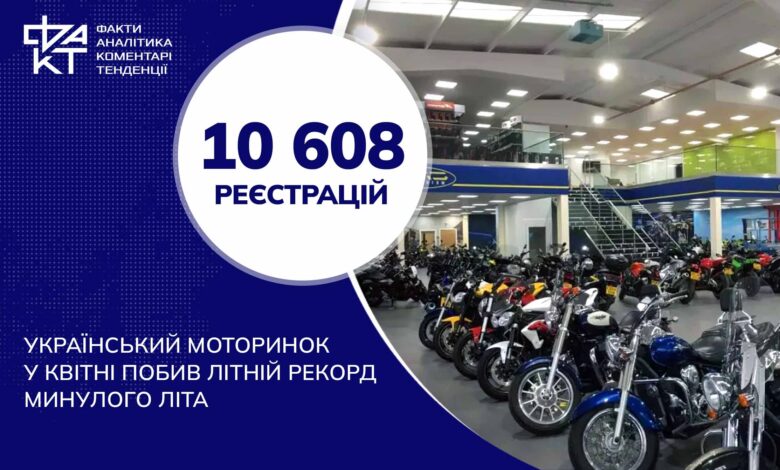
The Ukrainian motorcycle market in April unexpectedly showed a figure that a few years ago would have seemed unrealistic for a country where a car was traditionally considered the main symbol of personal transport. According to data from the Auto Market Research Institute, in one month Ukrainians registered 10,608 motorcycles – even more than during the previous peak last summer.
It has long been a question of no longer seasonal interest in two-wheeled vehicles or a fashion for biker culture. The market has actually recorded another trend: more and more people are beginning to perceive a motorcycle not as an addition to a car, but as its cheaper replacement.
Against the backdrop of more expensive fuel and weaker demand for passenger cars, motorcycles have begun to take the place that previously belonged to cars almost without competition. For some Ukrainians, it is no longer a weekend vehicle, but a way to get around every day cheaper, faster, and without the costs that a car entails. There is less romance in this story than it seems, but much more cold calculation.
The share of new imported motorcycles at 49.6% shows the main difference between the motorcycle segment and the automobile market. While Ukrainians often go to the secondary market for passenger cars, they increasingly choose new equipment for motorcycles. In April, there were 5,260 such registrations, and they were the main engine of the record month.
The annual growth of 19.5% in the new motorcycle segment explains why Lifan, Kovi, Mustang, Spark, and Tekken were among the leaders. The buyer is not looking for a loud emblem, but for a vehicle that can be bought without financial strain and used every day: for work, delivery, trips around the village, city or roads where a car no longer seems like a convenient solution.
The domestic market with 4,185 resales shows another part of the same picture: Ukrainians did not abandon proven brands, but began to calculate the resource and price more carefully. The average age of such equipment is 11 years, and next to Honda with 494 transactions and Yamaha with 396 transactions, Lifan, Geon and Kovi are already confidently holding their own, which a few years ago came as a budget novelty, and now form a full-fledged secondary market.
The share of used imports of 11% seems small only at first glance, because this segment added 43.6% compared to April last year. In April, 1,163 used motorcycles were imported, and here the buyer behaves differently: he is ready to take the equipment with an average age of 14 years, if it is backed by Honda, Yamaha, Suzuki or Kawasaki.
The presence of Honda only in 10th place among new motorcycles with 160 units sold well exposes the current nerve of the market. Japanese quality has not lost its value anywhere, but in the salon the buyer often chooses not a dream, but the amount in the check. That is why prestigious brands are holding on more strongly in the used segment, while more affordable manufacturers are taking over the new market.
January’s 120% growth in domestic transactions already hinted that motorcycles have ceased to be a purely summer purchase. April only consolidated this change: motorcycles are increasingly being bought not for the mood or the season, but for a specific need – to spend less and stay mobile.
The record of 10,608 registrations is therefore impressive not only in quantity but also in content. Ukrainians are not just switching to two wheels en masse, they are reconsidering the price of mobility. Where a car becomes an expensive obligation, a motorcycle is turning into a practical tool for daily movement.


