The issue of financial support in the Ukrainian army is extremely painful, because it is about how much the state values its defenders, how it correlates payment for service with risk, exhaustion and daily expenses. The military, performing combat missions under constant threat, receive money, a significant part of which is then dissolved in expenses for equipment, food, fuel, medicine, means of communication and dozens of small but necessary things, without which the unit cannot hold its position. This difference between officially accrued salaries and the real needs of the front shows the attitude of the state towards people who are carrying the war on themselves.
This imbalance looks especially striking against the background of constant talk by officials about the lack of funds in the State Budget for proper support of the military, but at the same time, almost daily news appears about large-scale corruption, embezzlement in public procurement and abuse in the system, which should work for the army, and not exhaust it from within. At the same time, reports of the involvement of high-ranking military officials in such schemes are perceived especially sharply, because it is about the destruction of trust in the very logic of state administration during the war. When the country has been living in conditions of full-scale war for the fifth year, and the problem of corruption and embezzlement has still not been overcome, this looks like the unwillingness or inability of the state to protect its own army from those who profit from its needs.
Cash support for the military: how a military salary became a resource for survival
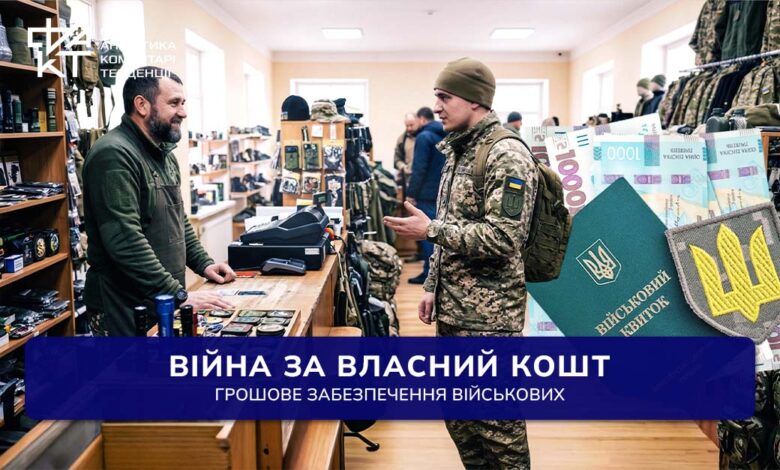
Currently, the minimum cash support for the Ukrainian military is from 20 to 25 thousand hryvnias, depending on the rank, but in a combat environment this amount is perceived completely differently than in civilian life. At the same time, a significant part of this money is not retained by the soldier, because he has to spend his own money on high-quality uniforms, shoes, even on tape, electrical tape, packaging materials and bubble wrap, which are needed to safely deliver water, food and equipment to the front line.
Due to problems with logistics, which often occur by air, water and other liquids have to be packed especially carefully so that the container does not break when falling from a height and so that the cargo reaches the trenches in a suitable condition. In such a situation, even an ordinary bottle of water ceases to be an everyday trifle and becomes a separate task that requires money, organization and constant attention. In fact, this means that part of the military costs arise from the very method of survival and provision of the unit on the front line.
Against this background, the data presented during a speech in the Verkhovna Rada by People’s Deputy Nina Yuzhanina are indicative. She stated that about 60% of the military are forced to buy equipment, footwear, drones, medicines, communication equipment, thermal imagers and other technical means at their own expense, using their own salaries or the help of volunteers, because state supplies do not cover all the needs of the front. Moreover, this figure is confirmed by official data from the Accounting Chamber, as well as assessments of the military and their commanders. At the same time, only a quarter of the military are completely satisfied with the support provided by the state.
In addition, the situation with food is not better. More than 50% of the military say that they are not satisfied with it, so they are forced to buy food with their own money, since the format proposed by the state does not meet the needs of the army. Another 26% of the military report a shortage of fuel in their units, although, according to the estimates of the fighters themselves, the actual figure may be higher. In such cases, fuel also has to be purchased at their own expense or rely on the help of volunteers.
Against this background, discussions on the revision of budget expenditures look contradictory, since some of the deputies who publicly speak about the “need to revise expenditures” previously supported the budget, which does not provide for an increase in payments to the military, and inflationary allowances are aimed at maintaining the state apparatus.
A special burden in this situation falls on the families of military personnel, who are often forced to purchase additional equipment, food, medicines, technical equipment and household items at their own expense, without which service on the front line becomes even more difficult. At the same time, not every family has the financial opportunity to regularly cover front-line needs, because they have their own expenses for children, loans, housing rent, treatment and ordinary daily survival. At the same time, in equally dangerous conditions, some military personnel receive additional support from their relatives, while others are forced to make do with what they have from the state.
The principle of calculating payments itself creates a separate tension, since the military expects a fairer approach, according to which the financial support would not depend so sharply on the differences between individual types of combat missions. The feeling of imbalance is also exacerbated by the fact that in some cases foreigners receive more than Ukrainian military personnel. For those who have families, children and a constant financial burden, such a difference is perceived especially painfully, because we are talking about comparing the state’s attitude towards its military and mercenaries.
Are changes in the financial support of the military foreseen
From April 1, 2026, the financial support of the military in Ukraine will not change, although all current additional payments will be retained. The State Budget for this year does not provide for an increase in military salaries, and therefore the basic structure of payments will remain the same as it was. According to the Law “On Social and Legal Protection of Military Personnel and Members of Their Families” and Cabinet Resolution No. 168, additional monthly payments amount to 30 thousand hryvnias for those who perform combat or special tasks during the period of ensuring the defense of Ukraine, protecting the security of the population and the interests of the state in connection with the military aggression of the Russian Federation.
Servicemen who perform combat or special tasks as part of military management bodies, headquarters and commands that carry out operational management of units receive 50 thousand hryvnias. For those who are in an active combat zone or undergoing treatment or rehabilitation due to contusion, injury or mutilation, as well as for those who were taken prisoner, 100 thousand hryvnias are provided. A separate additional payment of 70 thousand hryvnias has been established for those who are on the front line for a month.
The structure of monetary support consists of several parts, and each of them is tied to the formal parameters of the service. The official salary is the main part of the payments and depends on the military position: the higher the position, the higher the salary and, accordingly, the higher the basic level of support. The salary for the military rank is paid depending on the assigned rank — private, sergeant, lieutenant and others — regardless of the position held by the serviceman. At the same time, the seniority bonus is calculated as a percentage of the official salary and salary by military rank and increases with the length of service – from 5% for one year to 50% for 25 years or more. However, the amount of the reward does not depend in any way on whether the soldier is a contract soldier or mobilized: the position, rank and other factors provided for by the system remain decisive.
Against the background of this unchanged model, the Verkhovna Rada initiated a large-scale review of the remuneration system in the public sector. The draft law No. 15093 of 19.03.2026 proposes to amend the Law on the State Budget-2026, focusing resources on the defense sector. Among the key innovations is an increase in payments to the military to 150% of the level set for January 1, 2026.
In addition, for the period of martial law, it is proposed to set a limit for the salaries of officials and heads of state enterprises: they should not exceed the provision of an ordinary soldier of the Armed Forces of Ukraine of the first tariff category together with “combatants”. At the same time, judges, judges of the Constitutional Court and security forces who take direct part in hostilities are exempted from this limitation. It is planned to finance such expenses by increasing the tax rate on bank profits from 50% to 75% in 2026. However, these are just another promise and only a bill, the adoption of which is very doubtful.
As a result, a picture emerges in which the officially prescribed payment system and the real cost of service exist as if in different planes, although they collide every day in the wallet of the same military. On paper, the state determines salaries, allowances and additional payments depending on the position, rank, length of service and the nature of the tasks. However, in the trenches, these funds pass through a completely different filter – the need to purchase additional equipment, equipment, medicines, food, packaging materials and everything else that is indispensable for the front-line routine.
The most unpleasant thing about this situation is that it has become almost commonplace for the state. When the person who protects it buys his own equipment, buys additional food, looks for fuel and covers his own household and combat needs with his own salary, this indicates the real price of state “support”. Behind the beautiful formulations about caring for the army, a much harsher fact is hidden: those on whom the front is supported are often perceived by the state not as people who should be adequately provided with everything necessary, but as a resource capable of suffering a little longer, buying something else and somehow pulling the situation out at his own expense.
That is why the complaints of officials that people are in no hurry to join the army sound especially cynical. It is difficult to convince society of the necessity of service when it sees that even those who are already fighting are often left alone with a lack of the most necessary things, and the state has been in no hurry for years to eliminate this gap between official promises and front-line reality. With this attitude, the problem of mobilization rests on trust in the state: people look at how it treats its defenders and draw their own conclusions.
What is needed from the government is not explanations, promises, and not another correct formulation, but decent material support for those who are fighting. Now it is clearly evident that in most cases it has left the military alone with the war.