Plans for regions instead of state protection of energy systems: what’s wrong with Zelenskyy and Shmyhal’s order

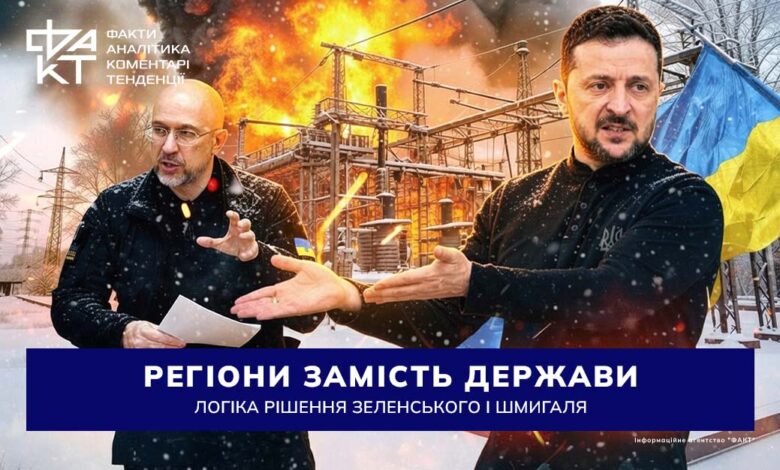
The President and the Deputy Prime Minister – Minister of Energy of Ukraine instructed the regional authorities to prepare plans for protecting the energy system for the next autumn-winter period against the backdrop of the threat of new attacks from the Russian Federation. In fact, the state recognizes that the next autumn-winter period is viewed as another cycle of life under fire, where each region must independently calculate its own resilience. The energy crisis with which Ukraine entered the winter of 2025-2026 is a consequence not only of Russian strikes, but also of the state’s systemic inability to ensure the stability of the infrastructure. At the same time, the colossal money allocated from the State Budget and international aid have not turned into effective results.
Solution Zelensky and Shmyhal: How the Protection of the Energy Sector Was Shifted to the Regions
The President of Ukraine instructed regional authorities to prepare plans for protecting the energy system for the next autumn-winter period amid the threat of new attacks from the Russian Federation. Further coordination of this order was entrusted to the government level, so Deputy Prime Minister and Minister of Energy Denys Shmyhal outlined the practical framework for implementing the President’s order. He emphasized the need for the leadership of cities and regions to develop appropriate plans for protecting the energy system by September 1.
Within this general approach, Shmyhal paid special attention to the Kharkiv region, where a certain amount of work had been completed. He noted that some of the defense measures have already been implemented in the region, but the current level of protection cannot be considered sufficient given the nature of the threats, so “we must continue and strengthen them.”
The presidential order on the preparation of regional plans for protecting the energy system was issued at a time when the country has been living under the constant threat of shelling of energy infrastructure for almost four years. Large-scale damage to CHPs and power grids, emergency shutdowns, and chronic stress in the work of energy workers who heroically keep the system in working order during the war create conditions in which new management decisions are perceived as a belated reaction to a long-obvious problem. Against this background, the requirement to urgently prepare plans does not look like a new strategy, but a fixation on the fact that the system has long been operating in emergency mode.
At the same time, the instructions of Zelensky and Shmyhal clearly demonstrate a change in emphasis in responsibility, since the key part of protecting the energy systems is transferred to the regional authorities. In fact, the state recognizes that the upcoming autumn-winter period is seen as another cycle of Ukrainians’ lives under fire, where each region must independently calculate its own resilience.
The problem is that protecting energy infrastructure by its nature cannot be a task confined to the local level, since most critically important facilities fall outside the jurisdiction of communities. Large substations, main networks, and key energy hubs are not under the control of local governments, and the physical protection of such facilities requires resources, decisions, and coordination that are concentrated precisely in central government bodies. When responsibility for the result is blurred between different levels of government, a situation arises where a plan exists, but real levers of influence remain inaccessible to those from whom this plan is demanded.
Local authorities have a clearly defined range of responsibilities related to civil protection of the population, ensuring the operation of boiler houses and local networks, participation in coordination headquarters and interaction with military administrations regarding the deployment of mobile fire groups and electronic warfare equipment. However, these functions cannot compensate for the lack of systematic physical protection of strategic energy facilities, which remains the responsibility of the government, law enforcement agencies and energy system operators.
The protection of energy infrastructure in Ukraine is a complex multi-level system involving the Ministry of Energy, the Ministry of Community and Territorial Development in terms of coordination, the State Agency for Reconstruction, the Security Service of Ukraine with its counterintelligence and cyber defense functions, the Armed Forces and air defense units, as well as operating companies and the state regulator. However, the main one in this system is the Ministry of Energy of Ukraine, headed by Shmyhal. It is responsible for ensuring the protection of energy systems by strengthening the physical security of facilities, modernizing and decentralizing generation, restoring damaged infrastructure, accumulating energy resources, and attracting international assistance for the purchase of equipment.
However, Shmyhal has shifted the responsibilities of the ministry to the regions, where, in addition to managerial capabilities, a significant limitation is the financial reality in which communities are forced to cover the increase in electricity costs for water utilities and other critical services. Under such conditions, the requirement to invest in enhanced protection of energy facilities seems to many communities to be a task that goes beyond their budgetary capabilities.
The deadline of September 1 leaves minimal space for thoughtful preparation, and while for large cities this means a complex but feasible mobilization of resources, for small communities with limited budgets and personnel capabilities such a requirement turns into a serious problem.
Energy protection between reports and reality: where did the billions go
The sums that were directed to the protection and restoration of Ukraine’s energy system during the years of full-scale war would have been perceived as exceptional in terms of scale and pace of funding in peacetime. Against this background, the current vulnerability of infrastructure to missiles and drones appears not only to be a direct consequence of enemy strikes, but also a sign of internal management problems.
The budgetary and extra-budgetary funding that the state declared as of the beginning of 2026 is indicative. More than 50 billion UAH, declared as funds for the protection and restoration of the energy system, in terms of conversion, is approximately 3–3.5 billion euros, and the detailing of the State Budget for 2026 further emphasizes the scale of the flows. A separate line in it includes about UAH 21 billion for energy security, another UAH 13.6 billion is provided for the energy sector in general, and the Energy Efficiency Fund is planned to be financed at the level of UAH 0.6 billion and the Decarbonization Fund at UAH 1.9 billion, which together form a picture of large expenses that should be converted into modernization, protection and sustainability of the industry.
In addition, it is worth mentioning a separate decision of the Cabinet of Ministers, enshrined in Order No. 1135-r dated October 18, 2025, which allocated UAH 6,009,382.131 thousand from the State Budget reserve fund to strengthen defense capabilities and prevent man-made emergencies, in particular for the construction of protective structures for fuel and energy sector facilities.
The statistics of financing the protection of Ukrenergo substations are no less telling, where both the dynamics of resource reduction and and a chronicle of incomplete utilization of funds. In 2025, the State Agency for Infrastructure Reconstruction and Development was allocated 30% less money than in 2024, as the head of the agency, Serhiy Sukhomlyn, said, and at the same time he detailed the previous years. In 2023, UAH 9.4 billion was planned for the second level of protection, of which only UAH 4.7 billion was used, in 2024, UAH 4.4 billion was used out of UAH 5.4 billion, and in 2025, the agency was provided with UAH 3.6 billion with the assurance that this time they would be used in full.
Also important in Sukhomlyn’s statements is the limit of actual coverage of facilities, which he voiced without trying to hide the disproportion. The agency, he said, is building protection for only 22 substations, which is about a third of Ukrenergo’s key facilities, and each substation consists of several separate facilities and requires different elements of protection. Even if we proceed from optimistic reports, we are not talking about a solid shelter for the power grid, but fragmented solutions that cannot cover all vulnerable areas.
International aid, which is regularly cited as an argument for supporting Ukraine, is also measured in large amounts, and these figures only reinforce the question of the final effect. In particular, only recently the United Kingdom has allocated 20 million pounds sterling for emergency repairs and protection of energy infrastructure facilities, the Norwegian government has allocated 4 billion kroner, or about 17 billion hryvnias, to Ukraine for the energy sector and its protection. A separate array is the funding from the World Bank, EBRD, EIB, the USA and the EU, which provided about $2.3 billion in 2023, and in 2025 added a grant of $200 million for Ukrenergo.
Added to this picture is the assistance of Lithuania, which during the full-scale invasion transferred to Ukraine sets of equipment for CHP and NPP, over two thousand solar panels, various equipment and contributed 5.7 million euros to the Energy Support Fund of Ukraine, and in January 2026 prepared a new government decision on additional energy assistance for Kyiv and the most critical regions. The combination of these resources is a powerful support, but in reality the issue of infrastructure sustainability remains open. And it remains unclear: where does all this money go?
In 2025, the government reported on the construction of 46 elements of protection for energy facilities, of which 38 were allegedly fully completed, and another eight were 90% ready with a promise of completion by the end of the year. The installation of protection at 22 substations was then publicly announced by Prime Minister Yulia Svyrydenko, but these figures did not provide a convincing explanation for why even “protected” facilities continue to fail after each massive attack.
If we return to the origins of the high-profile state concept of multi-level protection of energy infrastructure, to which significant funds were directed, then the key starting point becomes 2023. Then the government of Ukraine, together with the General Staff of the Armed Forces of Ukraine, made a fundamental decision to engineer the fortification of energy facilities from Russian missiles and drones, and the State Agency for Infrastructure Restoration and Development, which was headed by Mustafa Nayem at that time, was given a central role in the implementation of this program. The agency took on the function of the customer, coordinator and public communicator of the process, and therefore its head became the main bearer of promises about the result.
At that time, Nayem gave assurances about a systematic and unprecedented approach to protecting the energy structure, and the then Minister of Energy Herman Galushchenko said that Ukraine had allegedly become the first country in the world to introduce multi-level protection of civilian energy infrastructure. This formula was actively replicated as evidence of strategic foresight and technological maturity of management decisions, and it was precisely because of the scale of the statements that society received the expectation that the engineering shield had already been built or was close to completion.
The first level of protection was described by Nayem as basic and massive, and its essence was reduced to the construction of gabions and big bags. According to official data, 90 facilities in 21 regions were protected in this way from missile and drone debris, and this level was presented as a quick response to the threat, which should reduce secondary damage without complex design solutions and long-term construction.
The second level began to be implemented in March 2023, and it consisted in the construction of concrete structures around key elements of the Ukrenergo network. According to the agency’s reports, 22 substations and 63 autotransformers in 14 regions were covered by this protection, and the robots themselves were positioned as an active barrier against drones and “shaheeds”, which were already being used massively by Russia at that time. The logic of this level was clear: to cover the most important nodes not with temporary means, but with structures capable of withstanding typical air attacks.
The third level was defined as the most complex and expensive, since it concerned protection against direct missile hits. Here again, the same 22 substations in 14 regions were included, for which engineering structures capable of withstanding the blows of the most powerful means of destruction were to be built, and all design solutions, according to official reports, were agreed with the General Staff and the State Emergency Service and were based on documentation received from specialists from Great Britain and the United States. At the level of public descriptions, this system looked consistent: from quick solutions to heavy engineering structures.
At the level of press releases and public speeches, the three-tier architecture really looked logical and convincing, and Mustafa Nayem regularly emphasized that the agency worked hard according to military guidelines, international standards, and taking into account real combat experience. However, over time, the gap between the declared protection design and the actual state of the energy sector became too noticeable to be explained only by enemy strikes.
The problem is not only that even “protected” facilities continue to suffer critical damage, but also that the scale of implementation declared by the agency objectively did not correspond to the scale of the Ukrenergo system and the entire energy infrastructure of the country. A third of the key substations do not form a system, but remain a fragment that is physically unable to ensure the stability of the network in conditions of massive and repeated attacks, even if individual nodes have protection and partially withstand the load.
An additional factor was the fact that the first level in the form of sandbags and gabions, which, according to the head of Ukrenergo Volodymyr Kudrytsky, remained from the previous winter, was by its nature a temporary solution. In contrast, the second and third levels have been in the “actively implemented” mode for years with approximate deadlines “before the cold weather”, which have repeatedly shifted, without being accompanied by public responsibility for disruptions in deadlines and falling behind the declared plans.
In this matter, Mustafa Nayyem’s role at that time was significant, because he was the face and voice of the program, and the agency under his leadership operated with billion-dollar budgets for the design and construction of protective structures. Публічні заяви, зроблені ним, формували у суспільства очікування, що енергосистема отримала надійний інженерний щит, але, як виявилося, вони були порожніми і ніхто за це не поніс жодної відповідальності. Проте Найєм з вересня 2024 року працює старшим радником з питань боротьби з корупцією та відновлення інфраструктури у проєкті Promoting Integrity in the Public Sector Activity (Pro-Integrity), який фінансується урядами США та Великої Британії. Тобто він продовжує «боротися з корупцією» та далі «відновлює» інфраструктуру, і цей поворот виглядає особливо контрастно на тлі реального стану енергозахисту. Як то кажуть, без коментарів…
Натомість реальність зими 2025–2026 років показала, що між задекларованими трьома рівнями захисту і фактичним рівнем вразливості лежить прірва, заповнена недобудованими конструкціями, обмеженим охопленням об’єктів і відсутністю відповіді на базові запитання. Чому проєкт, який погоджувався Генштабом, ДСНС і міжнародними партнерами, так і не перетворився на повноцінний бар’єр для енергетичного терору, і хто за це відповів, коли наслідки відчули мільйони людей.
Окремої уваги потребує історія з відставкою Германа Галущенка та Світлани Гринчук, які у листопаді 2025 року залишили посади міністрів на тлі корупційного скандалу в «Енергоатомі». Цей епізод став одночасно показовим і тривожним прикладом того, як політичне усунення здатне заміняти собою реальну відповідальність, залишаючи суспільству більше відчуття недомовленості, ніж відчуття відновленої справедливості.
Розслідування, яке НАБУ розпочало спільно зі Спеціалізованою антикорупційною прокуратурою, виявило корупційну схему в державній компанії, що є ключовою для енергетичної безпеки країни, і сам цей факт звучить особливо гостро на тлі енергетичної кризи. У ситуації, коли кожне управлінське рішення в галузі прямо впливає на здатність держави забезпечувати світлом і теплом мільйони людей, поява корупційних підозр у стратегічному сегменті підриває довіру не тільки до посадовців, а й до спроможності держави захищати критичну інфраструктуру.
Реакція влади виглядала швидкою, проте її наслідки залишилися обмеженими, оскільки за наполяганням Володимира Зеленського обидва посадовці подали у відставку, а Верховна Рада 19 листопада 2025 року проголосувала за їх звільнення. Такий крок дозволив формально знизити політичну напругу, однак він не дав відповіді на питання юридичної відповідальності Галущенка та Гринчук, адже усунення з посади, за всієї публічної ваги, є лише формою політичної відповідальності. Воно не передбачає вироку, заборони обіймати посади надалі та компенсації збитків, якщо їх буде доведено. Отже, і тут виникає відчуття розриву між гучними заявами про боротьбу з корупцією та реальними інструментами її подолання.
Окремий сюжет у цій картині формує роль Дениса Шмигаля в ситуації, яка склалася в енергетичній сфері. 14 січня 2026 року його призначили першим віцепрем’єр-міністром — міністром енергетики України. До цього з березня 2020 по липень 2025 року він очолював уряд на посаді прем’єр-міністра, а згодом встиг попрацювати міністром оборони. Така траєкторія кар’єри робить його людиною, яка тривалий час перебувала в центрі ухвалення державних рішень, що прямо впливали на енергетичну стійкість в країні.
Його заява, зроблена 16 січня 2026 року з трибуни Верховної Ради під час Години запитань до Уряду, виглядала як черговий структурований виклад заходів щодо відновлення енергосистеми, стійкості й модернізації. Проте за логікою дедалі виразніше проступає розрив між декларованими пріоритетами та тим, а яких умовах реально живуть люди, коли звітні конструкції не співпадають із відчуттям країни, що сидить у темряві.
Поки міністр говорить про критичний стан енергоструктури, відновлення генерації, підстанцій і мереж та про формування резервів обладнання, ці формулювання звучать переконливо лише до моменту, коли пролунає уточнення: значна частина завезених в Україну потужностей досі не встановлена. У такій ситуації провал вже неможливо пояснювати виключно обстрілами, оскільки бездіяльність, управлінські затримки та відсутність координації між центральною владою й регіонами перетворюються на не менший ризик, ніж ракети й дрони.
Ідея створення так званих «енергетичних батальйонів» на прифронтових територіях та інші заплановані заходи виглядають як відповідь на катастрофу, яка формувалася роками, а не як завчасно вибудувана система захисту. Саме тому виникає просте запитання, яке складно обійти: чому ці рішення не були реалізовані раніше, коли Денис Шмигаль очолював уряд і мав повний набір інструментів для ухвалення таких кроків? Натомість зараз він критикує ситуацію, що склалася в енергосистемі, та наказує місцевій владі розробити плани на осінь. Крім того, замість відповідальності за системні провали він впевнено переходить з однієї високої посади на іншу, і в цьому є парадоксальна деталь: тепер він очолює міністерство, діяльність якого, як бачимо, він сам і розвалив.
У підсумку публічні заяви Шмигаля про «грандіозні» плани різко контрастують з тим, що міста і села дедалі більше занурюються в темряву, регіони визнаються непідготовленими, українці живуть щодня по 5-16 годин без світла, проте відповідальність за провали дедалі частіше перекидається на міську, а не центральну владу.
Отже, проблема полягає не стільки в дефіциті коштів і можливостей, скільки в провалі державного управління енергетичною сферою, масштабній корупції та повній безвідповідальності посадовців.
Якщо державний захист енергосистеми зведеться до регіональних планів, а центральні органи влади продовжать обмежуватися лише координаційними заявами та перекладанням відповідальності на місцеву владу, то енергетична сфера остаточно перейде в режим хаотичного виживання.