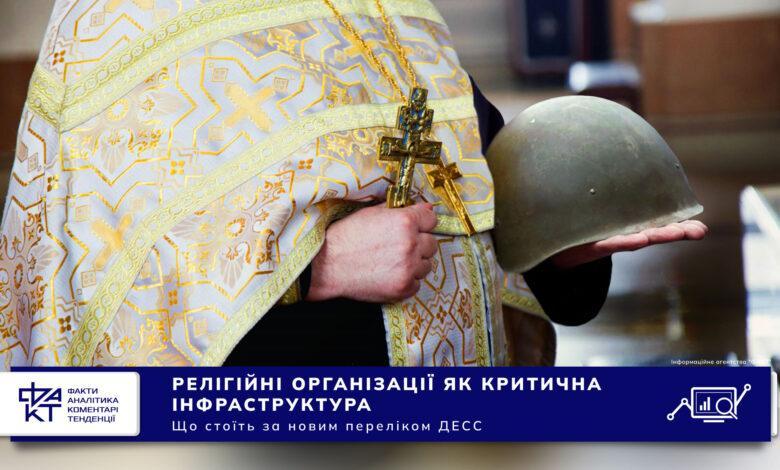
Do they belong in the trenches or at the altar? While fierce fighting continues at the front, the state once again faces a sensitive choice at the intersection of faith, law and defense. The State Service for Ethnopolitics and Freedom of Conscience has approved a list of 7,736 religious organizations recognized as critically important for ensuring the livelihood of the population, supporting the Armed Forces of Ukraine, and the functioning of the economy in wartime conditions. This status paves the way for the reservation of clerics, allowing them to remain in communities instead of being drafted. Also, this decision is accompanied by the definition of the criteria of a religious organization as critically important, but they require meaningful analysis. Do these criteria really meet the real challenges of wartime? Do they have a connection with ensuring the livelihood of the population and the Armed Forces, the economy and the stability of the rear? In the conditions of a full-scale war, these questions acquire special importance.
Reservation of clerics: a new procedure in the conditions of war
On June 5, 2025, the State Service of Ukraine for Ethnopolitics and Freedom of Conscience (SESS) issued Order No. H-80/11, which approved the list of religious organizations recognized as critically important for the functioning of the economy and ensuring the livelihood of the population in a special period. This document opens up the possibility for them to initiate the reservation of conscripted clergy. So, for the first time at the level of the state procedure, religious structures were officially included in the reservation system — by analogy with enterprises of the defense, energy or medical sectors.
The list of religious organizations that are critically important for the functioning of the economy and ensuring the livelihood of the population in a special period includes 7,736 organizations, distributed by administrative regions, it contains 514 pages.
In addition, the State Service of Ukraine for Ethnopolitics and Freedom of Conscience approved Order No. H-21/11, which defines clear criteria by which a religious organization can be recognized as critically important for the functioning of the economy and ensuring the livelihood of the population in a special period, that is, during emergency situations, martial law or a large-scale crisis. First, a religious organization must be officially registered in the Unified State Register of Legal Entities, Individual Entrepreneurs, and Public Organizations. Moreover, its identification code must appear in the Unified State Register of Enterprises and Organizations of Ukraine.
Secondly, such an organization had to be registered no later than December 26, 2024. This deadline is set as the cut-off date after which new structures will no longer be subject to this mechanism. Thirdly, the organization should not be included in the list of religious organizations connected with foreign structures, the activities of which are prohibited in Ukraine. Such a list is determined in accordance with Article 5-1 of the Law of Ukraine “On Freedom of Conscience and Religious Organizations”, and concerns, in particular, structures affiliated with religious centers of the aggressor state.
Fourth, the legal address of the organization must be located exclusively on the territory controlled by the Ukrainian authorities. If it is located on the territory temporarily occupied by the Russian Federation, then the organization cannot be recognized as critically important. Fifth, the organization’s charter or bylaws must remain in effect to the extent that the organization’s official name is defined. This rule excludes organizations that do not keep their documentation up to date.
Sixth, the organization must be included in the Register of non-profit institutions and organizations. This confirms its non-profit nature and allows the state to control its financial activities. And finally, the seventh condition is the mandatory submission of a report on the use of income (profits) for the last basic tax period. Organizations that have not reported their activities to the tax office will not be able to receive critical status.
It should be noted that the issue of the mobilization of clergy in Ukraine became especially relevant in 2024-2025 against the background of changes to the legislation. On December 26, 2024, the Cabinet of Ministers of Ukraine updated the resolution on the reservation procedure, supplementing it with a provision according to which clergymen of all religious denominations have the right to reservation. To exercise this right, a religious organization must have the status of a legal entity and officially registered employees. This means that the clergy must be officially employed and pay contributions to the Pension Fund. At the same time, unlike the private sector, such organizations are not subject to the minimum wage requirement, in particular, more than 20 thousand hryvnias.
Different perspectives on the mobilization and reservation of clergy
In the religious and expert circles, the decision to book priests is met with mixed reviews. Some representatives of religious denominations consider reservations to be a necessary step to preserve the functioning of the religious life of communities, especially in rural areas, where one priest often serves several parishes. In the absence of armor, churches may be left without spiritual care, which in wartime is seen as a critical violation of the right to freedom of religion.
Another position is based on doctrinal principles — a number of Christian denominations prohibit or limit the possibility of using weapons and shedding blood for clergy. According to this approach, a cleric cannot be integrated into the structure of the armed forces without violating canonical principles. In the case of refusal to book, this can lead to a religiously motivated refusal to comply with combat orders, which creates a conflict between law, conscience and order.
At the same time, in part of the religious environment, there is a widespread opinion that the status of a clergyman should not automatically exempt one from the duty to protect the state. Proponents of this approach believe that all citizens, regardless of spiritual status, should be equal before the law, and the defense sector cannot be an exception. According to this logic, clerical work should remain outside the scope of legal privilege, and reservation should be applied only in exceptional cases where a socially important function is concerned.
There is also a technical and legal dimension to the problem. In order to successfully book a cleric, the organization must provide a complete package of documents, confirm legal status, employment, compliance with duties and absence of grounds for restrictions. The procedure for submitting such documents is currently still under development. DESS is preparing a relevant normative legal act, which will define a clear algorithm of actions and a list of supporting documents. After approval, this document must be published on the official website of the service.
The legal side of clergy reservation
As of June 2025, the procedure for booking clergy remains subject to further regulatory regulation. However, today it appears as a tool not only of legal, but also of value policy — at the junction between state administration, religious freedom, public morality and defense capability. In each specific case, the question of reservation becomes a mirror of the social agreement about the limits of duty, the function of the spiritual guide and the admissibility of exceptions during general mobilization.
It is worth noting that in Ukrainian legislation there is no automatic basis for an official postponement of mobilization solely on the grounds that a person is a clergyman or a representative of the spiritual hierarchy. Neither the status of a bishop, nor the rank of a priest, nor the presence of letters from the diocese or religious community in themselves are grounds for granting a deferment. All conscript citizens, including clergymen, are subject to the general rules of mobilization accounting and deferrals.
The grounds for postponement are clearly defined in the legislation and are the same for everyone: these include, in particular, the presence of three or more minor children, an established disability, unfitness for service due to health conditions, guardianship of persons with disabilities, loss of close relatives in hostilities during ATO/OOS or under martial law.
In the absence of such grounds, the very fact of belonging to the clergy does not confer a special status. That is, in case of mobilization necessity, both priests and heads of religious organizations, including the highest clergy, can be called. The decision on mobilization in each specific case is made by the Territorial Center of Procurement. They have at their disposal data about a person, his profession, age, religion, and take these circumstances into account – however, the law does not provide for exceptions guaranteed only on the basis of rank.
Among the key unresolved aspects in the clergy reservation system are a number of categories that fall out of the regulatory field. The current rules are aimed mainly at persons who already have the status of a clergyman and official employment in a religious organization with the status of a legal entity. However, they do not cover those who are in a different religious status or on the path to priesthood.
Currently, the issue of seminarians — students of theological educational institutions who are preparing for ordination — has not been settled. Formally, they do not have the status of clergy, do not perform rites and most often do not work with any religious organization. As a result, in the current order of reservation, they are not considered as potential candidates for postponement, even though they are the future personnel reserve of the church structure.
Similarly, the question of monasticism remains open. Monks do not always perform the ritual functions of a priest, are not always employed in the format of an employment contract, and the activities of monasteries are often formalized not as a separate legal entity, but as part of a wider church structure. As a result, the lack of formal legal registration and clear accounting can lead to the fact that even clergy with permanent monastic service do not have grounds for reservations.
The situation with deacons, regents, psalmists or other workers of the church environment, who do not have a sacred rank, but ensure the full functioning of parishes and services, is also not settled. Their role is no less significant in the context of community life, but the regulatory framework does not allow them to be booked, if they do not qualify as a “clergyman” in the narrow sense.
These gaps indicate that the current approach to reservations does not take into account the diversity of the religious environment and does not provide a comprehensive approach to preserving the structures that ensure the spiritual stability of the population in conditions of war. Solving these issues requires a clearer definition of statuses within the religious community, as well as a corresponding expansion of the regulatory framework.
Clergy and the Army: Are Clergy Fighting in Other Countries?
In most countries of the world, the participation of clergy in the armed forces is regulated not only by national legislation, but also by international humanitarian law. According to Protocol I to the Geneva Conventions, military chaplains are recognized as non-combatants — that is, persons who do not participate in hostilities and do not have the right to use weapons. Their main function is spiritual guardianship, moral and psychological support of personnel, and the implementation of religious rites within the military units. However, despite the universality of this approach, in each country there are nuances in determining the status and role of the chaplain, as well as the peculiarities of the attitude to the question “can clergy fight.”
In the United States of America, military chaplains are officers who belong to various religious denominations. They undergo training together with other officers, but do not carry weapons and do not participate in combat operations. In active combat zones, chaplains work on the front lines or in rear medical units and are always accompanied by armed assistants who are responsible for their protection. Such support is especially relevant in areas where compliance with the status of a non-combatant does not guarantee physical safety. Historically, the U.S. military has seen some chaplains carry weapons in wartime situations, particularly in Vietnam, but this is considered an exception, sparking internal debate within the military and the religious community.
In Great Britain, military chaplains also belong to the officer corps, do not have the right to bear arms and perform the functions of spiritual care. They are involved in all types of armed forces – land, naval and air. They work in military units both at home and in overseas deployment zones, providing assistance to soldiers regardless of religious affiliation. All chaplains operate within the confines of legislation that expressly prohibits their participation in combat.
Canada follows a similar approach. Military chaplains here are part of the official structure of the Armed Forces and represent not only Christian denominations, but also Judaism, Islam, Buddhism and other religions. Their service involves active participation in moral support, work with families of servicemen, participation in funerals, counseling of people with post-traumatic syndrome. According to Canada’s national defense policy, chaplains are not required or authorized to engage in armed conflict. They do not undergo combat training, but are present in combat zones.
Finland follows a similar model. Both Lutheran and Orthodox chaplains serve in the country’s Armed Forces. They have military ranks and, formally, can carry weapons only for the purpose of self-defense, but are not intended for combat service. The main functions are spiritual support, religious service, assistance to military personnel in crisis situations. Interfaith cooperation takes an important place in the Finnish model, with the aim of providing access to spiritual support for representatives of different religions.
In countries with compulsory military service, such as Israel, clergy are not required to serve, but may voluntarily serve as chaplains. The IDF has a system of military clergy, where chaplains — usually rabbis — accompany the troops, responsible for observing religious norms, organizing prayers, funerals, and providing religious counseling. Their status is official, but combat participation is prohibited for them.
In other countries, such as Poland, Germany, France or Italy, there are also institutes of military chaplaincy with similar functions: religious service, moral support, consultations, service in the conditions of peacekeeping and combat missions. They are not combatants, are not required to participate in military operations and work as part of the humanitarian component of military structures.
Thus, in most countries of the world, clergymen do not take part in hostilities, even if they formally have military ranks. Their status is that of a non-combatant protected by international law. Participation in war for them is defined not as physical presence with weapons, but as service in the form of support, prayer, ritual and moral care. Even in countries with a strict mobilization regime, the religious component is treated separately, and clerics usually have a special status that protects them from direct participation in armed conflict. However, among them there are quite a few who go to serve or work as chaplains.
Criteria without content: is the special status of religious organizations justified during the war period
The recognition of a religious organization as “critically important” for the functioning of the economy and life of the population and the armed forces in a special period looks like a logical oxymoron. And although the technical criteria are formally written out — such as the presence of a code in the registry, non-involvement in prohibited structures, reporting to tax and non-profit status — none of these points are related to criticality for the economy or the livelihood of civilians and military personnel. It is only about the formal presence of the organization in the legal field, but not about the functions that really matter in the conditions of war.
A separate focus is an attempt to explain that humanitarian aid, psychological support, volunteerism or reconciliation in communities are the elements that bring a religious organization to the level of a critically important structure for national security and economy. And this is not just a replacement of concepts, but an institutional manipulation. Psychological support is important, but is it “indispensable”? Volunteering is valuable, but there are hundreds of volunteer associations that do the same tasks without claiming reservation.
Even more absurd is the thesis that religious organizations can be critically important for meeting the needs of the Armed Forces. In what way? The fact that priests consecrate crosses and amulets, perform service and take money for the funeral of fallen soldiers? It is a real bitter truth – in many cases the church itself has become a commercial service that works with pain and death. And here the moral conflict appears extremely acute: why do the priests not fight, but arm themselves? Why don’t they serve as chaplains or in other positions, if they want to be useful to the army and if they cannot take up arms? Why are there so few among them who voluntarily went to the front, as in other countries, and so many who achieved armor using the mechanism of “critical importance”? Rhetorical questions. And if the average believer has to go through the entire procedure and get the commission’s opinion, why is a clergyman automatically released just because he serves in the church? This creates a two-class system, where some have to prove their conscience, and others only have to show registration.
The formal writing of conditions in the regulations about the code in the registry, the lack of ties with the Russian Federation, the current statute looks like a smokescreen for the real purpose: to enable institutional religion to gain advantages without real critical importance. This is outright legalized hypocrisy: against the background of general mobilization, casualties, front-line workload and public tension, priests are armored with zero critical importance, minimal revenue transparency and a weak basis for exceptional status.
Therefore, the recognition of religious organizations as critically important in the conditions of martial law has no logical or functional basis. In addition, there is deep resentment in society that priests, not participating in combat operations, regularly take payment for rites, including those related to death, grief and war. Consecration of crosses, prayers for the military, mourning the dead — all this has long been put on a commercial basis, has a set price, often unofficial, but constant. And when, against this background, religious structures receive the right to armor, it is not perceived as recognition of the role of the clergy, but as an indulgence paid for money.
In its current form, criticality criteria only enshrine a legal exception for a limited range of individuals without proper accountability and open accountability to society. Exceptional status should not be granted on the basis of religious affiliation, but on the amount of real, documented contribution to defense, economy, medicine, logistics or other important areas. Otherwise, the reservation system turns into another form of legal evasion — with a blessing and a price for each service.