Smilyansky called employees “sick in the head”: the head of “Ukrposhta” again found himself at the center of a scandal amid a prolonged management crisis

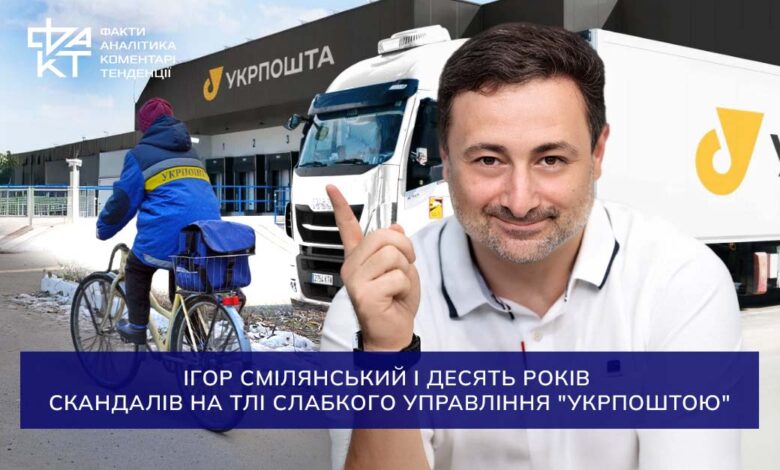
Ihor Smilyansky has been at the helm of Ukrposhta for ten years, constantly finding himself at the center of scandals and turning the management of the state-owned enterprise into a field of his own emotions and public conflicts. Instead of ensuring its profitability, taking care of decent salaries for subordinates, modernizing the infrastructure and creating a stable service for millions of customers, he is constantly distracted by personal squabbles and scandalous statements on social networks. Joint-Stock Company Ukrposhta continues to accumulate losses, lose the market and remain dependent on constant additional financing. At the same time, the state founder and shareholder in the person of the Ministry of Infrastructure of Ukraine does not react to the company’s systemic problems and the behavior of the manager.
Smilyansky’s salary rhetoric: how the words of a top manager outrage society
The scandalously famous CEO of Ukrposhta, Ihor Smilyansky, has never been distinguished by polite behavior in public. This time he distinguished himself again, but not with useful deeds for the state, but with another scandalous post, which is more befitting of a boor and a stand-up comedian than the head of a strategically important state-owned company.
Smilyansky’s latest comment on the social network once again caused a wave of indignation and criticism in society. He wrote in an obscene form in Threads that he does not understand people who agree to the minimum wage at a time when there are “millions of vacancies” in the country. The official added that healthy men and women who work for the minimum wage are “sick in the head.” Such a position looks cynical and does not take into account the socio-economic nuances that millions of Ukrainians face.
Smilyansky’s words are even more striking because he himself receives almost a million hryvnias per month before taxes. Such a salary is accrued thanks to a complex system of motivation for top managers of state-owned companies, where the salary is tied to the Cabinet of Ministers Resolution No. 859 and is supplemented by bonuses for results.
When asked by a journalist whether he is ashamed to have such a salary, Ihor Smilyanskyi stated that he does not feel ashamed:
“No, I am not ashamed. It is €15 thousand. Before Ukrposhta, I had $50 thousand per month. And something tells me that after Ukrposhta, I will probably have more,” Smilyanskyi replied.
It is significant that in response to comments about the low salaries of ordinary Ukrposhta employees, Smilyanskyi replied that operators in large cities receive 17 thousand hryvnias, and branch managers receive 21–22 thousand. At the same time, he explained the structure of the accruals — 80% is the base salary and 20% is a bonus. In addition, according to him, the company wants to make this ratio 70 to 30 so that employees with a larger amount of work can earn more. This seems to look like a modern motivation system, where income depends on the result, and the company seems to be moving towards a more flexible payment model. Smilyansky also noted that when he headed the company, the average salary at Ukrposhta was only $ 52.
However, as reality shows, the situation at Ukrposhta is significantly different from Smilyansky’s statements. As of the beginning of 2026, the average salary of a postman in Ukraine fluctuates within approximately 7,700–9,000 hryvnias, and in villages it is often equal to the minimum — about 8,650 hryvnias. At the same time, the basic salary there is actually a ceiling, and the bonus part is formed from small accruals: a few hryvnias for pension delivery, kopecks for newspapers and insignificant surcharges for additional services in the form of the sale of manufactured goods. As a result, there is not a motivational system, but an attempt to “pull” the salary to the minimum level by constantly increasing small work.
In large cities, the situation is different, but it is not as unambiguous as Smilyansky presents it. Due to the larger volume of shipments and bonuses, income may be higher, but this is not an average rate, but rather an upper limit, which depends on the intensity of the workload, the implementation of plans and the specifics of the department. If we analyze the nationwide statistics for the position of “postman-postman”, as well as vacancies posted by Ukrposhta on the work.ua website, the average salary is 9,000 hryvnias and below. This contrasts sharply with the rhetoric of the head of the company about competitiveness and high earnings.


In addition, Smilyansky’s statement that at the time of the beginning of his leadership, the average salary in the company was $52 is used by him as an argument in favor of progress. However, without taking into account inflation, currency fluctuations, and the general increase in the minimum wage, this figure becomes a convenient reference point that does not explain the current imbalances. The question is not only how much nominal wages have increased, but also whether they have become sufficient to keep people in the profession without a permanent shortage of personnel and overwork of those who remain.
As a result, a gap appears between official statements, which sound average figures for large cities and plans to improve the bonus system, and the everyday reality of postmen in small communities, for whom the minimum wage remains not a temporary stage, but a permanent state. It is this gap that becomes an indicator of whether Smilyansky’s statements correspond to the actual state of affairs in the company.
His attempt to explain the problem of low incomes as personal choices of employees seems especially contradictory given that the company itself has been reporting a shortage of personnel and difficulties in retaining staff for years. If there are not enough people, if branches are working at the limit of their capabilities, if postal services in villages are being curtailed or transferred to a mobile format, then it would be more logical to talk about increasing the attractiveness of work, and not about the dubious “normality” of those who agree to the minimum wage. When a manager with ten years of experience does not connect the personnel shortage with the level of wages, but instead appeals to the abstract availability of vacancies in the country, this is no longer a rhetorical blunder, but evidence of systemic self-deception.
So, a paradox arises: the head of Ukrposhta calls on people to leave their jobs for low pay, calls his subordinates “sick in the head” and at the same time admits that the company is experiencing a shortage of personnel. In such logic, a contradiction arises between market rhetoric and the social responsibility of the head of a state structure.
At the same time, the disparaging insults of people working for the minimum wage by the head of a state-owned company, his interpretation of the choice of low-paid work as a sign of the inadequacy of his subordinates, indicate cynicism, disregard for ethical behavior, as well as a complete lack of systemic understanding of the country’s labor realities. “Millions of vacancies,” according to him, do not mean an even distribution of decent jobs, and low salaries force employees to choose between survival and professional development.
Ten years of Igor Smilyansky at Ukrposhta and the systemic crisis of the enterprise
Igor Smilyansky, who has been heading Ukrposhta since 2016, has experienced more than one scandal during this time, but none of them seem to have forced him to change the tone of his conversation with society and his own employees. It is also indicative that the state founder and shareholder in the person of the Ministry of Infrastructure of Ukraine does not react at all to the systemic problems of the company and the behavior of the manager.
After ten years in office, one could expect from Smilyansky a deeper understanding of the processes at the enterprise, which is an element of social infrastructure. The post office in a Ukrainian village is not a romantic attribute of the past and not an unnecessary link that can be easily optimized for the sake of beautiful financial reports, but an access point to pensions, payments, basic services and simply human contact for those who physically have no alternatives. When stationary branches are closed, postmen are reduced or transferred to half-time, equipment wears out faster than it can be updated, statements about a “huge market of opportunities” sound like a theoretical construct that does not withstand the realities of practice.
During the years of Smilyansky’s leadership, the company has repeatedly found itself in the center of criticism due to queues, technical failures, branch closures, and the difference between the declared achievements and the everyday experience of customers. However, public squabbles and the demonstrative contempt of the company’s head for critics year after year push to the background the question of the state of Ukrposhta itself, where many systemic problems have accumulated, because the company is forced to work under financial pressure, staff shortages, and constant remarks about the transparency of management.
September 2025 was especially revealing, when the conflict on the X social network around the dismissals of postmen and the implementation of plans for subscriptions and the sale of manufactured goods demonstrated Smilyansky’s misunderstanding of the boundaries that separate a private person from a public manager. Instead of explaining the logic of management decisions and responding in essence to the remarks of Ukrainians about the workload on employees, the discussion turned into insults.
It should be noted that all this took place against the backdrop of much more serious challenges. In 2025, the National Bank of Ukraine announced the difficult financial condition of Ukrposhta, a high level of debt burden and risks of default, as well as the need for additional capitalization, which as of May 2025 was estimated at UAH 826 million. However, Smilyansky’s reaction was limited to explanations about the change in accounting methodology and the “paper” nature of part of the losses, which, according to the company, can be compensated by 2026 with its own resources. However, for customers and employees, the difference between the accounting treatment and the actual consequences is almost imperceptible when the company operates at a loss, reduces staff and optimizes the branch network.
The issue of salaries in state-owned companies is always a painful one, especially when it comes to an enterprise that is 100% state-owned, works with public funds and regularly appeals to its “social mission”. A separate area of conflict is the issue of management remuneration and transparency of financing. In 2024–2025, the situation became particularly acute: after long replies and ignoring journalists’ requests, information on the income of members of the Supervisory Board of Ukrposhta was made public only after appeals to the Verkhovna Rada Commissioner for Human Rights. According to the official response, five of the seven members of the board — Rinat Abdrasilov, Yakub Karnovsky, Gary John Carroll, Olena Malynska and Ihor Mityukov — receive a monthly remuneration of UAH 165,090, including taxes. The very fact that this data became public only under pressure from journalists raised more questions than answers.
Additional tension was created by the practice of an automatic charitable contribution of UAH 1 from each parcel in favor of the KSE Foundation. Although the company reports over UAH 67 million in aid to the Armed Forces of Ukraine and the presence of an international audit, the very mechanism of deductions without separate active consent of clients and the foundation’s connection with Timofey Mylovanov aroused suspicions among Ukrainians. However, Smilyansky repelled them with harsh rhetoric instead of explaining the procedure in as much detail as possible.
All this unfolded against the backdrop of chronic problems with the service — outdated software, queues, slow work of operators, mass layoffs of postmen, closure of branches in villages, the spread of the Russian-language press in 2025 and attempts to diversify income through the sale of sweets and food products with strict plans for employees.
On February 2, 2026, Ihor Smilyansky loudly announced the company’s “great achievement” — a large-scale rebranding dedicated to the 32nd anniversary of Ukrposhta. Instead of the previous yellow pin with a horn, a new logo appeared – a postal horn, stylized as the letter “U”. The design and corporate font were developed by the Ukrainian team Spiilka Design Büro with a hint of the aesthetics of Ukrainian “steppers” of the UNR times, while the cost of preparing for the rebranding was approximately 640 thousand hryvnias. Against the background of problems related to the war, the company’s deep financial crisis, losses of hundreds of millions of hryvnias and the urgent need to modernize sorting lines and digital services, such expenses look like a showy demonstration of image and waste, and not a strategic step that can improve the operation of the branch network or the quality of services for millions of customers.
“Ukrposhta” remains one of the key infrastructures of the country, operating thousands of branches and serving millions of customers. However, the question is becoming increasingly obvious not about what prevents the enterprise from developing, but about how long it can function in its current state without deep systemic changes. After Ukrposhta’s loss in 2024 amounted to over 413 million hryvnias, hopes for a financial turnaround were never realized. In 2025, the situation only worsened: the company’s equity went into the red and reached approximately 660 million hryvnias.
For a state-owned company of this scale, this means that it simply cannot survive without regular additional financing. Now Ukrposhta actually exists from one financial injection to another, without the resources for large-scale investments or strategic experiments that could ensure its sustainable development.
Against this background, revenues also began to decline: in 2025, the company lost approximately 6% of revenue. The reasons for this phenomenon go far beyond the impact of the war or the general decline in demand. Classic postal services, which were supposed to become a point of growth, continue to lose importance, and the parcel segment, which could become a source of profit, is being lost to private operators. At the same time, Ukrposhta’s competitors (for example, Nova Poshta) offer faster and more predictable services that are understandable and convenient for the client.
It is worth mentioning that in the fourth quarter of 2025, Ukrposhta’s management reported a net profit of UAH 257.9 million, which is 69% more than in the same period last year. However, this result was achieved largely due to the sale of property (UAH 168 million), and not the core business.
On February 26, Smilyansky announced the sale of 20 real estate objects with a total area of 32.8 thousand m². The auctions will be held in the Prozorro system. Sales from March 3 to 12. The initial cost of all objects is almost UAH 248 million. Property that is no longer used in the daily activities of the enterprise is put up for auction. Among the objects are from small premises in the villages of Transcarpathia to the former sorting center in Lviv with an area of 5.6 thousand m². In total, this is about 3% of all assets of the company.
“It was built back in the 1920s in the very center of Lviv near the railway station. Everyone who came to Lviv saw this building when they left the station. It is clear that having a sorting center in a beautiful, historical, pedestrian zone of the city of Lviv is absurd. But building a hotel, office center or apartment building there is exactly that,” – said Smilyansky.
According to him, the sale of these objects will allow the company to save more than 3 million UAH on maintenance and taxes. In addition, additional profit of tens of millions of hryvnias is expected, which will be directed to the development of Ukrposhta, in particular, to renew the fleet, install post offices and modernize sorting lines. However, as we can see, instead of systemic development and modernization, the company is actually reducing its assets, which indicates not strategic growth, but forced patching up financial problems through the sale of property.
In the draft State Budget for 2026, the government, according to the Ministry of Finance’s report on fiscal risks, classified JSC Ukrposhta as a risky asset due to unprofitability and insufficient capitalization, which may threaten macro-financial stability. At the same time, the National Bank pointed to the company’s significant financial problems, which Smilyansky denied. In 2026, the financial condition of Ukrposhta is forecasted as difficult, but with a tendency to improve. Підприємство очікує невеликий прибуток у 0,13–0,23 млрд грн завдяки зростанню доходів від посилок, але воно має високе боргове навантаження, зниження ліквідності та ризик дефіциту капіталу
Водночас цифровізація, яку керівництво «Укрпошти» регулярно презентує в своїх пресрелізах, так і не стала системною. Автоматизовані сортувальні лінії та партнерства з міжнародними трекінговими сервісами існують лише номінально або частково, тоді як клієнти та бізнес продовжують стикатися з відстеженням відправлень, що «зависає» на тижні, особливо у випадку міжнародних пересилок. Для малого бізнесу та експортерів це призводить до суттєвих фінансових втрат.
Крім того, залишається нерівним обслуговування клієнтів: один і той самий сервіс може без збоїв функціонувати в одному відділенні і провалюватися в іншому. При цьому проблема полягає не в окремих працівниках, а системі, де низькі зарплати, перевантажений персонал і відсутність реальної мотивації роблять стабільність і якість обслуговування проблематичним.
Також проєкт «Укрпошти» щодо створення поштового банку, який міг би дати нове джерело доходів і змінити бізнес-модель, зараз фактично зійшов нанівець: негативний капітал і фінансові ризики зробили його неприйнятним для регулятора. Закон про створення поштового банку існує, проте на практиці проєкт ще не реалізовано у вигляді запущеного банку. Значною мірою це пов’язано з зауваженнями Національного банку України щодо недостатньої капіталізації та фінансових ризиків «Укрпошти», що робить створення повноцінної банківської структури наразі неможливим. В результаті Укрпошта залишилася без диверсифікації, залежною від сегментів, які або стагнують, або скорочуються.
Як бачимо, підприємство функціонує з мінусовим капіталом, низькими зарплатами рядових працівників при космічних зарплатах топ-посадовців, фрагментарною цифровою модернізацією і сервісами, які працюють нестабільно. Проте поки «Укрпошта» з фінансовою дірою і великими проблемами балансує між дофінансуванням і стагнацією, Ігор Смілянський завжди знаходить час на особисті перепалки, скандальні пости та хамські випади в соцмережах. Такі дії можуть збирати лайки його фолловерів та приносити автору сумнівну славу, але вони не вирішують жодної системної проблеми підприємства, а лише відволікають увагу від критично важливих питань управління та стратегії. Як виявилося з ними в «Укрпошті» є великі складнощі, що створює ризик подальшого поглиблення збитків і структурної нестабільності.
У той час, коли власний капітал компанії зменшується, а клієнти місяцями скаржаться на сервіс, публічні конфлікти очільника «Укрпошти» виглядають як цинізм і втеча від відповідальності. Замість демонстративної бравади і образ своїх підлеглих, йому слід було б зайнятися критично важливими завданнями: побудовою ефективної стратегії розвитку підприємства, яка має приносити прибуток і гідні зарплати працівникам, фінансовою дисципліною, а також забезпеченням стабільного сервісу у всіх поштових відділеннях. Поки увага Смілянського сконцентрована на боротьбі з українцями у соцмережах, підприємство продовжує втрачати ринок і накопичувати проблеми.