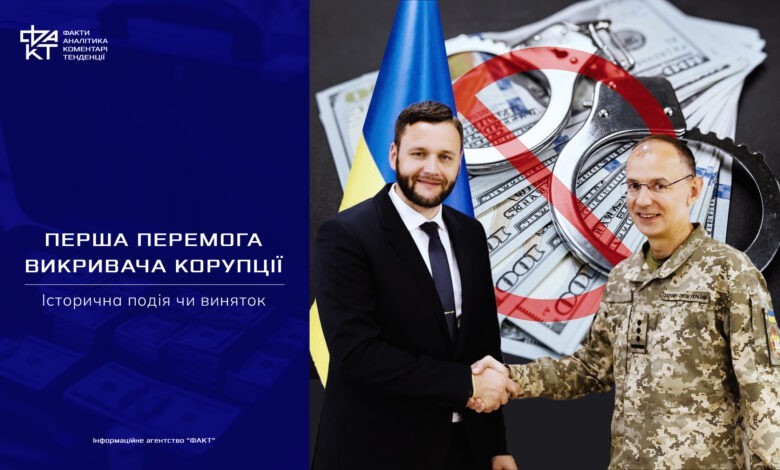
Corruption has long been one of the most acute problems of Ukraine, which citizens consider the main obstacle on the way to the successful development of the country and victory in the war. However, the fight against it remains declarative rather than effective. For the first time in five years after the introduction of the possibility of compensation for corruption whistleblowers, the court finally decided on its payment. There is only one solution — and it is against the background of numerous loud statements about the fight against corruption! Why is the whistleblower reward system in place since 2019 barely working? Did the tool, which should have become a powerful weapon in the war against bribers, gather dust for so many years due to indifference or fear of exposure on the part of the officials themselves?
Historic court decision
For the first time in the entire history of independent Ukraine, the court ruled in favor of a whistleblower, which is an unprecedented case in our country, where the fight against corruption often remains only on paper. An important precedent was the court’s decision to pay 1.68 million hryvnias to Andrii Boyko, an active serviceman who worked as the director of the internal audit department of the Ministry of Defense in 2020-2021. This decision is not only a reward for one brave person, but also a blow to the corruption system that has been eating away at state bodies for decades. The payment of this amount of reward shows that it is possible for whistleblowers to receive a fair reward, but the very fact that it happened only once and only now raises many questions.
In 2021, Andrii Boyko turned to the National Anti-Corruption Bureau of Ukraine (NABU) after he was offered a bribe of 24 million hryvnias for a positive audit of work performed in the interests of one of the enterprises. It was about a contract for more than 400 million hryvnias for the arrangement of a special facility of the Ministry of Defense. This contract could pave the way for further financing of the enterprise from state funds. However, Boyko, instead of covering up the fact of the crime or profiting, went against the system.
This case went through the consideration of the National Anti-Corruption Bureau (NABU) and the Specialized Anti-Corruption Prosecutor’s Office (SAP), but despite all the difficulties, the court of first instance in March 2023 refused to pay the reward. Reason? The whistleblower allegedly reported corruption as part of his official duties, which allegedly deprives him of his right to a reward. This decision caused indignation among the military and the public, because it was a clear injustice. However, Boyko did not give up. He appealed the decision to the High Anti-Corruption Court, and finally, on November 9, 2023, the court sided with him. The judges concluded that he was entitled to the reward, finding that the current law does provide for such payments even in cases where the whistleblowers are public officials. This decision was a real breakthrough in the fight against corruption.
Can it be considered a turning point for Ukraine? On the one hand, yes, this is an important step that should encourage other brave people to report corruption. On the other hand, the question remains open and extremely problematic.
Back in 2019, Ukraine introduced the possibility of paying compensation to whistleblowers, which was supposed to become an important tool in the fight against this phenomenon. The Law of Ukraine “On Prevention of Corruption” stipulates that the whistleblower can receive 10% of the monetary amount of the subject of the corruption crime or of the amount of damages caused to the state after the court’s conviction. However, in practice, the system works extremely slowly and faces many obstacles, and whistleblowers find themselves not only without reward, but also at risk of prosecution.
Why so? The answer lies not only in the complexity of law enforcement, but also in the scale of corruption, which eats away at all state bodies without exception. At the same time, whistleblowers, instead of receiving support and protection from the state, often become targets for attacks. Legal prosecutions, smear campaigns, burning down houses and even planting explosives under apartment doors are not fictions from movies, but reality for those who dared to oppose the system. And this is happening against the background of legislative changes that supposedly guarantee protection and reward to whistleblowers.
In September 2023, the Unified Whistleblower Portal began operating in Ukraine – a tool that gives citizens the opportunity to anonymously report facts of corruption. It has been joined by the National Police and the State Bureau of Investigation, which expands the circle of those who can expose crimes. It would seem that this has become a new stage in the fight against corruption, because the portal guarantees the confidentiality of messages. But does it really provide protection for whistleblowers, or will it just give corrupt officials a new way to find out who is behind the whistleblowers? The risks still remain high. Corruption whistleblowers become targets for retaliation not only from the corrupt officials themselves, but also from their connections in law enforcement agencies. In a country where corruption convictions remain rare, whistleblowers find themselves face-to-face with a system capable of destroying them.
Why are there no people willing to become whistleblowers?
One of the most acute reasons why corruption whistleblowers in Ukraine are still not properly protected is the weakness of law enforcement, as well as the systematic sabotage of these mechanisms by the state itself. The Ukrainian anti-corruption reform, which was supposed to be the driving force of changes after the Revolution of Dignity, has long since turned into a farce, where top officials only imitate the fight against corruption. At the same time, the NABU, SAP and other numerous anti-corruption bodies, which were supposed to expose corruption schemes, actually became hostages of political interests, where every step is coordinated with the ruling elites.
The recent case with the family of the head of the Khmelnytskyi regional center of MSEK, in whose apartment more than 5 million 244 thousand dollars, 300 thousand euros and more than 5 million hryvnias were found, is a rare exception in the context of the fight against corruption. Most corrupt people usually avoid exposure, but here she was unlucky, or maybe she didn’t share it with anyone. At the same time, such cases often end with the defendants being released after court proceedings, having paid bail, which is much smaller than the amount of illegal funds discovered. This allows them to avoid liability and keep a significant portion of their assets.
Despite numerous statements about the priority of anti-corruption reforms, in reality, higher state bodies remain the main obstacles on the way to real changes. Political will? These are just beautiful words, because it is these bodies that block the implementation of effective protection of whistleblowers, fearing to lose access to multibillion-dollar schemes and corruption streams. For them, corruption is not a problem, but a source of personal enrichment. The political elite in Ukraine continue to enrich themselves at the expense of corruption schemes, especially during wartime, so it is to their advantage that whistleblowers remain defenseless. None of those in power wants the system that allows them to “live comfortably” to be destroyed. No matter how the anti-corruption laws are declared, in practice they remain dead letters. The levers of power are firmly in the hands of those who use corruption as the main tool of the political game.
In addition, every attempt by whistleblowers to bring corrupt officials to light is met with the fact that state bodies either do not act at all or deliberately block cases. What does it look like in practice? Cases related to corruption revelations drag on for months or years. Whistleblowers remain without any protection and support, and the responsible authorities simply ignore their appeals. As a result, instead of fighting corruption, the bureaucratic machine actively protects it – either through inaction or through deliberate sabotage of processes. So it turns out that bureaucratic sabotage is not just passive inaction, but active opposition to any attempts to expose corruption.
Officials who should protect whistleblowers turn into their main enemies. The bureaucratic apparatus actually serves as a tool to destroy any efforts of whistleblowers. Complicated procedures, endless paperwork and deliberate delays in decision-making are just a few of the mechanisms used by the state apparatus to prevent whistleblowers from achieving their goals. Moreover, the lack of reaction to these revelations makes the situation even more dangerous: those who dare to challenge the corrupt system often risk not only their careers, but also their lives. So, instead of real changes, we see only demonstrative activity, which only increases the sense of hopelessness among those who have decided to expose corruption schemes.
However, one of the biggest problems for whistleblowers is the lack of a real protection mechanism against harassment. Although the law provides for anonymity and certain guarantees for whistleblowers, in practice this often does not work. Corrupt connections among representatives of law enforcement agencies, judges and local officials allow influencing the fate of whistleblowers. They often become victims of repression by those whom they have exposed. They throw explosives under their doors, burn down houses, and carry out discrediting campaigns. And all this against the background of the lack of proper investigation of such incidents. Impunity for those who threaten or abuse whistleblowers sends a signal to other potential whistleblowers that the system is not on their side and it is better to remain silent. Imagine what will happen to a subordinate who stole the illegal actions of his management! It is not difficult to guess the consequences.
The effective implementation of the provisions of the law on rewarding whistleblowers should become not just a formality, but a real weapon in the fight against corruption. Otherwise, no portals or laws will help if whistleblowers continue to risk their lives to fight corruption, without receiving either protection or fair compensation.
Particular attention should be paid to the problem of corruption ties in the law enforcement agencies themselves, which creates a serious obstacle to the fight against corruption at all levels. Employees of the police, prosecutor’s office, SBU and SBU, who are supposed to be on the front lines of the fight against corruption and protect whistleblowers, often find themselves involved in the very schemes they are supposed to fight against. This situation became possible due to the lack of effective control over the law enforcement agencies themselves. As a result, corruption in these structures becomes invisible to external supervision, and such individuals can act with almost impunity. Not only do they not conduct proper investigations into corruption cases, but they also deliberately sabotage them. The point is that whistleblowers themselves become targets, because corrupt law enforcement officials use their official position to put pressure on them. This can be expressed in the form of delaying the investigation, creating artificial obstacles to the trial, or even in open threats or discrediting.
This entanglement of interests between corrupt officials and law enforcement officers leads to the fact that even the most obvious cases of corruption can be closed, and the main culprits remain at large. In addition, unscrupulous law enforcement officers often become a tool to protect their “clients” — corrupt officials or businessmen, helping them avoid responsibility and keep illegally acquired assets.
Also an important aspect is the lack of proper internal control in the structures themselves. Internal security systems in law enforcement agencies are often formal and do not operate effectively. This allows employees involved in corruption schemes to keep their positions and avoid investigations. Therefore, corrupt connections in law enforcement agencies become not only a barrier on the way to justice, but also a powerful defense for corrupt officials, which actually nullifies all efforts to fight corruption at the systemic level.
Until the law enforcement system is cleared of such internal connections and until effective mechanisms for monitoring the actions of law enforcement officers are established, any attempts to fight corruption will only be indicative and will not lead to real changes.
At the same time, a significant obstacle on the way to justice for whistleblowers is the modern judicial system, which is particularly evident despite the reforms. Despite attempts to improve judicial processes, the courts remain under the strong influence of corrupt groups and political interests. This creates a huge problem for whistleblowers, because non-transparent legal processes and artificially prolonged proceedings deprive them of their chances for prompt and fair resolution of conflicts. Whistleblowers face the fact that their cases can drag on for years due to court maneuvers and bureaucratic obstacles. The judicial system, which is supposed to act quickly and objectively, is often used as a tool to delay cases, throwing off the balance of those who are trying to achieve justice. It is not uncommon for whistleblowers to lose faith in the system after lengthy court proceedings, which not only consume time, but also drain financial and moral resources.
In addition, formal reasons are often used to deny whistleblowers the rewards or protection they deserve. Cases like Andriy Boyk’s case, where the court refused to pay the reward due to minor technical formalities, only reinforce the impression that the judicial system works not to protect justice, but to the benefit of corrupt elites. Even in cases where the law is on the side of the whistleblowers, the courts often make decisions that play into the hands of corrupt groups, using minor legal nuances to delay the process or dismiss the lawsuit. As a result, instead of receiving rewards or protection, whistleblowers find themselves in a situation where their rights are not recognized and court decisions remain a formality.
So it turns out that the judicial system, which should be a guarantor of justice, actually becomes an additional barrier for those who dare to expose corruption schemes. As long as the courts remain under the influence of corrupt groups and the lack of real judicial reform continues to be a problem, justice for whistleblowers will remain an elusive goal.
For decades, Ukrainian society still struggles with an entrenched culture of impunity that prevails among officials and corrupt elites. Whistleblowers who dare to point to a crime often face a wave of backlash, and those they expose stay in their positions or find ways to avoid accountability. This undermines confidence in the anti-corruption reform as a whole and discourages others from reporting corruption. There is a growing opinion in society that fighting corruption is dangerous, and that it is not whistleblowers who benefit from this fight, but only those in power.
Under the conditions of institutional weakness and lack of political will, when the fight against corruption remains only a declaration, and bureaucratic sabotage, corrupt law enforcement agencies and ineffective courts inhibit any real changes, corruption in Ukraine will never be overcome. As a result, it will only strengthen its position, state resources will continue to be stolen, and society will finally lose faith in the possibility of justice. This will lead to an even greater decline of state institutions, when corruption will become the norm, and there will simply be no more people willing to expose it. Without effective protection of whistleblowers and active steps by the authorities, the system will continue its self-destruction, undermining the foundations of statehood and leaving the country in a closed circle of lawlessness and corruption.