“To restore the population, Ukrainian women should give birth to 7–8 children”: what model of Ukraine’s future is being promoted by grant-seekers

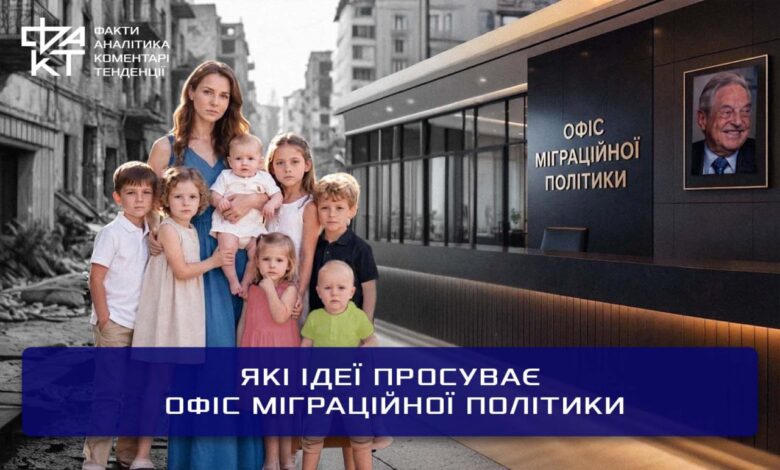
The head of the Migration Policy Office, Vasyl Voskoboynyk, stated that in order to restore the population, Ukrainian women should give birth to 7–8 children. The absurdity of this statement lies in how disconnected it sounds from the reality of a country that is experiencing a full-scale war, mass emigration, and economic exhaustion. At the same time, his other scandalous statements about the annual importation of hundreds of thousands of labor migrants from Asian countries and future “mestizo Ukrainians” attract no less attention. All this is combined into a coherent and rather alarming concept, in which the restoration of Ukraine is proposed to be solved not through the return of its citizens, economic development, and support for families, but through high birth rates and replacing the shortage of people with foreign labor. And here the question arises not only for Voskoboynyk himself, but also for the entire Migration Policy Office, which is financed by the Soros Foundation. What benefit do such structures bring to Ukraine if their public ideas increasingly sound senseless and dangerous.
Voskoboynyk’s statement on the level of fertility needed to restore Ukraine
The demographic crisis in Ukraine has worsened due to the war, mass migration, falling fertility and a reduction in the number of people of working age. Against this background, assessments are increasingly being made about whether the country can restore its population naturally and what levels of fertility would be needed for this. Head of the Migration Policy Office Vasyl Voskoboynyk commented on the demographic challenges faced by Ukraine on the air of the program “Superproposy” and explained why a simple return to pre-war indicators will not be enough for a quick restoration of the population.
According to him, if Ukraine is to not only compensate for the losses caused by war and migration, but also to approach the population size of the early 1990s, the birth rate should be extremely high.
“If we want to have as many children as possible, so that we can recover, so that the population returns to pre-war figures, even better — to the figure of 52 million, as we had at the time when Ukraine became independent, it is necessary for women to give birth to 7-8 children,” Voskoboynyk said.
At the same time, he admitted that such a scenario looks unrealistic. He asked whether modern society is capable of reaching a similar level of birth rate, and he himself answered that it is hardly possible.
In addition, the head of the Migration Policy Office emphasized that the problem of low birth rate is not exclusively Ukrainian. According to him, similar processes occur in many developed countries, even where there is no war, the economy is developing stably, and citizens have a sense of security. As an example, he cited Poland, where the birth rate is approximately at the same level as in Ukraine before the full-scale war: about 14 children per 10 women. At the same time, Poland is not experiencing hostilities, has stable economic growth and is under the protection of NATO.
Separately, Voskoboynik mentioned South Korea, where the birth rate situation is even more complicated. According to him, the indicators there are close to Ukrainian war realities: only 7-8 children are born per 10 women.
According to the head of the Migration Policy Office, low birth rate has become a global trend for developed countries. The higher the level of development of the state, the more often society faces a reduction in the local population.
Voskoboynyk’s rhetoric is not accidental: what his statements indicate
The Migration Policy Office (MPO), which positions itself as a structure for solving Ukraine’s migration problems and preserving the state’s human and labor resources, has increasingly found itself at the center of scandals in recent years due to the statements of its head, Vasyl Voskoboynyk. The organization declares that its goal is to preserve and develop Ukraine’s labor potential in the coming decades, as well as to attract labor migrants and talented people from other countries. Among its tasks, the MPO also mentions the preparation of specialized legislation through research, expert discussions and analytical work, which is supposedly based on facts, principles of non-discrimination and respect for human rights.
It is noteworthy that the Office of Migration Policy is financed by the International Renaissance Foundation (George Soros Foundation) and membership fees of intermediary companies in the field of international employment. The Office of Migration Policy openly indicates the Renaissance Foundation as its grantor and partner – we are talking about targeted micro-grants for holding press conferences, round tables, expert discussions and preparing texts of draft laws and program documents, in particular for the Strategy of the State Migration Policy of Ukraine until 2035. In Ukrainian realities, such analytical grants usually range from $10,000 to $40,000 per analytical project.
This is precisely why questions about a possible conflict of interest have long arisen around the activities of the Office of Migration Policy, because intermediary companies that are part of this environment directly earn money from international employment, document processing, licenses and commissions from employers. When representatives of such a structure begin to actively promote the idea of mass recruitment of foreign labor, critics naturally see this as the potential creation of a huge market for the personnel business.
At the same time, the recent absurd statement by Vasyl Voskoboynyk that in order to restore the population of Ukraine, women should supposedly give birth to 7–8 children each became particularly resonant. The scandalousness of this phrase lies in how disconnected it sounds from the reality of a country that is experiencing a full-scale war, mass emigration, economic exhaustion and a record drop in the birth rate. At the same time, Voskoboynyk does not talk at all about the economic development of the state, affordable housing, stable work, security conditions, support for families, the development of the system of educational institutions for children, medicine, tax incentives or long-term programs to support parenthood. That is, about everything that should stimulate people to have children and return to the country. It all boils down to the abstract statement that the birth rate should be unrealistically high, although the country has not created even the basic conditions for planning the future of Ukrainians.
Because of this, his position looks narrow, one-sided and superficial. It seems that they are trying to explain the causes of the demographic catastrophe only by global trends, although the situation in Ukraine is much more complex and dramatic than the problems of most developed countries.
The decline in the birth rate is indeed one of the main demographic trends of the 21st century. In demography, this process is called the demographic transition: agrarian societies are gradually turning into industrial and post-industrial ones, and at the same time the family model and people’s behavior are changing radically. Moreover, urbanization makes children not an additional labor force, as was the case in agriculture, but a source of large financial expenses.
The emancipation of women leads to the fact that they obtain higher education, build a career and become financially independent, which is why the birth of the first child is often postponed after 30 years. At the same time, access to medicine and contraception allows for family planning, and low infant mortality removes the old model of giving birth “with a margin”. Added to this is a change in values, as modern people increasingly focus on comfort, self-realization, travel, and quality of life. Social systems have also destroyed the traditional need to have many children to support their parents in old age.
All these factors have led to an aging population in many countries, a shortage of labor, and the growing dependence of economies on migration. Japan, South Korea, and most Western European countries have long faced a crisis of low fertility. However, Voskoboynyk’s attempt to present the situation in our country as an almost normal manifestation of a global trend looks manipulative. Ukraine is not a developed country in terms of income, social standards, or family support capabilities. Demographers have long described the current situation as a “demographic trap,” because the country has not managed to achieve the prosperity of Western countries, but has already acquired their model of low fertility.
The reasons for the decline in fertility in Ukraine are also radically different from those in Western Europe or South Korea. In rich countries, people postpone having children due to career priorities and a high standard of living. In Ukraine, the key factors were war, economic instability, low incomes, housing difficulties, mobilization, constant stress, the destruction of cities, and the mass emigration of millions of women with children abroad. This is a forced decline in fertility, not a consequence of the prosperous development of society.
The main difference is also that developed countries compensate for low fertility with high life expectancy and the attraction of migrants. In Ukraine, life expectancy is much lower, especially among men of working age, and the war has only exacerbated this problem. Western countries have the financial resources for powerful family support programs — large payments, tax breaks, affordable kindergartens, and social guarantees. The Ukrainian budget is exhausted by the war and is unable to provide a similar level of support.
That is why the statement of the head of the Migration Policy Office that low birth rate is a sign of Ukraine’s “development” looks not just incorrect, but frankly manipulative. It actually masks the depth of the crisis and allows one to shift responsibility from state policy to abstract “world trends.”
In addition, the absurdity of Voskoboynyk’s statements about “300 thousand migrants” and “mestizo Ukrainians” is no less surprising than his words about birth rate, since in this rhetoric the logic of replacing our population, rather than the policy of preserving Ukrainians, is increasingly evident. Voskoboynyk has repeatedly stated that due to low birth rate, Ukraine will have to import about 300 thousand labor migrants from Asian countries every year — India, Bangladesh, Nepal, and other states. The problem lies not only in the figure itself, which seems colossal for a country at war, but also in the fact that this concept is presented as an inevitable alternative to restoring its own population. In such logic, Ukrainians are written off in advance as a demographic resource that cannot be returned or retained.
His statement that in the future Ukrainians will become “mestizos” and, most importantly, that these people “simply pay taxes” caused an even greater resonance:
“Ukrainians can become mestizos — a mixture of Ukrainian and Indian. This will be our path. The main thing is that the people who come to us pay taxes and become part of our political nation.”
Such rhetoric became the point after which the discussion about migration went far beyond the economy and the labor market. These words sound like a cold technocratic formula in which issues of culture, identity, historical continuity, and the very concept of the Ukrainian nation are reduced to tax revenues and filling vacancies. While the country is experiencing the greatest demographic catastrophe in modern history, millions of citizens have left due to the war, and hundreds of thousands of people are fighting at the front, the Migration Policy Office is increasingly actively promoting the thesis of the mass import of foreign labor as the main scenario for the future.
It should be noted that the structure headed by Voskoboynyk is connected to the international employment market. As already noted, the Migration Policy Office is financed not only by grant structures, but also by membership fees of intermediary companies that earn money from labor migration. Because of this, the media has repeatedly accused Voskoboynyk, who has been a long-time representative and lobbyist of the Ukrainian personnel business, of promoting its interests. Mass labor migration is a huge market that has colossal profits from the processing of documents, permits, licenses, and commissions from employers. Therefore, the calls of the head of the Migration Policy Office for the annual importation of hundreds of thousands of foreigners are perceived not as “concern about demography in Ukraine,” but as an attempt to create a large-scale market for intermediaries, covering it up with rhetoric about “inevitable global processes” and a shortage of workers.
The official mission of the Migration Policy Office, which declares the preservation of Ukraine’s human resources, looks particularly contradictory. When a structure with such a name increasingly speaks about the need to import the population rather than about the return of its own citizens, the question naturally arises: where is the line between real demographic policy and promoting the interests of the migration business and its financial donors?
So, the question arises: why were such structures created in the first place, and what practical benefit did they bring to Ukraine? The latest statements and promotion of ideas unacceptable to our state by the Office of Migration Policy have only shown once again why grant structures like the Soros Foundation have created and supported such “expert” offices and analytical platforms for years. Under beautiful words about the restoration of Ukraine, migration policy and the development of labor potential, society is increasingly actively imposing the idea that mass emigration of Ukrainians, demographic extinction and replacement of the population with foreign labor is something natural and even inevitable.
Instead of the model of a state that fights for its development, the return of its own citizens, supports the birth rate and preserves the national human resource, grant-takers promote the logic of the global labor market, where the population is viewed as interchangeable labor material, and issues of culture, identity and the future of the nation are reduced to people “simply paying taxes”. Therefore, Voskoboynyk’s statements do not seem like his random personal opinion, but a completely organic continuation of the ideology that similar structures have been promoting for years under the guise of “expert” politics and “analytics.” Organizations that live on grant funds conscientiously work out the agenda of their donors, who, under the guise of “charity and support,” actively lobby for their political and economic interests.