
The Ministry of Education and Science has provided safety recommendations before the new school year: responsibility is again shifted to schools, not the ministry

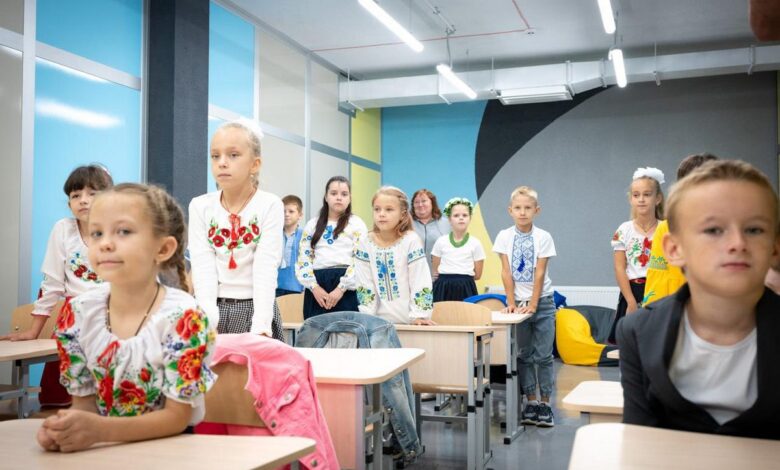
Ukrainian children are about to begin a new school year amid a prolonged, full-scale war, where air raid warnings, shelters, interrupted lessons, and learning to the sounds of explosions have long been part of everyday reality. For students entering first grade in 2022, normal face-to-face learning has never really become a familiar experience, while older students have spent much of their childhood between distance learning, shelters, and constant uncertainty. Despite the fifth year of war, the education system remains in a state of threat response, while the problem of a safe and stable learning environment for children of war has not been definitively resolved.
MES instructed to check shelters and preparedness for crisis situations
The Ministry of Education and Science sent educational institutions recommendations regarding preparation for the new 2026/2027 academic year. The officials focused on safety, the condition of shelters, preparedness for crisis situations, and work during martial law.
The ministry recommends that schools, colleges, and universities assess their own preparedness for possible emergencies during the academic year. First of all, attention should be paid to the safe educational process, infrastructure and technical condition of shelters.
Educational institutions are advised to modernize existing shelters or equip new ones. The documents specifically state that shelters must have water, ventilation, lighting, Internet access and first aid facilities. It also emphasizes the barrier-free nature of such premises so that children with disabilities and students with limited mobility can use them.
A separate block of recommendations concerns checking evacuation routes, fire safety and energy efficiency of buildings on the eve of the autumn-winter period. At the same time, the Ministry of Education and Science has not said a word about the participation of the ministry in this process, that is, officials again place all tasks on the leadership of educational institutions.
Children of war study between alarms and shelters for the fifth year
For Ukrainian schoolchildren, air raid alarms have long become part of the educational process. In many regions, lessons are regularly interrupted due to the threat of missile strikes, and some children spend several hours a day in shelters.
The situation remains particularly difficult in frontline regions and large cities that are regularly attacked. There, children are forced to study in conditions of constant psychological stress, where even a normal school day depends on alarms, power outage schedules, and the security situation.
During the years of war in Ukraine, a generation of children has been formed for whom distance learning, sheltering in basements, and lessons in corridors have become a familiar part of school life. Some students have lost the opportunity to fully communicate with their peers, a stable learning rhythm, and a normal emotional environment.
After numerous attacks on civilian infrastructure, the issue of shelters has actually become crucial for the operation of schools. In many communities, the availability of a shelter determines whether an institution will be able to operate offline. Because of this, schools have been forced to rebuild premises, re-equip basements, seek funding for ventilation, generators, furniture and basic conditions for children to stay underground for a long time for several years. Some institutions still operate in a mixed format, since old buildings do not have shelters or do not meet safety requirements. At the same time, the Ministry of Education and Science in its new recommendations advises institutions to use the self-assessment system “My Fortress”, which helps to check the readiness of shelters for the educational process.
The problem remains uneven across the country
The situation with school safety differs significantly depending on the region. While some communities were able to modernize shelters and return children to full-time education, in other regions schoolchildren continue to study remotely or in a mixed format due to the high risk of shelling.
A separate problem remains the psychological state of children. Long-term life in war conditions, constant stress, air alarms and instability of the educational process affect the concentration, motivation and emotional state of students. At the same time, the education system is largely focused on technical security issues – shelters, generators, evacuation and autonomous power supply.
According to the Ministry of Education, the recommendations provided should help educational institutions prepare for the new school year in conditions of martial law and possible crisis situations during the cold period. The ministry actually recognizes that the security component will continue to determine the format of education in many regions.
For schools, this means new inspections of shelters, assessment of the condition of buildings, preparation for power outages and organization of work in conditions of possible attacks. For children of war, this means another school year in which safe shelter remains as important a part of school as the classroom, textbooks and lessons.


