The right to leave during martial law: which labor law provisions did the Constitutional Court declare unconstitutional?

The issue of granting vacations during martial law has become one of the most controversial in labor relations in recent years. The law allowed employers to limit the duration of paid vacations, carry over unused days, and in some cases provide them without saving wages, which in practice often makes the employee completely dependent on the employer’s decision.
Lawyers from the law association “Repeshko and Partners” explained how the decision of the Constitutional Court of Ukraine affects the application of the norms of the Law of Ukraine “On the Organization of Labor Relations under Martial Law”, which provisions have lost force, and how the right of employees to annual paid vacation should now be implemented.
In modern realities, reference to martial law often becomes an explanation for restrictions that seemed exceptional a few years ago. Holidays no longer mean automatic days off, employees in certain areas, in particular, utilities, often work with excessive workloads, and the issue of rest is increasingly being pushed to the background. Many such decisions indeed have a logic dictated by security, the needs of the state and the work of critical areas, but this does not mean that any restriction of labor rights can remain beyond constitutional assessment.
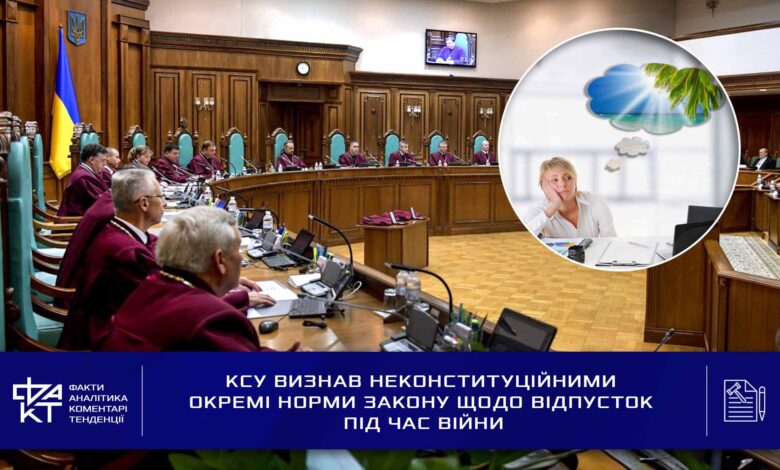
Therefore, the Commissioner for Human Rights of the Verkhovna Rada of Ukraine appealed to the Constitutional Court of Ukraine with a submission on the compliance with the Constitution of Ukraine, i.e. the constitutionality, of the provisions of Article 12 and the section “Final Provisions” of the Law of Ukraine “On the Organization of Labor Relations under Martial Law” regarding the right to vacation. Based on the results of consideration of this submission, the Constitutional Court of Ukraine adopted a decision on May 19, 2026.
The Law stipulates that “by decision of the employer, unused days of such vacation may be granted without saving wages.” It is also stipulated that “during the period of martial law, the granting to an employee of any type of leave (except for leave in connection with pregnancy and childbirth, leave to care for a child until he reaches the age of three and leave in connection with the adoption of a child) in addition to the annual basic leave provided for in paragraph one of this part, by the employer’s decision, may be carried out without saving wages. The granting of unused days of such leave shall be postponed to the period after the termination or cancellation of martial law. By the employer’s decision, unused days of such leave may be granted without saving wages.”
In addition, the Law establishes that certain norms regarding transferred leaves will continue to apply even after the termination or cancellation of martial law — until the moment when employees actually use the days of leave that were transferred. That is, the law allows the rules to remain in force, according to which unused vacation days could be carried over to the future period and granted without salary even after the end of martial law.
According to the Commissioner for Human Rights of the Verkhovna Rada of Ukraine, the problem was that the contested provisions of the Law could be read very broadly – and it was precisely such a literal reading that actually gave the employer significant scope for decisions not in favor of the employee. In particular, the employer could “unilaterally limit the provision of annual basic leave to 24 calendar days for the current working year”, “transfer to the period after the termination or cancellation of martial law unused vacation days during martial law”, “grant unused vacation days exceeding 24 calendar days without salary”, apply an approach under which “unused days of such leave may be granted without salary after the termination or cancellation of martial law – until the use of the vacation days that were transferred”, and also “deny the employee from granting unused days of annual leave during the period of martial law”.
For the employee, this situation seemed particularly problematic, since it was not about imaginary risks, but about the very real consequences of applying the law. If the employer referred to these provisions, it was difficult for the employee to object: formally, the corresponding possibility was indeed contained in the legislation. That is why these norms could work as a unilateral advantage for the employer – he received the right to decide when and to what extent the employee would take the leave, as well as whether it would be paid.
When considering the Ombudsman’s submission, the Constitutional Court of Ukraine drew attention to the general rule enshrined in Article 64 of the Constitution of Ukraine: “constitutional rights and freedoms of man and citizen may not be restricted, except in cases provided for by the Constitution of Ukraine”. The Constitution of Ukraine also provides that “in conditions of martial law or a state of emergency, certain restrictions on rights and freedoms may be established, indicating the period of validity of these restrictions. The rights and freedoms provided for in Articles 24, 25, 27, 28, 29, 40, 47, 51, 52, 55, 56, 57, 58, 59, 60, 61, 62, 63 of this Constitution may not be restricted”.
In this matter, it is important that the Constitution of Ukraine guarantees the right to rest to everyone who works. This is provided for in Part One of Article 45 of the Constitution of Ukraine. The Constitutional Court of Ukraine considered this right not in isolation, but together with the right to work and other labor rights. In previous decisions, the Court has already noted that the Constitution of Ukraine, “recognizing the importance of the right to work as the basis of human life,” enshrines and guarantees the basic labor rights of citizens, provided for in Articles 43, 44, 45, 46 of the Constitution of Ukraine. The Court also emphasized that the content of the right to work includes not only the ability to freely choose work, but also appropriate guarantees for the implementation of this right, in particular, the right of a working person to proper, safe and healthy working conditions, decent wages, rest days, vacation, etc.
It should be noted that the Constitutional Court of Ukraine linked the right to rest with the right to work: if a person works, he must not only perform labor duties and receive wages, but also have a real opportunity to restore his strength. The right to work, in accordance with parts 1, 2 and 4 of Article 43 of the Constitution of Ukraine, includes the opportunity for everyone to earn a living by work that he freely chooses or to which he freely agrees, the obligation of the state to create conditions for the full exercise of this right by citizens, as well as the right of everyone to proper, safe and healthy working conditions and to wages not lower than those established by law.
It follows from this that working conditions must be not only safe and healthy, but also fair. This includes, in particular, reasonable limitations on working hours and sufficient rest. The Constitutional Court of Ukraine emphasized that rest is needed not as a formality in the work schedule, but as a means of protecting a person from the negative impact of excessive work on his health and life, as well as as a condition that promotes labor productivity.
In view of this, the Constitutional Court of Ukraine noted that a humanistic model of labor is established at the constitutional level. Its content is that work should not absorb a person’s entire life, but should be combined with personal time, recovery and a normal existence outside of work. This is precisely the basis of the principle of balance between work and personal life, that is, work-life balance, which the Court called the fundamental value of modern labor law and the foundation of European international standards in the field of labor, in particular regarding the right to rest.
In its decision, the Constitutional Court of Ukraine also noted that the right to rest, like the right to work, is inherent in human nature. A person cannot work continuously to ensure his or her livelihood, since after performing work duties, he or she needs time off from work to restore physical and moral strength. Such rest prevents overfatigue, exhaustion, professional burnout, chronic diseases and shortening of life expectancy. Therefore, the right to rest not only creates conditions for high-quality and sustainable work, but above all contributes to the preservation and strengthening of a person’s health and ensures a balance between his or her professional activity and personal life.
Examining the content of Article 45 of the Constitution of Ukraine, the Constitutional Court of Ukraine drew attention to the fact that the right to rest is not limited to a general declaration about the possibility of a person to rest. The Constitution of Ukraine directly determines what guarantees this right is ensured by. This concerns the provision of weekly rest days, paid annual leave, the establishment of a shortened working day for certain professions and industries, as well as a shortened duration of work at night. In addition, it is the law that should determine the maximum duration of working hours, the minimum duration of rest, the duration of paid annual leave, weekends and holidays, as well as other conditions for exercising the right to rest.
In fact, the Constitutional Court of Ukraine emphasized that such guarantees cannot be determined arbitrarily or depend only on the decision of the employer or the current situation at the enterprise. The Constitution of Ukraine requires that both the content of these guarantees and their minimum amount be enshrined in law. Separately, the Court emphasized that paid annual leave is one of the main constitutional guarantees for the realization of the human right to rest. That is why the legislator is obliged to determine the procedure for its provision, minimum duration and mandatory remuneration. In other words, an employee must have a legally guaranteed minimum period of time during which he is released from work duties and at the same time retains his salary.
In addition, the Constitutional Court of Ukraine also drew attention to the fact that the paid nature of annual leave is its integral feature. Without the preservation of wages, such leave can no longer fully fulfill its function as a constitutional guarantee of the right to rest. The court effectively stated: a person should not be faced with a choice between rest and loss of income. In addition, payment for vacation time is considered a fair remuneration to the employee for the work performed and as a component of the salary guaranteed within the framework of the exercise of the right to work.
In substantiating its decision, the Constitutional Court of Ukraine referred not only to the Constitution of Ukraine, but also to international standards in the field of labor, in particular to the International Labor Organization Convention No. 132 of 1970 concerning paid holidays, which Ukraine ratified in 2001. According to Article 3 of this Convention, “every person to whom this Convention applies is entitled to annual paid leave of a minimum duration,” and the leave itself “shall in no case be less than three working weeks in one year of work.” The Convention also provides for the possibility of establishing a longer leave.
The Court drew special attention to the provisions of Article 7 of Convention No. 132, according to which an employee must receive at least his normal or average wage during the leave. At the same time, the amounts payable during the leave must be paid before its commencement, unless otherwise agreed between the employee and the employer.
The provisions of the Convention also imply that annual paid leave can be divided into parts, but one of them must last continuously for at least two working weeks. At the same time, international norms prohibit agreements on the employee’s refusal to take the minimum annual paid leave or replacing such leave with monetary compensation. Payment of compensation for unused annual paid leave is allowed only after termination of employment.
At the same time, the Constitutional Court of Ukraine drew attention to the fact that the law of the European Union and the acts of the Council of Europe provide for an even higher minimum standard for employees – at least four weeks of annual paid leave.
Summing up the above, the Constitutional Court of Ukraine noted that Ukraine, given its constitutional course towards European integration and the international obligations it has undertaken in the field of labor rights, must provide employees with minimum standards of the right to rest. That is why labor legislation must guarantee every employee the right to annual paid leave of at least three weeks, and in the future – with the possibility of increasing this standard.
Taking this into account, the Constitutional Court of Ukraine recognized as not complying with the Constitution of Ukraine, that is, as unconstitutional, certain provisions of the Law of Ukraine “On the Organization of Labor Relations under Martial Law”. In particular, the provision of the second sentence of the paragraph of the second part of the first article 12 of the Law of Ukraine “On the Organization of Labor Relations under Martial Law” of March 15, 2022, as amended, was declared unconstitutional in that part in which it did not provide persons under the age of eighteen and persons with disabilities with paid annual basic leave, the minimum duration of which exceeds 24 calendar days. This is a norm according to which “by the decision of the employer, unused days of such leave may be granted without saving wages”. It was this norm that the Constitutional Court of Ukraine declared unconstitutional.
The provisions of the second paragraph of paragraph 3 of the section “Final Provisions” of the Law of Ukraine “On the Organization of Labor Relations under Martial Law” of March 15, 2022, as amended, were also declared unconstitutional. In this case, we are talking about a provision according to which the Law is effective during the period of martial law and ceases to be valid after its termination or cancellation, except for certain provisions of Article 12, which were to remain valid until the use of vacation days transferred to the period after the end of martial law. The Constitutional Court of Ukraine concluded that this provision also does not comply with the Constitution of Ukraine.
It is important to know that the provisions of the Law, which the Constitutional Court of Ukraine declared unconstitutional, ceased to be valid from the date of adoption of this decision.
Therefore, we advise employees not to perceive martial law as an automatic reason for losing the right to paid vacation, and employers to carefully review their practice of granting vacations and not to apply legislative restrictions more broadly than the Constitution and the decision of the Constitutional Court of Ukraine allow.