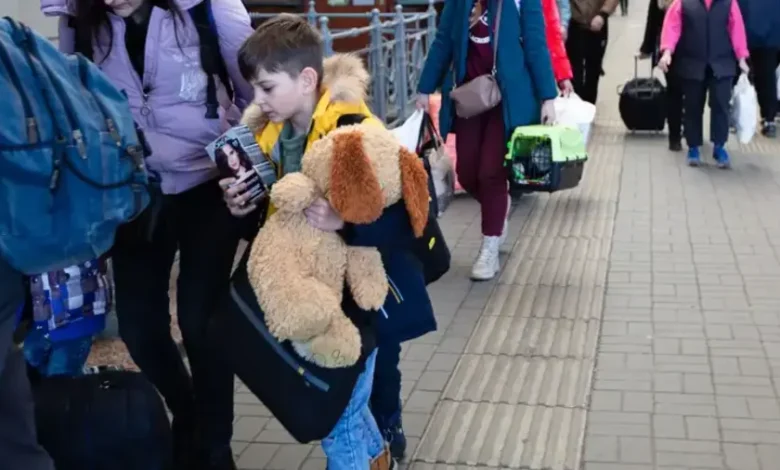
Dnipropetrovsk region, which after the start of the full-scale war became one of the main regions that accepted internally displaced persons, found itself at the center of a new social problem. Thousands of children from displaced families may be left without the promised assistance of 3,000 hryvnias due to criteria that turned out to be unattainable for many families from occupied and front-line territories.
What the new resolution provides
The government resolution, which was expected to simplify the return of payments, opened the other side of the solution, because the right to money was made dependent on the date of departure, the family’s property status and documents about destroyed or uninhabitable housing.
On March 18, 2026, the Cabinet of Ministers adopted resolution No. 390, which was supposed to open the way to payments to IDP children in the amount of 3,000 hryvnias regardless of the parents’ income. However, along with the declared restoration of assistance, the document introduced a system of requirements due to which a significant part of families risk falling off the list of recipients.
To be eligible for payment, a family must meet three conditions at the same time. The first one concerns the date of relocation: those who left after January 1, 2022 are eligible. The second one requires documentary confirmation that the housing is destroyed or uninhabitable. The third one concerns the property status of the family, which should not have bank deposits or large purchases worth more than 100 thousand hryvnias.
Why families from the occupied territories found themselves in a dead end
The most acute problem for IDPs who settled in the Dnipropetrovsk region after evacuation from frontline areas and temporarily occupied territories is related to confirming the condition of their housing. For many families who left Mariupol, Berdyansk, occupied parts of Zaporizhzhia and Kherson regions and live in Dnipro, Pavlohrad or Kryvyi Rih, it is simply impossible to collect such documents, since they do not have access to their homes.
The statement of the Minister of Social Policy, Family and Unity of Ukraine, Denys Ulyutin, only exacerbated this problem, because there is actually no mechanism for confirming the condition of real estate in the temporarily occupied territories. In his official statement, Denys Ulyutin actually admitted that the requirement to confirm the destruction or unsuitability of housing for displaced persons from the temporarily occupied territories rests on the absence of a real mechanism for such verification.
For families who left their homes under occupation and left for the Dnipropetrovsk region, this creates a situation in which the child’s right to payment depends on a document that cannot be obtained without access to the object itself. Because of this requirement, families who left their homes during hostilities or occupation find themselves in a situation where the support promised by the state depends on documents that they cannot obtain in wartime conditions.
How many children could be left without assistance
For the Dnipropetrovsk region, the consequences of this rule are of particular importance, since the region remains one of the largest centers for receiving displaced persons in Ukraine. According to the Ministry for Reintegration of Temporarily Occupied Territories, more than 450 thousand IDPs are officially registered here, a significant number of whom are children.
Preliminary estimates indicate that tens of thousands of children may lose their right to social assistance due to the current restrictions. For many families who have left the occupation or active combat zones, the problem is not a separate bureaucratic procedure, but the monthly support on which daily life after forced relocation depends.
What changes require revision
After a wave of indignation, the issue of the criteria of Resolution No. 390 was raised to the level of the Cabinet of Ministers and the President’s Office, People’s Deputy Pavlo Frolov appealed to the First Deputy Prime Minister – Minister of Economy Yulia Svyrydenko with a demand to revise the conditions for calculating payments.
Among the key proposals are the abolition of mandatory confirmation of the destruction of housing for those whose property remained in the temporarily occupied territories, the expansion of the circle of recipients to all children of IDPs displaced since 2014, as well as the simplification of verification through the automatic use of data from the Register of Damaged and Destroyed Property.
During the meeting chaired by Deputy Head of the President’s Office Iryna Vereshchuk, the participants agreed on the need to urgently change the government decision. The relevant departments have been tasked with preparing a mechanism that will allow the restoration of children’s rights without additional barriers for families who have lost their homes or left them in the occupied territories.
For a region that already spends significant resources on the reception and adaptation of displaced persons, the delay in such changes means new pressure on local budgets and charitable structures. At the center of this situation remain children, for whom the promised payment turned out to be dependent on criteria that, in war conditions, turned out to be unattainable for many families.