
Seven years after Volodymyr Zelenskyy’s inauguration: have the president’s promises made during his encouraging speech been fulfilled?

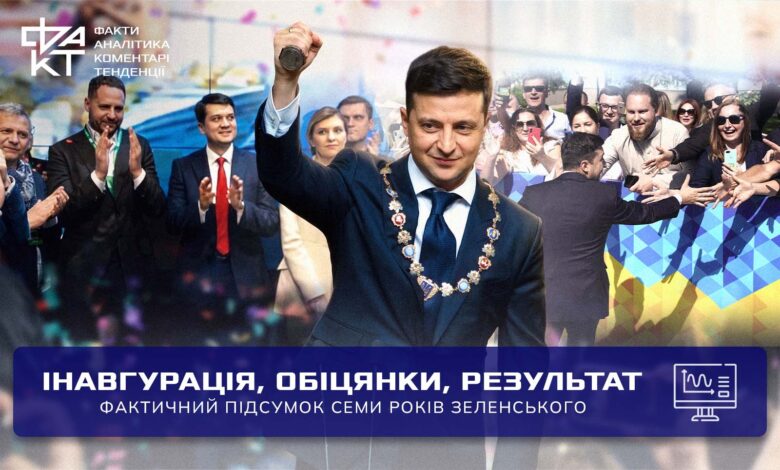
Seven years have passed since Volodymyr Zelenskyy was inaugurated — enough time to assess the results of the promises he made during his speech from the parliament rostrum. In 2019, 73% of Ukrainians voted for him, because society was tired of old politicians, corruption, war, poverty, and the feeling that the state has been living separately from the people for years. The new president came to power as a symbol of great hopes and expectations. He promised an end to the war, the return of Crimea, a different style of governance, “landings” and overcoming corruption, the end of the era of poverty, and officials who listen to citizens. Have these promises been fulfilled? Have the lives of Ukrainians changed for the better? The answers to these questions are analyzed objectively, based only on facts, decisions, and consequences, not political sympathies.
Volodymyr Zelensky’s inauguration ceremony: a historical excursion
On May 20, 2019, Volodymyr Zelenskyy was inaugurated, which took place according to an unconventional scenario. Instead of the expected ceremony with diplomatic smiles and restrained speeches, the country saw a speech after which the political system literally shuddered. During the inaugural speech, the new president actually pointed to the door of the government, called for resignations and announced the dissolution of the Verkhovna Rada of the eighth convocation. The solemn meeting, which usually turns into a state ceremonial with clearly defined roles, that day resembled a place of open political conflict.
The inauguration was held with increased security, an honor guard, fanfare, diplomatic delegations and a thousand invited guests. Ukrainian politics, which had been living for several months as an election campaign by a showman with no political experience, found itself in a situation where every gesture and every word of the new head of state carried great weight. According to protocol, all former presidents of Ukraine were invited to the ceremony, except for Viktor Yanukovych. In addition, five presidents of other states and representatives of the governments of all neighboring countries, except Russia, were present in the hall. The atmosphere of international attention was felt very clearly: for some European politicians, it was an attempt to understand what the new head of state would be like after a loud election campaign, and for the Ukrainian political elite, it was a day of forced acquaintance with a person who, a few years ago, remained for them exclusively a television character.
The presence of Zelensky’s parents attracted particular public attention, because before that, presidents appeared at inaugurations mainly with their wives. This detail changed the atmosphere of the ceremony: the procedure took on the features of a family event, although the political tension in the session hall did not become less.
During the performance of the national anthem, Zelensky was visibly nervous, and when the choir performed “Prayer for Ukraine,” it was difficult to hide the emotions on his face. Next came the main part of the ceremony — the presidential oath. After it, Volodymyr Zelensky received the symbols of power: the mace, the seal, and the presidential certificate. It was at this moment that an unfortunate incident occurred that instantly spread across the news and social networks: the certificate slipped off the pillow held by a soldier of the honor guard and fell to the floor. The document was quickly picked up, and Zelensky apparently did not even notice this episode. For a country where symbolism in politics has always been of excessive importance, the fall of the presidential certificate instantly turned into a subject of lively discussions and searches for hidden signs.
However, the main surprises began during the speech. Zelensky spoke about Europe, which, according to him, should not be somewhere abroad, but in Ukrainian heads. He appealed to Ukrainians abroad with a proposal to return and participate in state building if they are ready to bring with them experience and values. Such theses sounded like an attempt to show himself as a politician of a new generation, who speaks not in the language of the old bureaucracy, but through emotion and direct contact with society.
The moment when Zelensky turned to the topic of war attracted the greatest attention of society. He called the ceasefire in Donbas the very first task and stated that he was ready to make difficult decisions, lose popularity and even his position for the sake of peace, but separately emphasized: there will be no concessions in terms of territories. This part of the speech caused applause under the dome of the parliament, although among politicians there were enough of those who listened to the new president with obvious skepticism.
Speaking about the residents of the occupied territories, Zelensky switched to Russian, stating that in previous years the authorities had not done enough to make people there feel like Ukrainians. It was then that Oleh Lyashko exclaimed from the spot: “They understand Ukrainian!” Zelensky responded instantly and quite sharply, thanking Lyashko for “continuing to divide people.” After that, the hall erupted in applause again. This short skirmish very accurately demonstrated the change in political style: instead of the usual official restraint, the new president chose a public confrontation right during a solemn session of parliament.
The part of the new president’s speech devoted to the government and security forces sounded even harsher. Zelensky demanded the resignation of the head of the SBU, the Prosecutor General, and the Minister of Defense, and also sharply criticized the Cabinet of Ministers for inaction and bad roads. He advised government officials to write resignation letters and make way for people who will think not about the next elections, but about the next generations.
The reaction of the government members was indicative – the ministers smiled skeptically, Prime Minister Volodymyr Groysman shrugged his shoulders, and after the ceremony, some government officials openly demonstrated their disagreement with such statements. Minister of Social Policy Pavlo Rozenko spoke about political games and emphasized that the decision to resign still depends on the Verkhovna Rada. Minister of Defense Stepan Poltorak immediately after the celebrations submitted his resignation letter, ending it with the words “I have the honor.” Minister of Foreign Affairs Pavlo Klimkin also announced that he did not plan to remain in office, although he noted that Zelensky had offered him to continue working.
Then Zelensky called on the deputies to adopt a law on the abolition of parliamentary immunity, restore criminal liability for illicit enrichment, and adopt an electoral code within two months. After that, a phrase was uttered that instantly overshadowed all previous statements: “I am dissolving the Verkhovna Rada of the eighth convocation.” For the deputies, this sounded like a political blow during the inauguration, with part of the hall applauding, while others reacted coldly or confusedly. The speaker of the parliament, Andriy Parubiy, ended the meeting with the phrase: “It was fun!”, and there was much more nervous sarcasm in these words than humor.
In addition, a separate symbol of that day was Volodymyr Zelenskyy’s route after the inauguration ceremony. He walked to the Presidential Administration on Bankova Street, talked and took pictures with people who joyfully greeted him along the way, and even gave flowers to a female patrol officer. This behavior of the new president sharply contrasted with the usual restrained style of Ukrainian presidents, who traditionally distanced themselves from the crowd with motorcades, security, and closed routes.
The inauguration on May 20, 2019 was remembered not only for the festivities, lively congratulations, but also for surprises. The main effect of this event was that Zelensky used the ceremony as a tool for an instant political offensive. On a day when people usually talk about unity and state continuity, the new president immediately declared war on the old political system from the rostrum of parliament.
Zelensky’s speech that impressed and inspired Ukrainians
Volodymyr Zelensky’s inauguration speech was constructed unconventionally, as an attempt to immediately redistribute responsibility between the authorities, society, the army, parliament, and the government. He began with a personal story about his six-year-old son, who after the elections heard on TV that Zelensky had become president, and joked that then he too became president. From this homely remark, Zelensky derived the main idea of his speech: according to him, every citizen of Ukraine should feel like a president, regardless of whether he voted for him or not. “Each of us is a president,” the new head of state emphasized.
This beginning was strong not because of sentimentality, but because of a political reception. Zelensky immediately went beyond his 73% of supporters and declared that his victory in the elections belonged to all Ukrainians. In this way, he tried to remove the flavor of division into winners and losers from the elections, although the country remained emotionally heated after the election campaign. The phrase about 100% of Ukrainians sounded like an attempt to speak not to his own electorate, but to the entire country, including those who did not trust the new president or were wary of him.
Volodymyr Zelensky then developed the idea of a joint oath. He emphasized that he was not the only one who put his hand on the Constitution, because every Ukrainian, in his opinion, also swore allegiance to the state. Then he gave several imaginary newspaper headlines: the president does not pay taxes, the president ran a red light while drunk, the president steals a little because everyone does it. These examples were built on a sharp approximation of a high-ranking state position to the daily behavior of an ordinary person. Zelensky actually showed that responsibility for the state of the country lies not only with the authorities, but also with each citizen through his daily actions. He emphasized that changes in the state begin with personal honesty, law-abidingness, and people’s conscious attitude towards society: “From today, each of us is responsible for the country that we will leave to our children. Each of us, in our place, will be able to do everything for the prosperity of Ukraine. A European country begins with everyone.”
One of the central promises of the new president was the idea of a European Ukraine without empty imitation of foreign signs. Zelensky said that the path to Europe had already been chosen, but Europe must appear first of all in the way of thinking. He did not outline a detailed program of reforms, but he tried to translate the topic of European integration from diplomatic language to the plane of behavior: honesty in rules, respect for the law, responsibility in small things, a different level of interaction between people.
After that, the speech turned to pain, which was impossible to avoid. Zelensky said that every Ukrainian died in Donbas, everyone is an IDP and everyone is a migrant worker. There was a lot of emotional generalization in these phrases, but they worked as an attempt to gather the country’s various traumas into one common story. IDPs who lost their homes, people who welcomed them in their own homes, migrant workers who left because of poverty, families of military personnel, residents of peaceful cities — he tried to fit everyone into one political community.
At the same time, Zelensky separately emphasized that Ukrainians are not divided into big and small, right and wrong. He named cities and regions from Uzhhorod to Luhansk, from Chernihiv to Simferopol, mentioned Lviv, Kharkiv, Donetsk, Dnipro and Odessa. In this geography, it was not the enumeration that was important, but the desire to return to a single linguistic and political map the territories, some of which were already under occupation. The new president’s speech did not hide the losses, but did not recognize them as final.
A separate part of the speech was addressed to Ukrainians abroad. Zelensky stated that there are 65 million Ukrainians in the world, and called on those born on Ukrainian soil to return not to visit, but to return home. He promised to gladly grant citizenship to those who are ready to build a new, strong and successful Ukraine. From the diaspora, he asked not for souvenirs, but for knowledge, experience and mental values. This promise sounded like an attempt to turn Ukraine’s dispersion around the world from a sign of loss into a resource for the state’s development.
However, the most important promise of the new head of state was made in the part of his speech about the war. Zelensky impressively called the ceasefire in Donbas his first task. He declared that he was ready to make difficult decisions, to lose popularity, ratings, and even his position, if only peace would come. However, alongside this readiness, a hard line was sounded: peace cannot mean the loss of Ukrainian territories. This formulation combined the expectations of millions of people who were tired of the war and the fear of society before any concession to the aggressor.
Zelensky admitted that Ukraine did not start this war, but it is Ukraine that will have to end it. He called the return of all Ukrainian prisoners of war the first step towards dialogue. It is significant that he expressed part of this thought in Russian. This was a conscious gesture towards the people in the occupied territories and Russian-speaking Ukrainians, although in the parliamentary hall such a transition immediately became politically sensitive.
At the same time, Zelensky presented the issue of Crimea and Donbas not as a problem of “lost territories”, because, according to him, one cannot lose what belongs to Ukraine. He emphasized that Crimea and Donbas are Ukrainian land, but he called the most important loss people. In this fragment of the speech, the emphasis shifted from the map to consciousness. Zelensky said that it is necessary to return the sense of belonging to Ukraine, because the people there are not strangers, they are Ukrainians.
Zelensky’s phrase about passports sounded especially sharp. He stated that anyone can give out at least ten passports, but this will not change anything, because a Ukrainian is defined not by a document, but by what a person has inside. In the context of Russian passportization in the occupied territories, this thesis was not just emotional, but political. She contrasted the Ukrainian understanding of citizenship with Russia’s legal pressure.
The appeal to the military also became a separate block of the new president’s promises. Zelensky said that he knew about unity at the front from the fighters who defend Ukraine, regardless of whether they speak Ukrainian or Russian. He emphasized that there is no strife and discord on the front line, but there is courage and honor. For the defenders, he promised respect not in ritual phrases, but in concrete things: decent and stable financial security, housing conditions, legal leave after combat missions, rest for the military and their families.
In the same fragment, Zelensky said that NATO standards should not just be mentioned in speeches, but should be implemented in practice. His opinion was directed against the Ukrainian authorities’ habit of covering themselves with the right words without sufficient content. For the army, this meant demanding that the state change not its rhetoric, but its conditions of service, management, support, and attitude toward the military as a person, not as a resource.
After the war, Zelensky moved on to social problems, which he called the causes of Ukrainian misery. This list included shocking tariffs, humiliating salaries and pensions, painful prices, a lack of jobs, medicine, the improvement of which is often talked about by those who have not been to an ordinary hospital with a child, as well as roads that, he said, exist mostly in someone’s imagination. This block was aimed at the everyday experience of people for whom the state had remained a source of irritation and humiliation for years.
At the same time, the harshest attack was directed at the government. Zelensky quoted an American actor who became US president, with the idea that the government often does not solve problems, but is itself a problem. After that, he addressed the Cabinet of Ministers and said that he did not understand the government, which only throws up its hands and claims that it cannot do anything. The new president suggested that government officials take a piece of paper, a pen and write resignation letters in order to free up space for those who will think about the next generations, and not about the next elections.
At the same time, a separate blow was directed at the old political system. Zelenskyy said that Ukrainians are tired of experienced, systematic, arrogant politicians who, over 28 years, have created a country of opportunities for kickbacks, flows and deribans. This was one of the most acute parts of the speech, because it did not simply criticize a separate government or parliament, but questioned the moral right of an entire generation of politicians to continue to govern the state.
Against this background, his promise to build a country of other opportunities was heard – with equality before the law and transparent rules for everyone. It was presented without a complex legal structure, but it had a clear political content: people voted for Zelensky as a chance to escape from a system where access to justice, money, and state decisions often depended on connections. His victory, according to the logic of the speech, was supposed to prove that society was ready to let people from outside the old political corridors into power.
In his speech, Zelensky also reminded the people’s deputies that they had scheduled the inauguration for Monday, a working day, and saw this as a sign of readiness to work. After that, he put forward a specific list of demands: to adopt a law on the abolition of parliamentary immunity, to restore criminal liability for illicit enrichment, and to adopt an Electoral Code with open lists. The abolition of immunity was supposed to show the equality of deputies with citizens. Responsibility for illicit enrichment concerned trust in anti-corruption policy. The electoral code with open lists was supposed to change the way people got into parliament, and the resignations of the heads of the power and defense bloc demonstrated the new president’s desire to quickly reformat the key centers of power.
It is also worth remembering Zelensky’s final words, when he said that throughout his life he had tried to do everything to make Ukrainians smile, and now he would do everything so that they would at least not cry anymore. In this phrase, one could feel the transition from artist to president, from stage to office, from laughter to responsibility. His speech was sharp, emotional, and theatrical in places, but the main thing in it was a set of promises to society that touched on almost every major pain of the country: war, prisoners, army, poverty, tariffs, medicine, roads, corruption, parliament, diaspora, and trust in the government.
Did Zelensky fulfill his promises after being tested by the government
Ukrainians really believed in the fulfillment of the promises made by the president. After seven years of Volodymyr Zelensky’s presidency, it is clear that some of his promises have been fulfilled, but the loudest and most painful points with which he came to power have remained unfinished or failed. It should be noted that the full-scale war has dramatically changed state priorities, but it does not cancel the need to honestly divide the promises into two parts: what has actually been done and what has remained in speeches, expectations and political formulations.
Among the promises of the president that have been fulfilled, the most noticeable was his pre-election program called “Dream Country” on the digitalization of the state. “Action” gave citizens what the Ukrainian bureaucracy could not provide for years: quick access to documents and some services without humiliating queues, office arrogance and endless carrying of papers. However, the problem is that a convenient application does not replace a fair trial, an honest prosecutor’s office, and punishment for officials who continue to steal not in the analog, but in the digital century.
When the Verkhovna Rada abolished parliamentary immunity, Zelensky received one of the loudest symbolic results of the beginning of his term. The old political caste lost the shield that for decades seemed to society as a privilege above the law. However, the symbolic victory did not become a full-fledged legal revolution, because the mere possibility of bringing a deputy to justice does not guarantee that the investigation will be independent, the prosecutor’s office will be principled, and the court will be uncontrolled.
The launch of the land market was also included in the list of fulfilled promises, although there remains a lot of distrust, fears, and sharp disputes around it. The moratorium, which had preserved the land issue for years, was lifted, and the owners of shares received the right to dispose of their property. At the same time, this reform did not become a calm story of economic freedom, because society still reacts painfully to the risks of land concentration, the weakness of small farmers and insufficient control over large players.
After the legalization of gambling, the authorities fulfilled another promise, which was made as a way to bring the shadow market into the legal field. Casinos, bookmakers and slot machines received regulations, licenses and state supervision. However, legalization is not the same as cleansing, because people’s addiction, dubious schemes, issues of control and real budget revenues left this area very ambiguous.
As part of the “Great Construction”, roads, bridges, schools, hospitals and other facilities were really repaired and opened on a large scale. For many regions, this was tangible, because new asphalt, bridges and reception offices did not exist only in press releases. However, the infrastructure success had a dark side: society never received a full answer to the questions about the cost of the work, the legality of the choice of contractors, and why roads looked like a major state project in a warring country.
At the same time, the president’s most important promise to end the war was not fulfilled. In 2019, he said that he was ready to lose ratings, popularity, and even his position so that Ukrainian soldiers would stop dying. However, a lasting peace did not come, the fire in Donbas did not completely disappear, and on February 24, 2022, Russia launched a full-scale invasion. Responsibility for the aggression lies with Russia, but the fact remains: the president’s promise to stop the death of Ukrainians in the war remained a promise.
Everyone remembers how during the pre-election debates at the NSC Olimpiyskyi stadium, Volodymyr Zelenskyy declared that he was ready to kneel so that every Ukrainian child would wait for his father from the front, and every mother for her son. However, in reality, it turned out that this loud promise became not a moral guide for the authorities, but an empty pre-election promise. The war in Ukraine is still ongoing, and instead of the promised peace and the return of fathers and sons home, their relatives received endless expectations and at least an honest answer to the question of where they are now.
The promise to return all Ukrainian prisoners of war looks no less painful, because the word “all” in real politics turned out to be much heavier than any speech. Exchanges took place, hundreds of people returned home, families experienced rare moments of happiness in the midst of war hell. However, not all prisoners were returned, and after the full-scale invasion, the number of Ukrainians in Russian captivity became even greater.
The promise to return Crimea and Donbas also remained unfulfilled, despite the correct words that these lands are Ukrainian. Ukraine did not regain control over Crimea, did not return all the occupied areas of Donbas, and after 2022 faced new occupations, destruction, and a front that absorbed enormous human and state resources. Therefore, the political formula of returning the territories did not turn into a completed state action.
When Zelensky spoke about the return of people from the occupied territories, he touched on a very important topic, but the state never created a strong enough policy for this work. Russian propaganda, passportization, fear, repression, and isolation worked every day, while the Ukrainian strategy for communicating with people under occupation often looked fragmentary. The president’s words at the inauguration that a Ukrainian is not defined by a passport were accurate, but they were not followed by such a powerful system that could break through the information and administrative wall of the occupation.
The fight against corruption has also become one of the most notable failures of state policy, because expectations were inflated by the president and his team. Promises of “landings” did not turn into an inevitable punishment for high-ranking officials, and corruption scandals under the new government only intensified – in state structures, procurement, regions, party circles and around people connected to the power vertical. As a result, the system was not broken, it changed its face, adapted and learned to profit even more with impunity in war conditions.
Judicial reform also remained a weak point that drags down almost all other promises. Without an independent court, the fight against corruption turns into a television plot, equality before the law – into a beautiful phrase, and the protection of business and citizens – into a lottery. The reboot of the judicial system progressed slowly, with resistance and half-steps, so trust in justice did not become the support that Zelensky promised the country of new rules.
In addition, the promise to reduce tariffs did not give Ukrainians the relief they were expecting after harsh criticism of the old government. Utility bills remained a heavy burden, prices were rising, salaries and pensions for many did not become a source of dignity, and the economic blows of the war exacerbated this problem even more. Zelensky spoke of “shocking tariffs” at his inauguration, but did not create a model in which an ordinary family would no longer be afraid of paying.
The promise of a single presidential term also lost clarity. Zelensky entered politics with the thesis of five years, but later did not rule out the possibility of running again. Martial law made elections legally impossible, but the political promise was not about the technical date of the elections, but about voluntarily limiting one’s own power, and here the final honest point was not made.
The unfulfilled promises to the military are especially acute, because it is on them that the existence of the state now rests. Zelensky spoke about decent provision, housing, vacations after combat missions, rest for families and respect for defenders. After 2022, public respect for the army became enormous, but the state does not match it with the quality of solutions: the problems of rotations, bureaucracy, payments, treatment, rehabilitation, housing and fair treatment of the military remained extremely painful.
Along with this, the promise to create a country with equal rules for all did not stand the test of the authorities. New faces in parliament and government did not automatically become a new quality, and some of the people who came under the banner of renewal quickly found themselves in scandals or showed weak professionalism. The voter was waiting for the dismantling of the old system, but saw that the old culture of agreements, loyalty, closed decisions and dependence on the center of influence could live peacefully with new surnames.
The phrase from the president’s inauguration speech that he is not an icon or a portrait sounded beautiful, but the personalization of power did not disappear. On the contrary, many processes were increasingly tied to the presidential vertical, a narrow circle of trusted people and political expediency. Portraits may have disappeared from the walls, but the cult of the political center remained in decisions, appointments and the fear of officials to argue with Bankova.
Regarding Zelensky’s final words, when he said that throughout his life he had tried to do everything so that Ukrainians would smile, and now he would do everything so that they would at least not cry anymore. Seven years have passed – and today millions of Ukrainians are crying from the war, the loss of their children and relatives, poverty, disappointment, injustice and the bitter feeling that this promise remained words.
So, Volodymyr Zelenskyy’s term began with great expectations, because Ukrainians actively voted not only for a new president, but also for hope for another state and their happy future without the old political figures. However, the main promises that made people want change were never fulfilled. A full-scale war completely overturned the very idea of a calm and stable life with which the president came to power in 2019. Therefore, for most Ukrainians, the period of his rule became not a story of a dreamed-of new life, but a period of very difficult trials, great losses and constant survival, where the loud words of the inaugural speech began to sound much more tragic over the years than on the day the country first heard them.


