Unsupervised children: in Volyn, an 11-year-old boy got behind the wheel and hit his two-year-old sister to death

During the full-scale war in Ukraine, thousands of children are left without constant adult supervision every day. This is due to many factors: the mobilization of parents, the shift in family roles, the breakdown of household ties, the absence of schooling in the usual format, relocations, and the forced employment of the mother or father. As a result, children find themselves in situations where adult decisions are expected from them before they develop basic self-control skills.
As reported in the National Police of Volyn, on August 4, a road traffic accident occurred in the village of Nemyr, Lutsky district, Volyn region, as a result of which a two-year-old child died. A seven-year-old boy was also injured in the accident. According to preliminary data, both child victims are siblings of the boy who was driving.
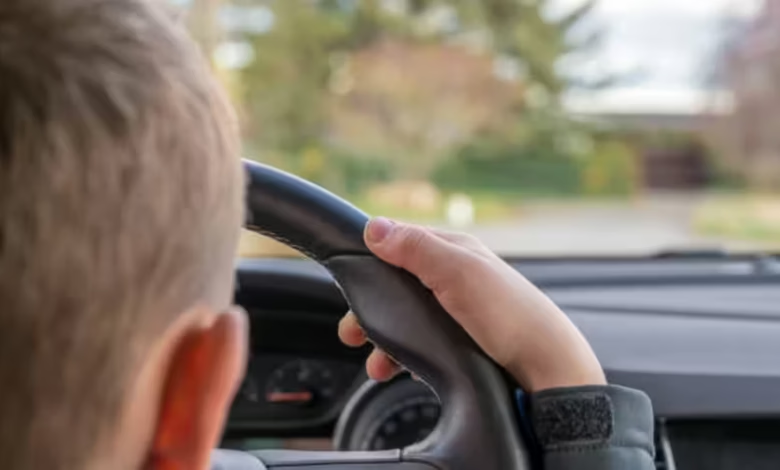
An 11-year-old boy, taking advantage of the absence of adults, independently got behind the wheel of an Audi car parked in the garage. While leaving the premises, he ran over his two-year-old sister and hit his seven-year-old brother. The girl died on the spot. The boy was hospitalized with injuries.
Investigators and juvenile prevention workers worked on the spot. The police noted that a criminal case was opened in connection with the tragedy under Part 2 of Article 286 of the Criminal Code of Ukraine — violation of road safety rules that caused death.
It should be clarified that the subject of a criminal offense under this article can only be a natural person who has reached the age of 16 and is of sound mind. In the case of an 11-year-old child, there is no question of criminal responsibility. Instead, coercive measures of an educational nature, provided for by a separate section of the Criminal Code, may be applied to the minor, taking into account the actions, circumstances, risks and consequences.
The condition of the tragedy was that the child had access to the car. The keys were not hidden or locked. The boy was able to get into the cabin, start the engine and drive away. The car was in good condition, and access to the garage was not restricted. The children were left unattended – this was confirmed by the investigation. Details about the duration of the adults’ absence, their presence at the time of the incident or after, are not publicly available at this time.
In such situations, law enforcement officers usually conduct a parenting assessment, interview family members, examine the family’s previous experience, school performance, medical information, and determine whether there were signs of neglect or irresponsible behavior by adults that may have contributed to the incident.
In the absence of direct fault of the parents in providing access to the car, the issue of administrative or criminal responsibility of adults can be focused on the articles on improper performance of parental duties. But the formal presence or absence of fault does not mean the disappearance of the causal connection between the lack of supervision and the event that occurred.
Formally, an 11-year-old child cannot be a driver. Even basic driving skills are not allowed by law at this age. But in certain rural communities, in particular, in conditions of a shortage of transport and an increased burden on the family, children can have contact with the car – through helping adults, participating in household chores, or in the form of a game. However, none of these practices cancels the responsibility of adults to ensure the safety of children and prevent children from using objects of increased danger.
This case is not unique – in the years 2022-2024, against the background of the martial law in Ukraine, dozens of episodes were recorded when children got into dangerous situations due to access to equipment, vehicles, household tools or sources of risk left unattended. The statistics of the Ministry of Internal Affairs, reports of the State Emergency Service, reports of juvenile prevention services testify to regular incidents based on lack of care, lack of restrictions, and lack of prevention.
The tragedy in Nemyra requires an answer to the question: how to form a new system of prevention of children’s danger in the conditions of war, when the old models of care no longer work, and children are left alone with things that should not be in their reach.