Attack on the Shostka District Police Department: Public Reaction as a Marker of Hostility to Law Enforcement and the Management Crisis of the Ministry of Internal Affairs

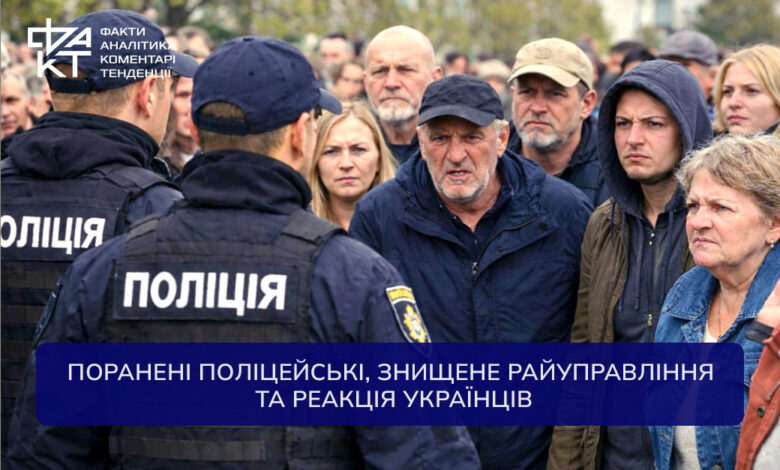
In Shostka, Russian drones destroyed the district police department, wounding 22 employees. At the same time, the reaction of Ukrainians to this event on social networks was shocking: almost all users did not express sympathy, but rejoiced at the “boomerang”, wishing that similar strikes would be carried out on all departments. This demonstrates the deep, years-old hostile attitude of society towards the police. However, the real cause of this problem lies in the systemic crisis of the Ministry of Internal Affairs, whose leadership does not think about how to make the law enforcement agency authoritative in the eyes of Ukrainians. When mistakes and abuses are transferred to lower levels, and there is no strategic management, even lawful actions of the police cause anger and distrust in society, which undermines the very foundation of law and order.
Ukrainians’ reaction to the strike on the Shostka district police department
On March 11, Russian drones struck the Shostka district police department, destroying the building and wounding 22 employees. Information about the event quickly spread on social networks, but its discussion caused great surprise: almost all Ukrainians did not show any sympathy for the victims and indignation that they were fired upon by the enemy. The comments were filled with joy that the number of wounded was limited, and the wish that the strikes would hit all police stations.
The comments often referred to the “boomerang rule” — people assessed the event as a moral response to the system that, in their opinion, mocks Ukrainians. They wrote that “this should have happened earlier,” “if all stations were flown like this — there would be order.” Many emphasized that 22 victims were “too few,” demonstrating emotional satisfaction that the system had at least partially suffered losses.
An analysis of the Ukrainian reaction reveals two key trends: emotional satisfaction from the vulnerability of the police and a complete lack of empathy for the specific people who suffered. This indicates an unhealthy atmosphere in Ukrainian society, which rejoices in the grief of its own compatriots who have suffered at the hands of the enemy. This phenomenon is called schadenfreude (gloating) — a German word formed from the words Schaden, meaning “damage,” and Freude, meaning “joy.” It describes the pleasure that a person feels when observing the failures or suffering of others, and is often associated with a sense of moral or social superiority over the victim. In Ukrainian society, this is manifested through comparing one’s own situation with that of others: joy from other people’s losses becomes a way of psychological compensation and strengthening the sense of control in chaotic circumstances. When such a phenomenon spreads in the mass consciousness, it creates an atmosphere of emotional alienation, reduces the ability to empathize and threatens social cohesion, because collective pleasure in someone else’s grief weakens moral bonds and empathy in society.
In addition, such a reaction of society is an indicator of deep dissatisfaction with the work of law enforcement officers, which has accumulated over the years. In most comments, the event is assessed not as a tragedy for specific people, but as “retribution” for the system. At the same time, social networks act as an indicator of these sentiments: Ukrainians do not discuss the event only as a consequence of the attack, they evaluate it through the prism of the system, feeling moral satisfaction from the fact that the law enforcement structure turned out to be vulnerable. In conclusion, the attack in Shostka and the reaction of Ukrainians create a complete picture of how war and social expectations interact. In this case, the enemy’s attack on the district police department is a marker of public sentiment, demonstrating that the assessment of state structures during crisis situations can radically differ from standard ideas about compassion and moral response.
Why police actions during war provoke criticism from Ukrainians
Criticism of the National Police of Ukraine during a full-scale war focuses on several key areas that combine new powers and long-standing systemic problems, and it is because of this that society reacts so sharply to the actions of law enforcement officers. First of all, the participation of the police in mobilization measures causes indignation among Ukrainians. The force component of mobilization has become one of the most painful issues for society, at the center of which is the National Police, which acts as the main executor of the force part of this process. Police officers make arrests and intervene in conflict situations with the CCC, which is why a significant part of citizens perceive them not as a guarantor of order, but as an instrument of coercion. The identification and delivery of conscripts to recruitment centers, the so-called “busification”, is often perceived by citizens as pressure on the population and an excess of police duties. As a result, all the negativity that accumulates around mobilization procedures is instantly transferred to the police.
At the same time, the National Police already openly admits that participation in mobilization events leads to significant reputational losses. The head of the department, Ivan Vyhivskyi, emphasized that the police participate in the notification together with territorial recruitment centers and employees of the Joint Service, and this activity significantly affects the image of the agency. He emphasized that representatives of the CCC can conduct the notification independently, and law enforcement officers should be involved only in cases where “the person does not react.” However, it is the police that have the exclusive right to detain under Article 210 of the Code of Ukraine on Administrative Offenses, which automatically puts them at the forefront of the conflict, even if another institution initiates the procedure.
Joint actions of the police and the CCC often include forceful detentions, blocking transport, beatings, escapes of drivers, and physical attacks on the military. At the same time, the police, having the right to check documents and deliver people to the CCC, are limited to three hours of administrative detention, but there are numerous complaints about illegal detention and actions that citizens perceive as an excess of authority. Often, relatives or passers-by join the conflicts, trying to “fight back” the detainees, which leads to fines and new proceedings, increasing the circle of tension.
At the same time, the practice of mobilization conflicts with the basic norms of the Law of Ukraine “On the National Police”, where public trust is defined as a key criterion for the effectiveness of the body’s activities. However, the results of the survey by the Kyiv International Institute of Sociology indicate the opposite trend: only 35% of citizens trust the police, and 46% express distrust. For comparison, in 2024 these figures were 37% and 38%, respectively, and the balance of trust-distrust deteriorated from -1% to -11%. These data illustrate the real gap between the legally declared function of the police and its perception in society, emphasizing that the reputational losses from mobilization practices are systemic and deep.
However, judging by the comments on social networks and the general attitude of Ukrainians towards the police, the results of the survey by the Kyiv International Institute of Sociology look controversial, since almost all the comments contain negativity towards law enforcement officers.
Minister of Internal Affairs Ihor Klymenko explained during a recent plenary session of the Verkhovna Rada that the police participate in activities to notify and deliver conscripts to recruitment centers only upon request from territorial recruitment centers and do not independently determine the status of violations of military registration rules and mobilization legislation. According to the minister, administrative protocols are drawn up exclusively by representatives of the CCK, and the police only carry out instructions regarding persons who already have the established status of a draft evader. At the same time, he emphasized that all actions of the National Police take place exclusively within the limits of the powers provided for by the Constitution and laws of Ukraine, and that the issue of organizing the mobilization process is not the direct responsibility of the Ministry of Internal Affairs.
Despite these explanations, Klymenko’s words caused a sharp reaction in Ukrainian society, in particular, on social networks users were outraged and accused him of lying. The public has repeatedly emphasized that for many people, the participation of the police in the delivery of conscripts looks like an excess of duty, going beyond the functions of law enforcement agencies and is illegal. Indignation is especially intensified by reports that the police carry out these actions in the form of direct forceful influence, which is perceived as pressure on the civilian population during a war, when social expectations of justice are heightened.
Additional sources of criticism concern the abuse of expanded powers that the police received during martial law: checks of documents without justification, groundless stops of cars, illegal searches or excessive use of force, which for society looks like a direct violation of citizens’ constitutional rights. Against the background of these cases, even official explanations do not look convincing enough, since people assess the situation through the prism of their own experience and perception of the police as an institution that often does not meet people’s expectations of justice and protection of rights.
An equally important factor of discontent among Ukrainians was the fact that a significant part of the experienced police personnel was reserved from mobilization. For many citizens, this seems paradoxical: law enforcement officers who have combat experience and know how to act in extreme situations remain on the ground, while there is a shortage of trained personnel at the front. This situation creates a sense of injustice and irritation, because people expect that everyone who can effectively defend the country should be involved where their skills are most needed. Moreover, this increases social tension, because many perceive the reservation for law enforcement officers as a priority of personal or administrative interests over the needs of defense.
Along with this, there remains criticism of the old problems of the law enforcement system – corruption schemes, “covering up” businesses, reluctance to register complaints, inability to solve crimes, opacity of statistics and concealment of crimes, as well as the suspension of mandatory certification of police officers during the war, which Ukrainians assess as increasing distrust in law enforcement officers in general.
The effectiveness of law enforcement officers in the deoccupied territories is separately criticized for slow or incomplete investigation of war crimes, cases of collaborationism and insufficient organization of security. People on social networks combine emotional indignation with specific facts, which emphasizes that distrust in the police during the war is based on its real problems in its work.
It should be noted that trust in the police is also undermined by the obvious incompetence of many police officers. Weak training and insufficient knowledge of the law are constantly demonstrated on social networks, when citizens experienced in legal matters publicly ridicule and point out the mistakes of law enforcement officers. Each such case reinforces the feeling that the police are unable to effectively perform their duties and undermines the authority of the institution in the eyes of society.
Police activities against the background of public criticism
Against the background of criticism, police activities in wartime appear extremely complex and multidimensional, while negatively disposed Ukrainians do not think about what the implementation of their emotional demands will lead to. If the entire police force goes to the front, who will be left to respond to emergencies, maintain public order, and investigate crimes? To what extent can the front line compensate for the lack of stability in the rear? The issue of the consequences of the mass withdrawal of police officers to the front is practically not discussed in public appeals, although they are the ones who respond daily to domestic violence, robberies, missing children and accidents.
At the same time, it is worth recalling that thousands of police officers have been participating in combat operations on a par with the Armed Forces, the National Guard and special units since the first days of the war, performing tasks under fire and suffering losses. This is often forgotten by those who perceive the war through the news feed, while the military on the front line knows well that law enforcement officers are standing next to them, participating in assaults and combat operations.
At the same time, the police perform functions that were previously unusual for them: the evacuation of civilians from combat zones in the “White Angel” units, demining territories and recording thousands of war crimes by Russia, direct participation in combat operations, for example, as part of the “Lyut” brigade. Back in 2014, police officers were among the first to go east as part of volunteer units, performing combat missions near Ilovaisk and Vuglehirsk, and after the conflict subsided, they returned to their official duties. The full-scale invasion of 2022 forced many to take up arms again in systematic military participation.
A prime example was Volyn, where the “West” battalion was formed, which arrived in the east in May 2022 and actively used mortars, aerial reconnaissance, FPV drones, destroying the enemy on a par with the military. Hundreds of police officers passed through the battalion, for whom combat experience became part of the service. In 2023, the “Lyut” assault brigade was created with 5,000 people, including civilian volunteers, which participates in the most intense battles, assault operations, and counteroffensives. Along with it, the “Predator” brigades and KORD units operate on the front lines, and the “White Angels” evacuate civilians from combat zones.
At the same time, the rear police units bear a huge burden, as patrol officers respond to over 1.3 million calls each year, the criminal police investigate complex criminal schemes, and investigators record hundreds of thousands of cases of violence, including war crimes. The total volume of work since the beginning of the full-scale invasion has increased by approximately 80%, while the number of personnel has remained limited due to the priority of the state budget for the Armed Forces of Ukraine.
Today, more than 40,000 police officers serve in front-line regions, combining law enforcement, evacuation of civilians, recording war crimes, and countering sabotage. At the same time, a quarter of the personnel are women, performing complex tasks in investigative units, operational groups, and patrol service. In the first thirteen days of the large-scale war alone, 22 officers were killed, 88 were seriously injured, seven were missing, and three were captured. Now they continue to die and be injured almost every day, but commentators on social networks never mention this.
The Ministry of Internal Affairs’ Management Crisis
Society has long been accumulating indignation directed at the National Police, but the issue of authority and trust in the agency should not concern ordinary employees who find themselves on the front lines of crime and conflict every day, but the leadership of the Ministry of Internal Affairs and the minister himself. After all, it is they who form approaches to work, standards, and policies that determine how the police interact with citizens.
The police can effectively perform their functions only under the condition of professional management and support of a system that combines discipline, responsibility, and strategic planning, rather than shifting miscalculations to the grassroots levels. The absence of this during war threatens to cause even the most dedicated employees to find themselves in a situation of chaos, and society remains without guarantees of law and order.
I wonder if officials led by the minister do not think about why Ukrainians see the police as an enemy, not a defender, and why even the performance of legal duties generates waves of negativity in social networks and offline discussions? This tension has consequences not only for the image of the department, but also for stability within the state. When citizens perceive the police as a threat, not a service to the people, the very basis of law and order is undermined, the risk of conflicts, disobedience and aggression in interaction with the authorities increases. In addition, the lack of trust in the police can turn into a deep social crisis, because when people are not only afraid of the police, but also actively avoid contact with them, this greatly complicates the process of preventing and solving crimes.
In democratic countries, law enforcement authorities view public trust as a truly key indicator of their effectiveness, rather than an add-on to crime statistics. In the UK, the US, Scandinavia and during reforms in Georgia, community trust has become a central indicator of police effectiveness. A comprehensive Community Policing strategy based on partnership rather than coercive methods helps to achieve it. At the same time, police authorities ensure transparency and accountability by creating independent bodies to investigate complaints against officers, publicly disclosing information about critical incidents and using body cameras to objectively record interactions with citizens.
It is noteworthy that the introduction of digital technologies, in particular the automatic uploading of body camera video to the cloud without the right to edit by police officers, radically changes the balance of trust and risk. In the US, case law treats the absence of a record as evidence of the officer’s guilt, which increases disciplinary and legal liability, forcing police officers to act predictably and consciously in any situation involving the use of force.
Real authority in the system is formed when external oversight has real autonomy, which is why independent bodies abroad inspect any police station without warning, remove data from servers and suspend management for the duration of the investigation. This ensures that violations of the law by law enforcement officers will not go unpunished. At the same time, strict responsibility of management for the actions of their subordinates ensures an interest in ensuring that corrupt or violent subordinates do not work under their management, which destroys the system of circular responsibility and reduces the risk of impunity.
The experience of the UK shows that the independent oversight body Independent Office for Police Conduct effectively monitors the system of complaints against police activities. It not only examines the most serious cases, such as misconduct or deaths after contact with the police, but also analyses wider trends and helps to identify systemic problems in the work of the police force. The IOPC conducts its own investigations, and sometimes leads or accompanies police investigations when the situation requires it, and also issues recommendations to improve practices and standards. It also monitors the correct handling of complaints by police departments on the ground, and seeks to increase public confidence in the law enforcement system through transparent audits and training of officers.
In addition, in the United States and the United Kingdom, the basic principle of vicarious liability, known as Vicarious Liability or the doctrine of Respondeat Superior, operates in the police. Its essence is that a manager is responsible for the wrongdoing of his subordinates if negligent supervision, inadequate training or ignoring complaints are proven. The new chief who takes over automatically “inherits” the claims against the department that arose under his predecessor, which makes the responsibility continuous and clearly formalized. This principle is combined with the doctrine of command responsibility in international law, according to which a leader can be held criminally liable if he knew or should have known about the crimes of his subordinates, but did not take measures to prevent them. Similar standards are supported by the Council of Europe: higher authorities are obliged not only to respect human rights, but also to prevent violations by subordinates, and they cannot hide behind the argument of “impossibility of control”.
The close connection between funding and public trust forms another layer of control over police activities abroad, where the increase in complaints about its illegal actions directly affects the budget. In Scandinavian countries, management is forced to “compete” for taxpayer support, because it is on this that the modernization of equipment, salary increases and overall efficiency of the police depend. Such financial intervention changes the motivation from achieving internal indicators to responsibility to society.
At the same time, judicial precedents, in particular the decision in the USA to abolish or limit qualified immunity for police officers, demonstrate how influential an officer’s personal liability can be. There, law enforcement officers bear not only disciplinary or criminal liability, but also financial liability for harm caused to citizens through unlawful actions. This changes both legal consequences and everyday behavior on duty. Under such legislative requirements, law enforcement officers become more careful, carefully document their actions, respond more attentively to complaints, and strive to follow procedures in order to avoid personal liability. At the same time, social networks and public investigations further enhance the effect, because any illegal action by a police officer can become public and have consequences for his career and finances.
The Ukrainian police, as in any large organization, are made up of different people, and reducing the entire system to one negative image is an unfair simplification of reality. Side by side with those who are now heroically performing tasks on the front lines, participating in assaults and returning from rotations, there are officers who conscientiously perform routine but extremely important work every day: they go out on calls, evacuate and rescue people, document crimes, investigate cases that do not make the headlines. At the same time, there are those in the system whose actions discredit the police and the very idea of the service, undermining the trust of citizens and fueling general irritation.
The war has further exposed the management problems of the Ukrainian law enforcement system, because while patrol officers find themselves the face of forced decisions and bear a wave of public indignation, the heads of the Ministry of Internal Affairs demonstrate inefficiency in matters of management, personnel policy and communication with the population. Criticism of the police, which focuses exclusively on ordinary employees, ignores the broader context: the problem of managing the Ministry of Internal Affairs system, the lack of a clear strategy and successful personnel policy, poor organization of work and training of specialists. Many experienced professionals have left the service, and young, ambitious, but inexperienced managers have taken up leadership positions. As a result, conflicts and mistakes arise, for which ordinary police officers are responsible.
The police cannot be effective if senior management does not combine discipline of subordinates with their own personal responsibility and continues to shift their own mistakes to lower levels. The main problem lies in the inability of the management vertical to create conditions under which competent specialists remain, systemic errors do not become the norm, and the trust of citizens is not destroyed due to chaotic or irresponsible management. The experience of constant reforms shows that the police have never become authoritative and effective. Having destroyed the old system, they have never built a new one. Each new reform creates more problems than it solves, and instead of improving the system, it only increases citizens’ skepticism and irritation with the actions of law enforcement officers.