Competition for the head of the State Customs Service: will the new head change the system, which for decades has been considered the most corrupt

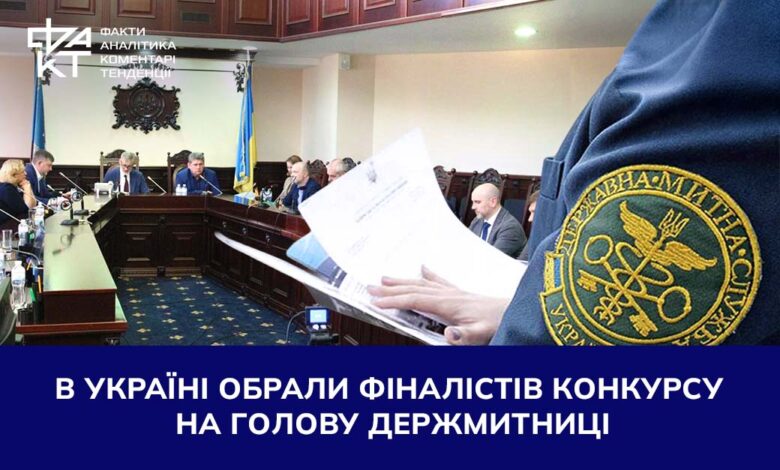
The customs service, which has been considered the most corrupt sector for decades, has been without a full-fledged head for more than four years, although the filling of the State Budget depends significantly on its work. The current competition for the head of the State Customs Service goes far beyond personnel news, because it exposes the old problem of its renewal, which in Ukraine has been postponed, masked and transferred from one political cycle to another for years. The commission selected the finalists of the competition, who were employees of the NABU. However, the main question is not who will get the position, but whether the new head will change the service, which is rightly criticized for systemic corruption, bribery, bureaucratization, delays in customs clearance of goods and opacity of procedures.
Customs without a head for the fifth year: the competition was reduced to two NABU detectives
On August 4, 2025, the Cabinet of Ministers launched an open selection procedure for the head of the State Customs Service, opening a competition for the position that has been vacant for more than four years. While the government is only approaching a final decision, the customs service is working with an acting head, this function is performed by the Deputy Head of the State Customs Service, Serhiy Zvyagintsev.
The competition was designed so that the final appointment remained with the government, but through a filter of several stages and a vote of the competition commission. The final decision on who will head the customs service for five years is made by the Cabinet of Ministers upon the proposal of the Minister of Finance, Serhiy Marchenko. Up to this point, the applicants had been going through a consistent selection process all this time: after the general abilities test, a special integrity test took place, then the candidates had an interview with a psychologist and a test to assess personal traits, and the final stage before the commission was to determine the two finalists was an integrity interview.
It should be noted that the first stage of the competition ended on January 17, and 16 out of 38 candidates passed it. On the same day, a general abilities test for the position of Head of the State Customs Service of Ukraine took place, and its results recorded a different number of participants: out of 36 applicants, 16 people who scored 107 points or more in three blocks of tasks — verbal, abstract-logical and mathematical. Against this background, the indicators of the two future finalists looked restrained, but sufficient to advance: Ruslan Damentsov then received 107 points, and Orest Mandziy – 115. At the same time, eight of their competitors showed results in the range from 116 to 130 points.
The final voting mechanism left the candidates with a fairly strict corridor of requirements. In order for a candidate to maintain a chance of reaching the final, he had to receive at least four votes “in favor” from six members of the commission, and among these votes there had to be at least two from its international members.
On March 27, the selection commission for the head of the State Customs Service identified two candidates for the position of head, who were current employees of the National Anti-Corruption Bureau of Ukraine Ruslan Damentsov and Orest Mandziy. Both candidacies have already been submitted for consideration by the Ministry of Finance, after which the government must appoint a new head of the service within ten days.
Both finalists reached the decisive stage from the anti-corruption environment, although their positions within NABU differ in profile and level of responsibility. Ruslan Damentsov holds the position of deputy head of the second unit of NABU detectives, and also previously participated in the competition for the position of director of the Bureau of Economic Security. Orest Mandziy heads the sixth unit of NABU detectives.
Customs under the supervision of competitions, audits and donors: reform of the State Customs Service
Customs has traditionally been considered one of the most corrupt bodies in the state, where numerous offenses and conflicts of interest have accumulated over the years. In early 2019, the President of Ukraine conducted demonstration inspections of regional heads of customs offices in order to combat smuggling, asking the question “where did the iPhone come from?” However, this initiative, although it had a public resonance, was unable to eliminate systemic problems and did not lead to a fundamental change in the customs service’s work practices. Six years later, an analysis of the candidates’ integrity shows that the situation has not changed, with customs officers continuing to find hundreds of square meters of luxury real estate, millions in cash, expensive cars, and real estate registered to relatives.
In January of this year, the head of the Anti-Corruption Center “Border” Martyna Bohuslavets published data on the candidates for the position of head of the State Customs Service, among whom former and current customs officers, tax officers, border guards, businessmen, teachers, NABU detectives, and NACP employees predominate. In total, 38 candidates registered for the competition at that time, but our preliminary analysis of their integrity and lifestyle indicated numerous potential conflicts of interest, as well as attachment to old schemes that have long supported corrupt practices in the customs system.
According to the research of the National Agency for the Prevention of Corruption for 2024, it is the customs sector that business considers to be the most corrupt sector, and this definition sets the tone for all further actions regarding its reform and the appointment of the head of the service. This process is given additional weight by the fact that reform has become one of the key conditions for external financing. For the International Monetary Fund program for 2023–2025, the transformation of customs was identified as one of the basic requirements, and structural changes in this area have already been included in the upcoming program with the fund for 2026–2029. Therefore, these are obligations, the fulfillment of which depends on much more than the appointment of an individual official.
In October 2024, the president signed the law No. 6490-d on the reform of the State Customs Service, which became an important structural beacon for the International Monetary Fund, the World Bank, and the United States. It also laid the foundation for a new architecture for the service, and its emergence is tied to several framework documents: the Plan of Ukraine within the framework of the European Union instrument Ukraine Facility and the National Revenue Strategy for 2024–2030.
The aforementioned reform changed the competitive selection procedure for the position of Head of the State Customs Service. The approach was based on approaches already used in NABU, SAPO and other anti-corruption bodies. This implies that the competition should be built according to rules, where procedure, verification and protection from political influence are of crucial importance. At the same time, it is envisaged to involve international experts who have high professional competences and at least five years of experience in the fields of law, economics and/or corruption prevention. Their presence in the selection is designed to change the very trust in the competition, because for the customs service, whose reputation has long become part of the anti-corruption problem, external professional control is no less important than internal voting.
At the same time, the law was not limited to the competition alone, but establishes a clear algorithm for decision-making by the competition commission. The principle is that the commission must submit a proposal to the Prime Minister of Ukraine for one candidate, that is, the winner of the competition, and not propose a wider list of applicants. Such a model reduces the scope for vague interpretations of the final selection, when the decisive stage turns into additional political bargaining between several names.
Another center of gravity of the reform concerns the powers of the future head of the customs service. The law gave him the right to form the personnel potential of the customs authorities, including through the appointment of his deputies on the proposal of the Prime Minister in accordance with the proposals of such a head. At the same time, the need to coordinate the appointments and dismissals of middle managers with the Minister of Finance was abolished. In practical terms, this meant an attempt to assemble the personnel vertical not as a set of disparate compromises, but as a system for which the head would be directly responsible.
No less indicative is the provision on an annual independent audit of the efficiency of customs authorities. If a negative conclusion is given as a result, this becomes the basis for the dismissal of the head of the State Customs Service. In such a model, responsibility is not dissolved in general formulations about intentions and plans, but is tied to a regular external assessment tool, which can have direct personnel consequences.
In addition, a separate block of reform concerned customs employees. The law defined the specifics of the requirements for admission to service, provides for a one-time certification of customs officials to establish compliance with the position held, and also fixes the approach to determining the size of employees’ salaries. In combination, these elements look like an attempt to influence three levels of the system at once: entry into the service, verification of those who already work in it, and the financial conditions within which this service exists.
Thus, the reform, supported by the International Monetary Fund, the World Bank, the United States and all business associations, was conceived as a structural beacon, following which, instead of a system where personnel decisions, accountability and integrity diverged in different directions, a customs office was to be created, where all these elements were combined into one managed and verified model.
Competition without breaking the system: why the customs office will not be changed by a new head
Since the authorities have not demonstrated a willingness to break the corruption and criminal model of customs management for decades, the competition to elect its head does not look like a tool for overcoming problems, but a way to differently distribute responsibility for what happens next. The logic here is quite simple: international partners demanded a competitive procedure, the participation of foreign experts, strict criteria for integrity and formal transparency – they got it. With this formulation of the question, the competition becomes not the beginning of a solution to the chronic disease of the system, but convenient proof that formally everything was done correctly, even if the disease itself remained intact.
During the interviews at the competition, this approach was especially pronounced, because instead of talking about how to break long-standing schemes and what the plan for restructuring the customs service should be, the commission members focused almost exclusively on the integrity of the candidates. Much more time and attention was spent on the issue of buying apartments and cars than on discussing what constitutes the core of the crisis of the service itself: the customs cash desks discovered by NABU, the sale of positions for a million dollars, schemes with beads and trucks, etc. That is, the conversation revolved around the private biographies of the applicants much more actively than around the mechanism of the system that they are supposedly expected to change.
This imbalance can be seen even more clearly if we compare the duration of the different parts of the selection: the commission spent from 30 minutes to an hour on declarations, the origin of property, and the search for signs of integrity, while the candidates were given only two minutes to present their vision for the development of the customs service. With this ratio, the procedure was set up from the very beginning not to find a person capable of launching the reform, but to weed out those who did not pass the moral and biographical filter. In other words, the commission was primarily interested not in the future project of the new customs service, but in the personal profile of the person who should enter it.
The general atmosphere surrounding the competition was no less telling, because this time there was almost no sabotage, which is common in Ukrainian realities. There were no lawsuits from people’s deputies about the illegitimacy of the procedure, no high-profile stories about the candidates’ passports, and no scandals that usually accompany processes that can affect truly sensitive interests. Such silence is difficult to consider accidental, because it indicates that the state system did not perceive this competition as a real danger to itself.
It is not surprising that among the finalists were employees of the NABU, that is, people from the anti-corruption environment. Their appearance at the decisive stage is undoubtedly a certain signal, but here too we should not replace reality with a beautiful frame, because the new leader enters the system as an alien element for it, as a representative of the government body that stood “on the other side of the barricade”. However, without political will at the highest level, such a leader will be bound in his capabilities from the very beginning, regardless of personal qualities and reputation.
So, the key question is not whether a virtuous person will be appointed, but whether he will be able to survive and operate within an environment where corrupt practices have been built up for decades. Customs has long existed as a space in which the extortion of illegal benefits for the unhindered clearance of goods and the passage of cargo is combined with “gray” schemes, smuggling, the passage of trucks without proper inspection, forgery of documents, cover goods and undervaluation of customs value in order to reduce taxes. Added to this are artificial delays, bureaucratic over-bureaucratization, business simplicity, failure to meet revenue plans, weak fight against smuggling, political dependence, arbitrariness during inspections and detention of goods due to conditional “errors” in declarations. Customs is also criticized for the complexity of electronic systems and the need to contact corrupt officials, because this is what pushes part of the market to seek “fast” informal ways of clearance.
When a person, after being appointed, finds himself alone with a system that generates millions of dollars in shadow taxes every month, serves the interests of representatives of various branches of government, and feeds the law enforcement sector with cash, there is almost no room for honest maneuver. The new head will face a tough choice: either enter into conflict with this structure or enter into contact with it. In the first case, he risks being broken and dismissed from his post very quickly, in the second – becoming part of the very processes he has to fight. Most likely, he will choose the second path, because he is not his own enemy.
When the conversation about the competition for the head of the customs is presented as evidence of a launched reform and an attempt to restore order in the system, the main thing is lost in sight: such a procedure in itself does not mean that the system will begin to change. Since the adoption of the law on reform, an effective transformation of the customs service has not taken place, because for ten years the state has not demonstrated a willingness to break the corrupt and criminal model of customs management. In addition, it is impossible to reform a single state body in the absence of a holistic strategy for the development of the state and a clear plan for updating the entire system of state administration, including law enforcement agencies. In such a configuration, any attempt to restore order in customs separately from the tax service, law enforcement agencies, the judiciary, and the political will of high-ranking officials is doomed to failure.