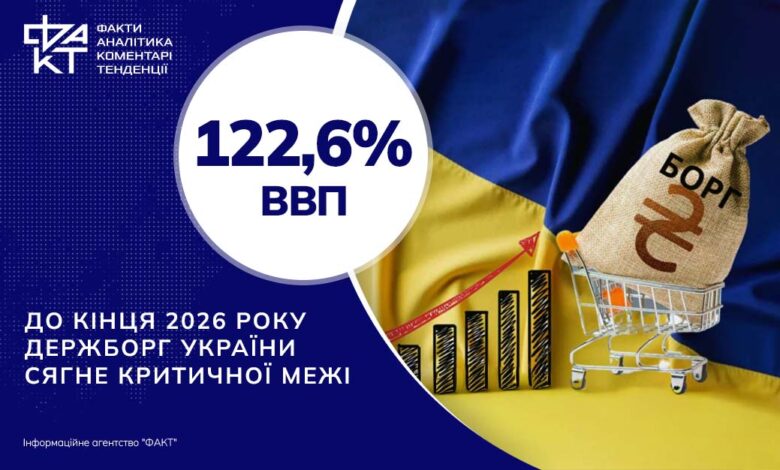
The International Monetary Fund has warned that without additional economic solutions, Ukraine’s public debt could become critically high and create serious problems for financial stability. According to the Fund’s estimate in its updated Memorandum on Economic and Financial Policy, by the end of 2026 the debt will reach 122.6% of gross domestic product.
This means that the volume of state liabilities will exceed the annual volume of all added value produced by the economy, which automatically increases the budget’s dependence on external financing and creditor conditions.
The baseline scenario modeled by the Fund looks even harsher: if no additional solutions are adopted, the debt will increase to 137.1% of GDP in 2027. Even in the long term, by 2035, the indicator will remain high and, according to the forecast, will decrease only to 97.1% of GDP. During 2030–2035, the average gross financing needs will be 7.2% of GDP, which means a constant need to attract significant resources to cover the deficit and service obligations.
To achieve debt sustainability, the IMF sets much stricter benchmarks: by 2035 the level of public debt should be reduced to below 68% of GDP, and the average gross financing needs in 2030–2035 should not exceed 7.0% of GDP. It is separately emphasized that in 2026–2028, debt service costs to external creditors, excluding multilateral ones, should remain within the limits of up to $ 1 billion per year.
Part of the debt burden has already been revised. In September 2024, Ukraine completed a major restructuring of its external commercial debt worth $20.5 billion, accounting for 78% of its external commercial debt. In September 2025, an agreement was reached with the Export-Import Bank of China to defer repayment of a loan of $850 million for the period 2034–2040. At the end of 2025, liabilities under GDP warrants worth $2.6 billion were settled.
At the same time, two components of the commercial debt still need to be settled: the restructuring of Ukrenergo’s state-guaranteed Eurobonds worth $825 million and the external commercial loan of Cargill Financial Services International worth $0.7 billion.
Official creditors agreed to a two-stage approach to restructuring. The first phase involves extending the current moratorium for the duration of the IMF program, while the second should consist of a final “debt relief” after the level of uncertainty has decreased.
Against this background, the IMF Board of Directors approved a new four-year extended financing program for Ukraine in the amount of $8.1 billion. Prime Minister Yulia Svyrydenko reported that the first tranche of about $1.5 billion will be received by Ukraine in the near future and will be aimed at covering the budget deficit and supporting macro-financial stability. The program provides for the continuation of reforms that previously contributed to maintaining financial balance.
An additional signal for assessing the prospects was the decision of the European Bank for Reconstruction and Development to revise the forecast for Ukraine’s economic growth. Analysts expect GDP to grow by 2.5% this year and by 4% next year, while the previous forecast for 2026 predicted 5% growth.
Taken together, these figures outline a complex situation in which the pace of economic recovery must be combined with a reduction in the debt burden, otherwise the debt-to-GDP ratio risks remaining at levels that the IMF itself considers dangerous for long-term stability.