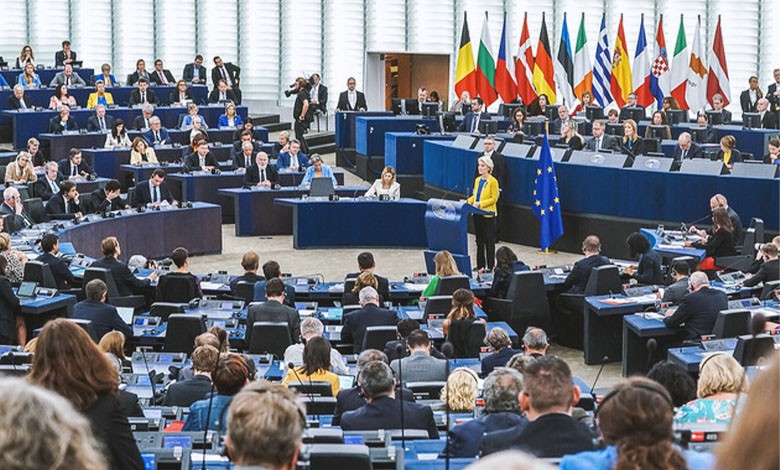
In 27 countries, voters (a total of 373 million people) will go to the ballot boxes from June 6 to 9 to elect the next European Parliament. All these voters will vote for 720 members of the European Parliament. It sounds very convincing, but no one should have any special illusions: these deputies have very few political rights. The only thing these deputies can really do is to elect a new European Commission, which has real political rights. Approve or reject the candidacies of those 27 members of the European Commission who actually manage the EU. At the same time, the future head of the European Commission must receive at least 361 votes of the members of the European Parliament. And now, although the elections have not yet passed, trading of future votes is already underway.
Today, the head of the European Commission, the de facto head of the EU’s executive power, is Ursula von der Leyen from Germany. She is from the centrist European People’s Party, but her politics are not too different from those of the left, so she has always had quite good relations with them. However, at the moment, most likely, she will have to look for some form of union with the right, for example, from Italy, and it is around the negotiations with the “right” that the whole intrigue of the upcoming elections revolves today. Actually, the elections of the European Commission are actually the most important task of this quasi-parliament, and in the future its powers will be largely purely decorative.
Members of the European Parliament are even deprived of legislative initiative – they cannot introduce laws for consideration, they only have the right to introduce changes to draft laws. In general, they have very limited political status, so voters are cool with these elections, so their turnout is likely to be much lower than in national elections.
What is the importance of the elections to the European Parliament for Ukraine?
The importance of these elections for Ukraine lies in the fact that they will show exactly where the political winds are blowing in Europe. And here everything is not quite as the Ukrainian mass media usually claim. They consider the upcoming elections in only one plane – the preservation of power by the left. According to them, only left-wing European politicians support Ukraine. For example, “Ukrainian Pravda” sees the coming to power of certain right-wing politicians through the lens of the issue of Ukraine’s survival as a front-line battle: how many percent will the “enemies” capture, how many seats will remain for “ours”, i.e. the “leftists”.
Considering the fact that grants for journalists in Ukraine are issued only by “left-wing” organizations, the position of our mass media is not surprising. Unfortunately, this is not only their position. In fact, the entire Ukrainian establishment is oriented towards the European bureaucracy and the left-wing political establishment of Europe. Bureaucrats in general are the main socialists always and everywhere, because do not feed bureaucrats with porridge – let them distribute something. At the same time, socialists like to share other people’s money, so bureaucrats and leftists are best friends. Hence the construction of our legislation: the rights of sexual minorities, the legislative struggle for a healthy lifestyle, ecology, “green energy”, etc. Typical leftist “agenda”. Ukrainian bureaucrats are the best successors of European bureaucrats.
One of the manifestations of the union of left-wing politicians and European officials is the campaign of endless PR promises to Ukraine, which both left-wing politicians and European bureaucrats love so much. The mechanism here is very simple: the people listen to dozens of loud statements and promises. Everyone is discussing, the mass media have long debates about future supplies. However, then the news dies quietly, because they all have a short life. Then, instead of what was promised, we receive another new promise, just as beautiful, bright and loud. And everything goes in a circle. Therefore, it should not be surprising that against the background of these loud promises and “guarantees of support”, the NATO Secretary General suddenly admits that only a small part of what was promised is actually being fulfilled.
The problem is that Ukraine needs real things, concrete supplies, not PR statements. Left politicians like to easily and casually promise something, and therefore, suddenly it turns out that it is impossible or possible to fulfill the promises, but in a few years. A typical example is Emmanuel Macron, the president of France. At one time, the calling card of this politician was considerations regarding the need for European armed forces. So that Europe alone, without US control, could defend itself. After all, it sounds so beautiful: “Europe defends itself!”. At the same time, France under Macron failed to make its military expenditures even at the level of 2% of GDP, as required by the terms of the North Atlantic Treaty (NATO). What can we talk about the European forces if even what was promised has not been implemented.
For many years, Europe believed in all this policy of bureaucratic concessions, promises, and grandiose plans, and today it has found itself in such a situation that there is no way out of it. In fact, the time of left-wing politicians is running out there, and this is one of the main problems for Ukraine: all Ukrainian politics and the vast majority of Ukrainian mass media are oriented towards the European bureaucracy and the left-wing political segment. And their role will be reduced.
In fact, Brexit struck the European Union in the heart. Covertly, European officials fear that Britain’s example could cause an avalanche-like process of disintegration of the EU. Today, a new player appeared in the political arena. More precisely, the old player managed to bring his game to victory, and in Holland, despite everything, the politician Geert Wilders came to power, who has a serious intention of Holland’s exit from the EU. Of course, it will be much more difficult for her to leave than Britain, but the political game begins with this stake in mind.
All this can certainly play a big role in the future European Parliament. It was almost a decorative body precisely because left-wing politicians entered into a strategic alliance with European bureaucrats. However, the right-wing parties of Europe stand on other positions, and they may not be satisfied with the status of a decorative flower in the European garden of democracy. And here is a very important question: will they change this status, or decide that the best option is the end of the European Union. But whatever the case may be, there is no doubt that we are in for a war between the European Parliament and the European bureaucracy.
Why is it about the right-wing parties now? Moreover, in the formulation of European bureaucrats, these are not even right-wing parties, but far-right parties. Or, as it is now fashionable to say, populist. In fact, this is a lie! The idea to call them right-wing populists was invented by the US Democrats. The logic here is very simple, the right says that they are the parties of Common Sense, and the left claims that these are parties that follow the lead of their voters because of popularity. And that is why they are populists.
This whole game is caused by an attempt to slowly label the right-wing parties as Nazis or fascists. After all, even the uneducated remember from school that the Nazis came to power on the wave of populism. However, this was a completely different populism, which had nothing to do with the current accusations of the “right” by the “left”. The most interesting thing in this case is that both fascists and Nazis, in fact, are all left-wing parties that adore a strong state. It is no coincidence that the Nazis were called the National Socialist Party, and Mussolini came from the Italian Socialist Party.
However, “right-wing” in Europe today is called someone who is not lazy. Usually, if a party is called “right”, it means that it declares rejection of the current establishment in power, but in reality this does not mean anything. There are right-wing “right-wing” parties, such as the Dutch “Freedom Party” of Geert Wilders, and there are right-wing “left-wing” parties, such as the French National Union party, whose economic program is much closer even to the left than to the centrists .
The political and economic crisis brought about by the long years of rule by the “sweet couple”: Euro-bureaucrats and socialists, pushed the party closer to the right of the political spectrum and the anti-establishment party to success. And according to opinion polls, it is these parties that can get their political “Oscar” this summer.
It is expected that the first place among the political blocs will be united by the European People’s Party. To call them right-wing is too much for them, you can say that they are centrists. By the way, in Ukraine, Poroshenko’s party is associated with this association. According to the latest polls, these political blocs are given 168 seats. In second place are the pure leftists – the Progressive Union of Socialists and Democrats. Then there are three much more right-wing associations: “Renew Europe” (80 seats), “European Conservatives and Reformists” (75) and “Identity and Democracy” (67). Of course, all these associations are from the current European Parliament. What will be the schedule in the new parliament, what will these associations be called, it is still difficult to answer. They have not changed for a long time, but only because the balance of power was virtually unchanged.
Currently, a sharp shift in the balance to the right is expected. It is quite possible that there will be a political realignment. And here it is necessary to understand in what position Ukraine found itself due to this expected “rightward” turn in politics in Europe. For a long time, the “right-wing” or “populists” were outcasts in European politics, a situation Putin took advantage of very actively. In addition, both the foreign and domestic policies of Ukraine are very much oriented towards the left and European bureaucrats. Ukraine consciously took an active part in relegating the “right” to the political sidelines. We did not communicate with them, they are a priori recognized as enemies. The right actively supported Putin on the issue of “traditional values” and “migration”, while the authorities actively opposed them on these issues.
Meanwhile, the right has a very negative attitude to any pressure on freedom, the struggle for it is one of their main political values. In Ukraine, it remained almost unnoticed that when Putin attacked Ukraine, those who in the West called him “Putin’s hand dogs” spoke out against his aggression, that is, in principle, there is a basis for cooperation. However, it should be borne in mind that unlike the left and European bureaucrats, who are ready to turn a blind eye to almost any sins of the Ukrainian government (corruption, problems of freedom of speech, etc.), the right can take a very tough stand against these crimes, especially against the corruption of funds, which Europe sends to Ukraine.
Most likely, if the “right” promises to help Ukraine, it will not be just words, as is mostly happening now. But, unfortunately, the Ukrainian establishment is hardly ready for a frank conversation with the “right”.
To assess the situation, let’s give one example – the recent elections in Poland. The Polish “rights” are, of course, not exactly “rights”, they are more nationalists. Ukraine had great ideological disputes with them, often extremely ill-conceived. Many people in our country were sure that the victory of the left would immediately improve relations with Poland, because they are so pro-European. Everything turned out to be the opposite: it was the “leftists” unofficially, secretly, but began to support farmers’ economic protests against Ukraine. This is the highest political dexterity: politicians seem to have nothing to do with farmers’ protests, but everything is going exactly so that problems arise in Ukraine. And, of course, in words – everything will be fine. And actually…
We can say that all the promises made by European politicians to Ukraine will now be frozen until the results of the elections to the European Parliament. Of course, we are talking about “Old Europe”. These are France, Germany, Belgium, Spain. The former countries of the “Soviet bloc” are much more realistic about the war in Ukraine, but even there serious steps will be taken only after the elections. So, Europe froze in anticipation of a new balance of power.
Leonid Shtekel