Mass closure of sole proprietorships in Ukraine: a verdict on the system that does not allow work

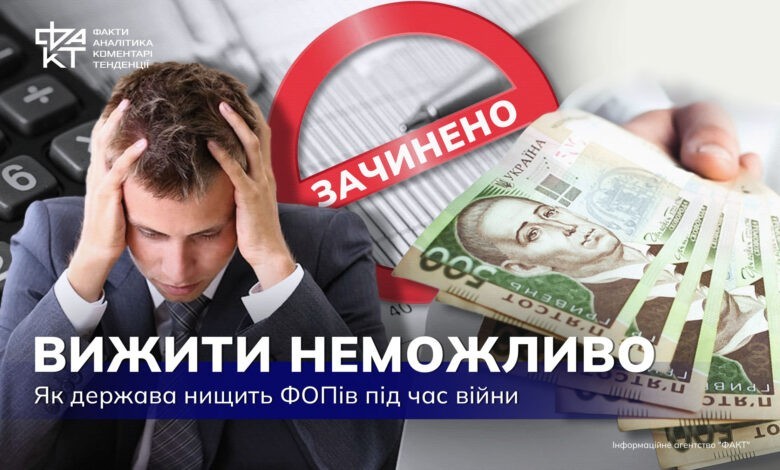
Recently, Ukraine has witnessed an alarming phenomenon — the mass closure of individual entrepreneurs (PPOs). What used to symbolize the freedom to do business and the opportunity for everyone to realize their entrepreneurial potential has now turned into a battleground between small business survival and regulatory rigor. Entrepreneurs, who were the backbone of the economy yesterday, are closing their businesses today due to tax pressure, bureaucratic complexity and changing rules of the game. Such a phenomenon has not only economic, but also social consequences. The closure of their activities means the loss of jobs, a reduction in tax revenues to the budget, as well as an increase in mistrust of government policy. What is behind this phenomenon — economic expediency or indifference to those who take risks?
Catastrophic law for FOPs
Ukrainian business has been operating for three years now in the conditions of a full-scale war, which forced entrepreneurs to adapt to reality, where stability has become a luxury. Despite constant challenges, from shelling to economic instability, the business has not only persevered, but is showing attempts to grow. Small startups, small businesses, and even large corporations are adapting quickly, seeking out new markets, innovating, and adapting their strategies to unprecedented conditions. They continue to operate even when their assets are threatened by missile attacks. Companies invest in new technologies, diversify their services and products, and look for customers abroad. However, this appearance of stability hides acute problems that hamper the possibilities for a full recovery.
Among the key challenges facing business today are not only the physical risks of war in the form of shelling or power outages, but also a complex of economic and social problems. Declining consumer activity, logistical problems, staff shortages and burnout, and a lack of paying customers all create conditions in which it becomes increasingly difficult to operate. However, instead of supporting small and medium-sized businesses, which are the basis of economic stability, the state, on the contrary, chooses the path of increasing pressure. Regulatory requirements are becoming more and more stringent, tax pressures are increasing, and bureaucracy is only adding new barriers instead of simplifying them.
At the end of November, the President of Ukraine signed a law on changes in tax legislation, which significantly increased taxes for individuals and entrepreneurs, as well as the military levy – instead of one and a half percent, it is now five percent. The consequences of this legislative innovation have become catastrophic – according to the data The opendatabase as of December 18, 22,521 individual entrepreneurs ceased their activities. Moreover, the day of signing the law, November 29, when 2,332 FOEs immediately closed their businesses, was a particularly noticeable and impressive dynamic. For comparison, on average, about 700 entrepreneurs cease their activities every day. Consequently, the change in tax policy caused a sharp jump in the number of foreclosures, which caused a significant uproar among the business community.
The closure of FOPs was a consequence not only of the increase in taxes, but also the accumulation of other problems that had been ignored for years. In particular, entrepreneurs point to increased bureaucratic pressure, the lack of transparency of the rules of the game, and limited access to financial resources. Many entrepreneurs claim that the new policy effectively deprives them of the opportunity to work legally, forcing them to choose between closing their businesses or moving into the shadow economy.
In total, since the beginning of 2024, 254,288 FOPs have ceased their activities, the highest peak of closures occurred in March, when 28,690 entrepreneurs closed. Surges in activity were also observed at the end of reporting periods, which is explained by the desire to avoid additional tax obligations. At the regional level, the largest outflow of entrepreneurs was observed in Kyiv, Odesa and Lviv regions. In the Lviv region, for example, the number of closed FOPs increased by 15% compared to last year. It is noteworthy that a significant part of closed entrepreneurs worked in the service and retail trade sectors, the most vulnerable to changes in tax policy.
Representatives of small businesses repeatedly appealed to the authorities to review the new tax policy, but all in vain. The lack of adequate dialogue between the government and entrepreneurs only worsens the situation, undermining trust in the state system. At the same time, representatives of the authorities emphasize that tax rates in Ukraine remain among the lowest in Europe, and suggest that entrepreneurs adapt to the new conditions.
It should be noted that since the beginning of the war, many Ukrainian entrepreneurs were forced to move abroad. There they open new companies, pay taxes and develop the economies of Poland, the Czech Republic, Germany and other countries that create favorable conditions for them. These countries receive from Ukrainian entrepreneurs not only investments, but also experience, jobs and innovative ideas that could work for the recovery of Ukraine. Those who stayed at home, despite shelling, economic instability and risks, continue to work, supplementing the state budget. But instead of support, they face constant pressure from the state: increased tax burden, fines, chaotic regulations and lack of a clear strategy to stimulate entrepreneurship.
FOEs have always been the foundation of the Ukrainian economy, the foundation of local communities and a source of self-employment. But today they are suppressed instead of supported. Entrepreneurs are made to understand that working honestly in Ukraine is becoming more and more difficult, and sometimes almost impossible. Therefore, the mass closure of FOPs and small businesses is not a coincidence or “natural selection”, but a consequence of the systematic undermining of the business environment. Today, working honestly in Ukraine means not only competing in the market, but also constantly fighting with state bodies that create obstacles instead of stimulation. A state that should have become an ally has become an enemy that is methodically squeezing the last resources out of business.
Opendatabot, a platform that researches the business environment, has launched a large-scale survey to find out how the new tax rules have affected businesses. Thousands of entrepreneurs took part in the survey, the results of which are expected by the end of December. This data can become an important tool for assessing the real impact of changes on the economy and making recommendations for the authorities.
Penalties for using old-style fiscal checks
In addition to tax pressure, from January 1, 2025, entrepreneurs in Ukraine face significant fines for using settlement transaction registrars (PRO/PRRO) with old fiscal checks. About this stated, member of the Verkhovna Rada Committee on Finance, Tax and Customs Policy Nina Yuzhanina. This innovation, established by the order of the Ministry of Finance No. 601, can be another blow to business, especially small and medium-sized ones.
The order of the Ministry of Finance, which entered into force on December 17, 2024, provides for a mandatory update of the form and content of fiscal checks. Entrepreneurs were given only 14 days to adapt the software and reprogram the PRO/PRRO. Currently, it is allowed to issue checks in the old form only until January 1, 2025, and for duty-free shops – until March 16, 2025. After that, old checks will be considered invalid, and issuance of such documents will be a reason for harsh sanctions. It should be noted that the development and coordination of the order took more than a year. However, entrepreneurs were given only two weeks to implement the updates. This puts the business in an extremely difficult situation, since most entrepreneurs physically do not have time to fulfill the technical requirements within the set time.
New fines could also be devastating to businesses along with high taxes. In case of violation, entrepreneurs will be fined 100% of the value of the goods sold with violations for the first violation and 150% for subsequent violations. For some categories of FOP-simplified persons, reduced fines are provided: 25% for the first violation and 50% for the second. Such sanctions have caused outrage in the business community, which believes that such measures are disproportionate and excessive.
The problem is not only in the amount of fines, but also in technical and organizational aspects. Reprogramming a PPO/PRPO requires time, money, and professional assistance that is out of reach for many entrepreneurs in rural areas or those operating on a shoestring budget. In addition, the software market in Ukraine is not yet ready for such a mass transition, and many service providers simply do not have time to serve customers in such a short time.
The new rules could trigger an even bigger wave of business closures. This is especially true for micro-entrepreneurs who do not have the resources to quickly adapt to new requirements. Instead of the expected increase in revenues to the budget, the state may face the further growth of the shadow sector of the economy and the reduction of the tax base.
So, the government is actually putting businesses in front of a choice: either shut down or work in the shadows. This creates an additional burden on those trying to remain legal and jeopardizes the development of small businesses in Ukraine. Currently, the situation looks like another example of how formal initiatives without taking into account the real capabilities of entrepreneurs can have the opposite effect.
Consequences of pressure on FOPs for Ukraine
The law on increasing taxes for private enterprises and introducing fines for the use of old-style fiscal checks will be a serious test for the economy of Ukraine. At a time when the country is at war and the economy is barely surviving, such innovations can lead to unpredictable and devastating consequences. They look like another example of when the fiscal ambitions of the state come into direct conflict with the real needs of society.
Entrepreneurship, which has always been one of the key factors of economic stability, is now in danger of disappearing. For many FPOs, especially in the fields of retail trade, services and transport, the new tax rules have turned into a direct challenge to survival. Fines in the amount of 100% or even 150% of the cost of sold goods are not only financial pressure, but also a signal that the state is ready to destroy small businesses for the sake of meager budget revenues.
In times of war, small business does not just provide goods and services, it is a support for local communities, a source of income for millions of families and an important tool for social stability. The closing of thousands of FOPs as a result of tax pressure will mean not only an increase in unemployment, but also the loss of a key source of tax revenue on which the state is so counting. The irony of the situation is that trying to collect more taxes can lead to a significant reduction in their base.
It will be especially dangerous in the post-war period, when the country will need an economic boost. Small business is the foundation on which the reconstruction of the country could be based. But if today the private enterprises are destroyed by administrative methods, tomorrow there will simply be no one to create jobs and ensure the payment of taxes. Reconstruction will require significant resources, and these will be difficult to obtain if small businesses are left in ruins.
In addition, fines for old-style fiscal checks look like a manifestation of the government’s absolute detachment from reality. Giving entrepreneurs only 14 days to adapt is not just unreasonable, but cynical. In the conditions of war, when many are working at the limit of their capabilities, ensuring the technical update of the PRO is a difficult, if not impossible, task. Such a policy pushes entrepreneurs to the shadow economy or to the complete closure of the business.
The closure of FOPs in Ukraine is a signal that sounds louder than any statements by government officials. A signal that economic policy boils down to a short-sighted desire to fill the budget at the expense of the most vulnerable. This is not the fight against the shadow economy, as they try to convince us, but the creation of conditions in which it is cheaper for an entrepreneur to close a business than to continue working.
If Ukraine wants to survive the war and ensure recovery after its end, the authorities should reconsider their approach to small business – replace repressive policies with stimulating ones, provide tax holidays, develop support programs, create real conditions for development, and not additional barriers. Otherwise, instead of reconstruction, we risk ending up in a country without entrepreneurship, investments and a future. Besides, only those who cannot leave and those who don’t care will remain in Ukraine tomorrow. Without small businesses, the country will continue its transformation into a stagnant economy dependent on monopolies and external creditors.