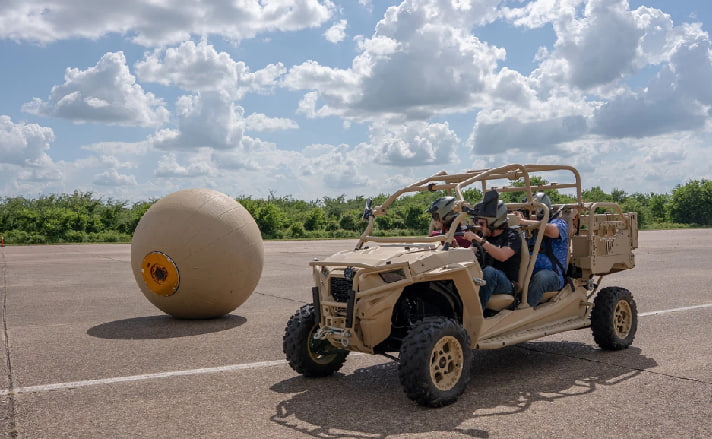
The study of the moon is usually carried out by lunar rovers with wheels, but scientists from Texas A\&M University (USA) are working on creating a fundamentally different device – a lunar rover in the shape of a ball. Such a robot will be able to roll on the uneven surface of the Moon without tipping over, as sometimes happens with classic devices, and conduct scientific research. This is reported by New Atlas.
Developers are creating a new type of robotic systems for the study of the Moon, capable of working in the difficult conditions of the surface of the Earth’s satellite. They were called RoboBalls, because in shape they resemble a sphere or a ball. Two prototypes have already been produced — RoboBall II and RoboBall III. They help verify the effectiveness of spherical robots in the study of craters and cross-country terrain.
RoboBall II has a diameter of 61 cm. Outside it is covered with a soft shell, and inside there is a propulsion system with a pendulum and motors on the axis. As the pendulum swings, it imparts momentum to the shell, forcing it to roll in the desired direction, changing the angle of inclination. During tests, this prototype moved through grass, sand, gravel and even water at a speed of up to 32 km/h.
RoboBall III is much larger – its diameter is 183 cm. This model is designed to carry a payload – sensors, cameras and sampling tools. Like the RoboBall II, it is able to roll as well as change its grip with the surface thanks to the inflation and deflation function of the shell, which allows it to work on different types of soil and reduces wear and tear. Both prototypes do not have the problem of falling on the side, which is characteristic of conventional lunar rovers.
Further tests include checking the robots’ ability to move from water to land. Work is also underway on the integration of science modules to assess how efficiently the spherical vehicles can transport research equipment.
According to the developers, the spherical robot will be useful not only for space research. It can also be used on Earth, for example, during search and rescue operations after natural disasters. Such robots could explore flooded areas after hurricanes and help find survivors.