The Dollar in the 21st Century: From the Birth of a Currency to the Center of the Global Economy

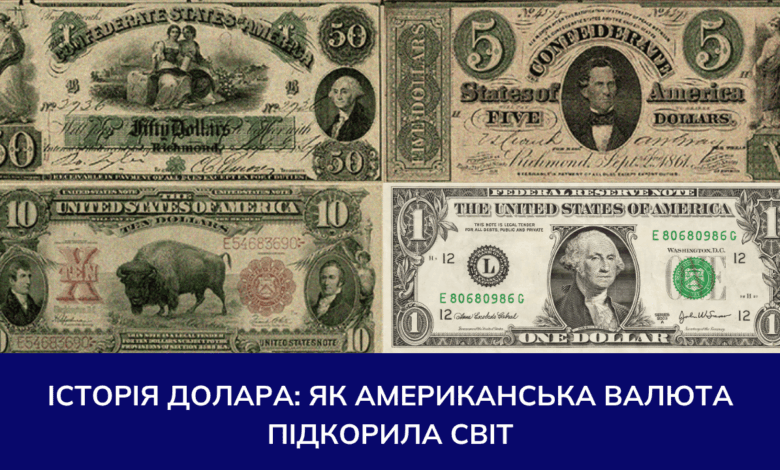
April 1 is considered the Birthday of the Dollar, and it is with its appearance that one of the most intriguing pages of financial history is associated. Over time, the dollar has ceased to be only the national currency of the United States and has become one of the main frameworks of the world economy, because it stores reserves, a significant part of international trade, credit transactions and settlements for strategic resources passes through it. For Ukraine, its importance is also quite significant, since the dollar affects the savings of the population, the cost of imports, the structure of financial assistance and the general feeling of economic stability.
From the abbreviation of peso to the symbol of capital: the real history of the dollar sign
Today it is difficult to imagine the global economy without its main Atlas – the dollar. However, its appearance was not the result of careful branding or a state decree. The transformation of an ordinary merchant abbreviation into a hieroglyph of wealth is one of the most intriguing pages of financial history.
April 1 is considered the birthday of the dollar, but it is celebrated on two dates, each of which is associated with a separate stage in its history. On April 1, 1778, the “$” sign appeared, proposed by Oliver Pollock, and on July 6, 1785, the US Congress officially recognized the dollar as the national currency.
The evolution of the “$” sign reflects the complex trajectory of the formation of the North American market, where Spanish influence prevailed before the official introduction of its own currency. In 1778, the Irish merchant Oliver Pollock used the “$” sign in his financial records, creating it based on the abbreviation of the Spanish currency peso, which was denoted as “PS”. When Pollock ingeniously combined the letters of the Spanish peso, he hardly realized the true scale of his invention.
The merchant simply optimized his reporting, but in fact created a symbol that, in terms of its influence, later surpassed the coats of arms of the oldest monarchies and the flags of the largest empires in the world. Over time, this symbol simplified to the familiar form of a vertical line crossing the letter S, and began to be widely used in documents and trade.
This version is considered the most plausible, although more romantic theories appeal to the Pillars of Hercules – a symbol of the Strait of Gibraltar, which adorned Spanish coins and was wrapped in a ribbon in the shape of the letter “S”.
Before independence, the colonies operated with a mixture of Spanish doubloons, British pounds, and commodity money, such as tobacco. The first attempt to create their own currency – the “continentals” of 1776 – ended in catastrophic inflation, since the paper was not backed by real gold.
The adoption of the Coinage Act in 1792 fixed the dollar as the official unit of the United States, but the symbol itself turned out to be older than the national currency, adapting to new realities with impressive flexibility. The use of one or two vertical lines in the sign is often interpreted as a reference to stability or even as a stylization of the letters “U” and “S”, although the latter version is not confirmed in documents from the early republican period.
The globalization of this symbol has turned it into a universal metaphor for money, used from the Canadian prairies to the Australian coasts, despite the significant differences in the economic systems of these countries.
During the 19th century, the United States suffered from “wild banks” that printed their own banknotes, which led to total confusion and fraud. The situation was corrected by the Civil War, when the appearance of the legendary “greenbacks” with a green reverse in the 1860s strengthened the role of the federal government. Although their value initially fell below 40 cents in silver, the subsequent industrial boom and the 1875 Means of Payment Restoration Act made the dollar the monolithic instrument of American expansion.
World Wars I and II finally cemented the United States as the world’s leading creditor. A key milestone was the Bretton Woods Conference of 1944, which effectively pegged the dollar to gold (at $35 per ounce), making it the world’s primary reserve currency. The creation of the IMF and the World Bank cemented this dominance, allowing America to dictate the terms of global trade.
However, in 1971 the system broke down, and President Richard Nixon announced the end of the convertibility of the dollar into gold. This “Nixon Shock” ushered the world into an era of floating exchange rates, where the value of a currency was based not on the metal but on confidence in the U.S. economy. Despite the volatility, the petrodollar system and the role of a “safe haven” allowed the dollar to maintain its leadership even after the 2008 financial crisis and the challenges of the COVID-19 pandemic.
Interestingly, the origin of the word “dollar” goes back to medieval Europe in the 16th century, starting in the Bohemian city of Joachimstal, where silver coins were minted — “joachimstaller”. Over time, linguistic evolution cut off the first part of the name, leaving the laconic “thaler”, which in English pronunciation transformed into the word we know, inheriting the centuries-old tradition of the European monetary standard.
Physical perfection and the alchemy of “greenbacks”
The modern US dollar bill is a unique technological artifact, the composition of which ignores wood cellulose in favor of cotton and flax, which provides incredible mechanical endurance. The ability to withstand more than 4 thousand bends without breaking makes this money almost eternal compared to ordinary paper, while at the same time turning it into a kind of environment for bacteria, which detect 94% of active banknotes. At the same time, the weight standardization of each unit, which is exactly 1 g regardless of the denomination, allows for a quick check of cash volumes, thanks to which a case with 1 million dollars in hundred-dollar bills weighs a symbolic 10 kg.
The conservatism of the design of the one-dollar bill, which has remained unchanged since 1963, contrasts with the dynamic development of security technologies of higher denominations, where high-tech 3D tapes and microprinting are combined with deep symbolism.
At the same time, the Masonic symbolism on the reverse, including the All-Seeing Eye above the unfinished pyramid and the Roman numerals of 1776, creates an aura of mystery around the currency, although in fact these signs reflect the ideology of the founders of the state. The lifespan of money is directly proportional to its value, because if a five-dollar bill wears out in 5 years of intensive circulation, then hundred-dollar bills retain their functionality for more than 2 decades.
The architecture of world reserves: how the dollar maintains financial hegemony
The status of the dollar as the world’s main reserve currency is confirmed by the concentration of colossal capital in the central banks of leading economies, where the American currency holds a share of about 60% of all world reserves. As of the beginning of 2026, China is confidently leading with a volume of over 3.2 trillion USD, using these assets as a strategic tool of geopolitical influence and financial security. Japan and Switzerland traditionally close the top three, demonstrating their commitment to the dollar as the most liquid means of preserving value in conditions of global turbulence.
Ukraine in this global system coordinates its own financial stability through the accumulation of significant reserves, which at the end of February 2026 reached 54.766 billion USD. The structure of Ukrainian assets is clearly focused on convertible currencies and securities, which make up 90% of the reserve, while the share of monetary gold remains at 8.34%.
The growth of these indicators was made possible thanks to systemic international support and a balanced policy of the National Bank, which allowed minimizing devaluation risks for the national hryvnia. But it is worth noting that for Ukraine the dollar remains not only a savings instrument, but also a kind of psychological anchor. It is not for nothing that even the popular name “bucks”, which comes from buckskin, which once served as currency in the colonies, emphasizes the deep-rooted tradition of trust in this asset.
Global balance of power: how national currencies challenge the dollar
In the modern globalized world, the dominance of the American dollar is often perceived as an unshakable constant, but a detailed analysis of the world’s financial systems reveals a completely different picture. Many leading states and economic unions have consciously abandoned the role of passive observers, building their own autonomous monetary spaces, which not only successfully compete with the American currency, but also form independent centers of financial gravity. For such countries, the creation of a national currency is not just a technical step, but a fundamental strategy for protecting economic sovereignty, allowing them to independently determine the vector of their development.
A fundamental shift in the global balance of power was made possible by the emergence of the Eurozone, where such economic giants as Germany, France, Italy and Spain united their financial destinies under the banner of the euro. This currency functions as a powerful collective shield, allowing member countries to minimize transaction costs within the continent and to act as a united front against the volatility of external markets.
In contrast to this integration model, the United Kingdom remains steadfastly loyal to the pound sterling, which remains one of the oldest and most authoritative financial instruments in the world. The City of London continues to use its own currency as a symbol of independent policy, allowing Britain to respond flexibly to internal crises without regard to common directives from Brussels.
At the same time, the Eastern Hemisphere demonstrates a completely different logic of monetary dominance, in which Japan uses the yen as a tool to support its export-oriented miracle. In general, the Japanese currency is traditionally considered a “safe haven” for investors in times of global turmoil, which emphasizes the stability of an economy built on high technology and colossal gold and foreign exchange reserves.
In turn, China is actively transforming the yuan into an instrument of geopolitical influence, gradually displacing Western counterparts from trade settlements within the region. Beijing is consistently implementing mechanisms that make the yuan an alternative pole of gravity, which forces world players to reckon with China’s ambitions for financial hegemony.
Despite its geographical proximity to the United States, Canada operates its own Canadian dollar, which is often called a “commodity currency” because of its close connection with energy prices. Ottawa skillfully balances close integration into the North American market and maintaining emission independence, which allows the Canadian government to independently regulate interest rates depending on national priorities.
A similar strategy is demonstrated by Australia, whose Australian dollar serves as a bridge between Western financial standards and the resource needs of Asian markets. Canberra uses the advantages of its isolation and mineral wealth to maintain the stability of the national currency, which remains independent of the fluctuations of the US Federal Reserve’s policy.
A special place in this list is occupied by Ukraine, where the hryvnia has gone from a newborn instrument of a market economy to a symbol of national invincibility over the decades of its existence. The Ukrainian currency ensures the functioning of the internal market even in the most difficult periods of testing, fulfilling the role of a critically important social and economic regulator.
The National Bank of Ukraine, operating in the hryvnia, is able to implement targeted support for the financial system, which would be impossible in the case of complete dependence on foreign currencies. Thus, each of these states proves that having its own currency is both a matter of prestige and a tool for survival and prosperity in the modern multipolar world.
Dollarization: between economic salvation and loss of sovereignty
At the same time, the phenomenon of voluntary abandonment of the national currency in favor of the US dollar often becomes a radical but effective method of overcoming hyperinflation, as demonstrated by the examples of Zimbabwe and Ecuador. The transition to settlements in foreign currency provides instant price stabilization and creates a predictable environment for investors, but deprives the state of the opportunity to conduct an independent monetary policy.
At the same time, countries such as Singapore and Nicaragua are integrating the dollar into domestic payments, trying to attract international capital and simplify financial logistics for tourism and export operations.
It is worth understanding that the use of the American currency as a parallel means of payment carries with it the advantages of low credit rates, and at the same time the risks of critical dependence on economic fluctuations within the United States itself. Asian economic giants are increasingly trying to diversify their payments in order to reduce vulnerability to the dominance of the dollar, although today no alternative currency is able to offer a similar level of global trust and liquidity.
In the Ukrainian economic environment, the dollar has long become not so much an alternative currency as a universal reference point through which society measures the value, risk and time stability of money. Its value was formed at the intersection of several factors: a long experience of hryvnia inflation, periodic devaluations, a high share of imports in consumption and the habit of evaluating large purchases in a more stable equivalent. Therefore, the dollar is present in Ukraine even where official settlements are made in hryvnia.
It is embedded in the logic of pricing real estate, cars, equipment, rent, certain services, and investment decisions of households. For the population, this is a way not only to preserve savings, but also to avoid constant recalculation of future expenses in a currency whose purchasing power is perceived as less vulnerable to internal economic fluctuations. Thus, the dollar performs the function of an unofficial unit of long-term value in Ukraine, and this is what explains its special presence in everyday economic behavior.
At the macroeconomic level, the dollar’s significance is even broader, since a significant part of foreign trade, reserve policy, and state financial support passes through it. Most critical imports — primarily fuel, energy, equipment, components, and some raw materials — are tied to dollar settlements, so changes in the value of the dollar almost automatically affect the cost of business, transportation costs, import prices, and further inflation in general.
At the same time, the dollar is the key currency of international reserves and foreign aid, and therefore one of the basic tools for maintaining currency stability in conditions of military and budgetary pressure. For the domestic economy, this creates a double effect: on the one hand, the dollar helps maintain external financial balance and provides support in times of crisis, and on the other hand, it increases the sensitivity of the domestic market to external currency fluctuations.
Currently, more than two-thirds of the dollar cash supply is in circulation outside the United States, which makes this currency a global public good and an instrument of “soft power”. We are watching how the medium of exchange has rapidly transformed into a complex cultural code, where every line on the “$” symbol and every shade of the “greenback” tell a story about humanity’s desire for stability in the changing world of capital.