Ukraine’s population during the war: where did the figure of 20 million come from and why experts disagree with it

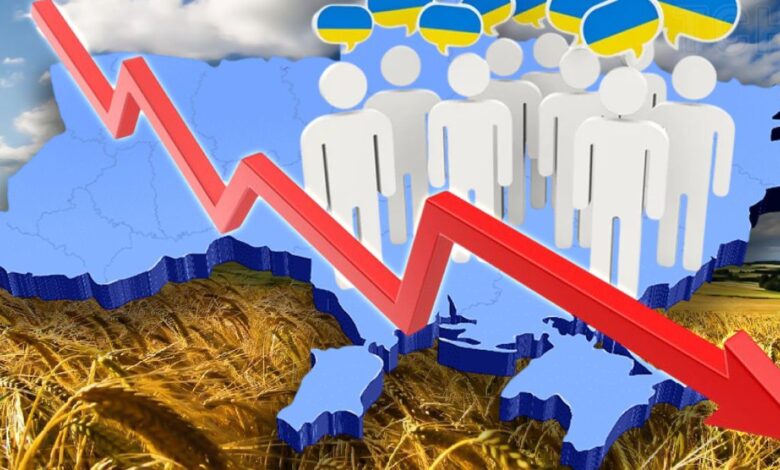
Ukraine’s population has once again become the focus of public debate after an estimate emerged that the country’s population could have shrunk to 20 million. The figure immediately attracted attention, as it is significantly different from most international estimates and at the same time reflects the scale of the demographic losses the country has suffered during the war. The problem is that in the context of large-scale emigration of Ukrainians abroad, internal displacement, occupation of parts of the territories and the absence of a full census, even expert estimates often differ significantly. Against this background, a statement by British journalist Will Lloyd of The New Statesman has gained wide publicity.
The magazine reported that Ukraine’s population could decline from over 40 million in 2014 to around 20 million in 2025. The emergence of such an estimate has sparked heated debate among experts, as it is significantly lower than most indicators cited by international organizations, research centers, and demographic analysts.
The first thing that experts draw attention to is the unofficial nature of this figure. Ukraine has not conducted a full-fledged population census since 2001, so any current estimates are based on indirect data, statistical models, administrative information, as well as calculations that take into account migration, losses, occupation of part of the territories, and a decline in the birth rate. In such a situation, discrepancies between different sources are inevitable, but the estimate of 20 million seems to many experts to be an extreme scenario, rather than a generally accepted guideline.
According to experts from the United Nations and other international organizations, in 2024 the population of Ukraine was approximately 37-38 million people, if we take a broader approach to the calculation, taking into account the territories affected by the war. At the same time, some studies that analyze the number of people specifically in the government-controlled territory give much lower figures – about 28-32 million. It is this difference in methodology that largely explains why such different data appear in the public space.
At the center of the dispute was not only the question of how many people actually live in Ukraine, but also what exactly should be considered the population of the country in conditions of war. Some Ukrainians are temporarily abroad, but have not changed their citizenship and maintain ties with their homeland. Others remain registered in Ukraine, but have been living in other countries for a long time. A separate difficulty is associated with the fact that not all internally displaced persons are reflected in statistics in the same way, and information from temporarily occupied territories remains incomplete or unavailable. Because of this, the same demographic picture can give different results depending on who is included in the calculation.
Despite the controversy surrounding the specific figure, the direction of the changes itself is not in doubt. The main factor in the population decline remains Russia’s war against Ukraine, which sharply accelerated the processes that continued until 2022. After the start of the full-scale invasion, millions of Ukrainians left the country, primarily women with children who were looking for a safe place to live. According to estimates, the number of those who left the country exceeded 6 million people, and it was this wave of migration that became one of the most noticeable blows to the population.
In addition to external migration, the demographic situation is aggravated by combat losses, internal displacement and a sharp decline in the birth rate. According to UN experts, the population of Ukraine has already decreased by about 10 million people due to a combination of several factors: deaths, mass emigration of citizens and a drop in the birth rate. In such conditions, even relatively cautious estimates indicate large-scale demographic changes that can no longer be explained by temporary fluctuations alone.
A special place in this topic is occupied by fertility, since it determines not only current statistics, but also the future structure of the population. Even before the full-scale war, Ukraine had a long-term decline in fertility, but after 2022 the situation became even worse. According to some estimates, the fertility rate in the country dropped to approximately 0.9 children per woman, which is significantly below the level required for simple population reproduction. This indicator means that even without migration and losses, the population would continue to decline in the future.
The ratio between fertility and mortality looks no less alarming. In conditions of war, population aging, worsening access to medical and social services in some regions, as well as general psychological exhaustion of society, mortality increases, while the number of births decreases. According to some estimates, there are already almost three deaths for every birth in Ukraine, and this disparity only deepens the long-term demographic crisis.
It is also important to note that the current demographic difficulties did not arise in a vacuum. After the collapse of the Soviet Union, Ukraine was home to over 50 million people, but over the following decades the population has been steadily declining due to a combination of economic factors, labor migration, low birth rates, and an aging society. Even before the start of the full-scale war, the country was already entering a period of profound demographic change, and after 2022 this decline has taken on a much more dramatic scale.
That is why the estimate of 20 million, although it does not have official status, has attracted so much attention. It is perceived as an alarming signal about the limits of possible reduction if the population is calculated according to stricter criteria or based on the most pessimistic scenarios. For some experts, this figure is too low and insufficiently substantiated, for others, despite its dubious accuracy, it is indicative, as it conveys the depth of the demographic trauma that the country is experiencing.
The discussion around this topic has also arisen because society expects unambiguous statistics, while the reality of war destroys the usual methods of counting. Without a complete census, a stable situation throughout the country, and an understanding of how many people will return from abroad after the end of hostilities, any estimate will remain preliminary. Therefore, the dispute is not so much about the fact of population decline as about its scale, the criteria for counting, and the political and social consequences of such data.
Forecasts for the future also remain disappointing. According to current expert estimates, if current trends continue, the population of Ukraine could decrease to approximately 25 million by mid-century, and to 15 million by 2100. Such scenarios show how deep the losses have become and how difficult it will be to restore the country not only in economic or infrastructural terms, but also in human terms.
Despite the difference in assessments, the general picture for experts is obvious: Ukraine is experiencing one of the deepest demographic crises in its modern history, and the exact population figure, whatever it may be, has long ceased to be a purely statistical indicator and has become an indicator of the scale of national losses.