Astronomers have determined the activation date of the giant black hole at the center of our galaxy

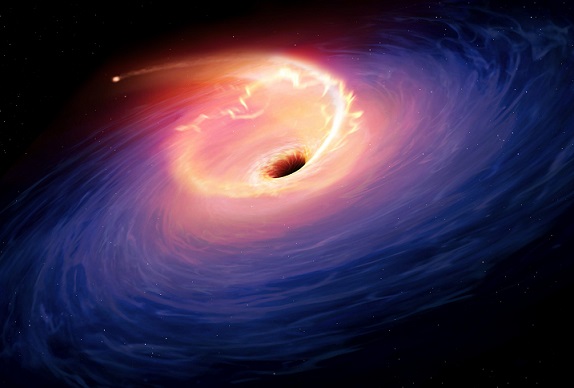
At the center of our galaxy is the supermassive black hole Sagittarius A*, which is currently in a dormant state because it absorbs very little surrounding matter. Astronomers have found out when it will become active again and what consequences it will have for our entire galaxy. This is reported by Daily Mail.
Supermassive black holes enter a phase of activity when they receive significant volumes of interstellar gas. Strong gravity causes matter to swirl around the black hole, heat up and form an accretion disk that emits light and energy. At the same time, part of the substance can be ejected in the form of jets that carry plasma and radiation, moving almost at the speed of light. In this state, the black hole is considered active. At present, Sagittarius A* remains inactive, because it lacks a sufficient amount of gas for powerful power.
Scientists’ calculations show that the black hole at the center of our galaxy will become more active after the Milky Way merged with its neighbor, the dwarf galaxy the Large Magellanic Cloud. This galaxy, the mass of which is about a hundred times smaller than the mass of the Milky Way, is located at a distance of about 200 thousand light years and has already come under the influence of the gravitational attraction of our system.
According to predictions, in 2.4 billion years the Large Magellanic Cloud will be absorbed by the Milky Way, its gas will spread through our galaxy and be directed towards the center where Sagittarius A* is located. This will cause the black hole to wake up and start actively absorbing matter. Scientists believe that as a result, its mass may increase eight times.
Active supermassive black holes often emit gamma-ray jets. In theory, if such jets were directed at Earth, they could destroy the ozone layer and cause a mass extinction. However, calculations show that even after 2.4 billion years, these jets will not pose a real threat to our planet. Because of the colossal distance, their radiation will largely lose energy. There is a possibility that during the merger of galaxies some of the stars will be thrown out of the Milky Way disk, but the Sun and the Solar System, according to astronomers, will remain intact.