The State Budget Reserve Fund is on the verge of extinction: how the government spent a year’s financial reserve in three months

The State Budget Reserve Fund is intended as a reserve for emergencies and expenses that cannot be accurately calculated in advance. However, already in early spring it was reduced to a level at which the main issue now is the state’s ability to get through the rest of the year without financial collapse in a time of crisis. This situation is made more acute not only by the speed with which the budget reserve disappears, but also by the nature of the expenses. The funds are directed to programs that are difficult to call priority in wartime.
How the State Budget Reserve Fund Shrank Rapidly at the Beginning of the Year
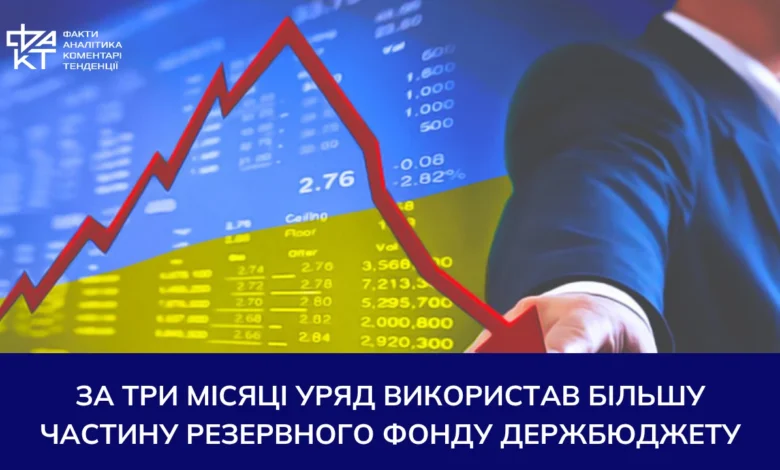
In less than three months of 2026, the Cabinet of Ministers used about 78% of the funds provided for in the reserve fund of the State Budget. What is most striking in this figure is the pace at which the financial “cushion” designed for the entire year is disappearing. Based on data from the Ministry of Finance, as of March, the undistributed balance of the reserve fund is 24.63 billion hryvnias out of 49.42 billion set aside in the budget, meaning that almost half of the entire annual resource has already been spent.
After March 18, the picture became even more telling, as the government adopted new decisions on the use of reserve fund funds: on March 20, 12.85 billion hryvnias were allocated, and on March 25, another 0.72 billion. In total, these two decisions mean an additional 13.57 billion hryvnias in spending over five days. This speed indicates a rapid depletion of state resources even before the end of the first quarter.
After these decisions, about 11 billion hryvnias should remain in the State Budget reserve fund, that is, only 22% of the amount of funding planned for the entire year 2026. To understand the scale, it is enough to compare two values: less than a quarter of the year has already passed, and almost 4/5 of the reserve fund has already been used. This proportion looks especially acute when you consider that there are still nine months ahead, during which this fund must fulfill its role as a reserve for unforeseen expenses. In fact, the government enters the nine-month period of the year with less than a quarter of the starting reserve, which is already difficult to perceive as a long-term insurance mechanism needed by the country during the war.
Why does the reserve fund exist and where is the line between necessary and questionable expenses?
The budget system of Ukraine is designed in such a way that the government cannot spend state funds on any new need just because it has appeared. To do this, it is necessary to go through the general procedure of budget planning and approval by the Verkhovna Rada, which usually takes at least several weeks. However, the reserve fund was created for a different logic: it gives the Cabinet of Ministers the opportunity to quickly direct money to where delay would mean a worsening of the situation, additional losses, or disruption of critical decisions that arose suddenly and could not be predicted in advance.
In wartime, such a tool is needed, and much more so than in peacetime. Shelling of the energy sector, destruction of infrastructure, emergency work, protection of critical facilities, preparation of regions for the heating season, urgent assistance after shelling, or new waves of displacement of people do not wait for the Verkhovna Rada to go through the full procedure of budget amendments.
However, the problem begins when the reserve fund is used not for emergency response, but to finance programs that have no signs of either unpredictability or urgency in the military sense. The most striking example of this is the National Cashback program, to which 2.138 billion hryvnias were allocated from the reserve fund, that is, almost 5% of its total volume. The idea of the program is to return 10% of the cost of Ukrainian goods, but the issue is not in the design of consumption support itself, but in the source of funding and budget priority.
If the program is planned in advance, drawn up, launched and administered as a separate policy to stimulate demand, then it is more like a full-fledged expenditure direction that should go through the usual budget procedure, and not be financed from a reserve designed for emergency circumstances.
The questionability of directing funds from the reserve fund to the “National Cashback” during the war is connected with several things at once. First, it is about spending a resource that should remain a reserve for truly urgent situations, and not for programs with a delayed and poorly measured effect. Secondly, even the declared economic benefit from it seems limited, because the impact of the program on the gross domestic product is estimated at about 0.001%, that is, almost at the margin of statistical error. Thirdly, such a support model is not neutral for the market, because it is much easier for large chains and manufacturers to integrate into it, while small businesses and individuals – entrepreneurs often face barriers due to the complexity of administration and fiscalization. As a result, public money does not so much create a broad economic impulse as it strengthens large market participants.
In addition, a separate question arises about the nature of such assistance. To participate in the “National Cashback”, people must provide access to transaction data on the selected card, and this transfers the program from the plane of simple consumer support to the plane of collecting sensitive financial information. At the same time, the accrued funds cannot be freely withdrawn in cash, they are allowed to be spent only on a limited list of goods and services. Under this model, the state spends billions not on directly strengthening defense resilience, eliminating the consequences of strikes, and urgent humanitarian aid, but on a complexly constructed mechanism to stimulate the consumption of domestic goods.
Even less convincing from the point of view of military expediency is the “fuel cashback”, for which approximately 860 million hryvnias are allocated in 2026. The program is valid from March to May 1, 2026, that is, a little more than a month, and provides for compensation of 15% for diesel, 10% for gasoline, and 5% for autogas. The maximum amount of payments within the framework of the government program is 3 thousand hryvnias, but you can receive no more than 1 thousand hryvnias for the purchase of fuel.
Formally, the state is thus trying to partially mitigate the blow from the price jump, but from the point of view of war priorities, such a design looks extremely controversial. First of all, because it is aimed at supporting private fuel consumption, and not at solving a critical systemic problem. This program does not create jobs in Ukraine, does not promote its own production, but stimulates fuel imports. Since Ukraine currently produces almost no fuel of its own (imports 90%+), state money through cashback actually goes to pay for the products of foreign refineries (Poland, Lithuania, Romania), which washes currency out of the economy.
This program also does not affect prices and sales, but the payment mechanism through large gas station networks creates conditions for a “schema” with fictitious checks, where cashback is washed out of the State Budget through fake transactions. Moreover, large gas station networks (OKKO, WOG, etc.) benefit the most from cashback on fuel, since it is technically more difficult for small gas stations to join the program. Thus, state funds actually stimulate the profits of big business.
At the same time, money from the reserve fund, which should support the poorest, is received by car owners (middle class and above). That is, at the expense of common debts, the state sponsors those who already have money. It turns out that the program supports car owners, while people without one participate in financing this policy as taxpayers. In other words, a person without a car is actually “resigned” to refuel someone else’s car through their taxes.
Along with this, part of the money for this program was transferred from the budget program to support deoccupied territories and communities. In November 2025, amendments were adopted to the State Budget, which redirected UAH 1.6 billion in subsidies (aid) for communities affected by the Russian aggression to finance cashback. As a result, the money that was supposed to go to the restoration of destroyed cities is being spent on bonuses for refueling.
Against this background, those budget decisions that are not financed from the reserve fund, but demonstrate the same problem of priorities during the war, are especially indicative. This is, in particular, the “1000 Hours of Content” program initiated by President Volodymyr Zelenskyy worth almost 4 billion hryvnias, included in the State Budget for 2026 for the Ministry of Culture. The Cabinet of Ministers has already approved a resolution on the organization and holding of art competitions for the selection of cultural and artistic projects within the framework of this initiative. It covers a wide range of areas – feature and documentary films and series, animation, children’s content, modern music, performative art, visual projects, audiovisual shows and videos for social networks.
The ideological justification for the program is understandable, because the government insists on the need to create an alternative to Russian content, form a Ukrainian information environment, support the cultural and creative industry, and develop the market. However, the question now is not whether culture is important, but what place such expenditures should occupy in the hierarchy of state needs during a war. Almost 4 billion hryvnias have been allocated for content production at a time when there is not enough money to finance the Armed Forces of Ukraine, protect the energy sector, recover from strikes, and meet basic social obligations.
This is where the line of expediency is crossed: expenditures on information and cultural sustainability may make sense, but in conditions of acute resource shortages they are impractical. Moreover, such a program does not provide narrowly targeted information products for crisis communication, but a very wide range of projects – from TV series to shows for social networks. With such a scale and such a cost, it looks like a budgetary luxury of wartime, and not a critically needed tool for immediate state response.
This also applies to the financing of the telethon “United News” and the channel “Home”. For 2026, about 1.5–2.1 billion hryvnias have been allocated for these needs in the main part of the State Budget through separate programs of the Ministry of Culture and Strategic Communications. In total, over 5.2 billion hryvnias were spent on the telethon and foreign broadcasting (including the channel “Home”) in 2022–2025. It is important to emphasize that these are not reserve fund funds, but for the purpose of assessing the general budget logic, this example shows how in wartime the state continues to spend significant amounts on a media product, the effectiveness of which is increasingly being assessed critically.
Therefore, now the reserve fund is losing its logic, according to which it finances expenditures whose urgency and priority are questionable. The pace of use of the reserve fund in the first three months of 2026 means, first of all, a sharp narrowing of the financial space for decisions that the state may need by the end of the year. The government enters the rest of the year with a significantly weakened ability to respond to new blows to the energy, infrastructure, housing, logistics, or humanitarian sectors without additional revision of the State Budget.